QUESTION IMAGE
Question
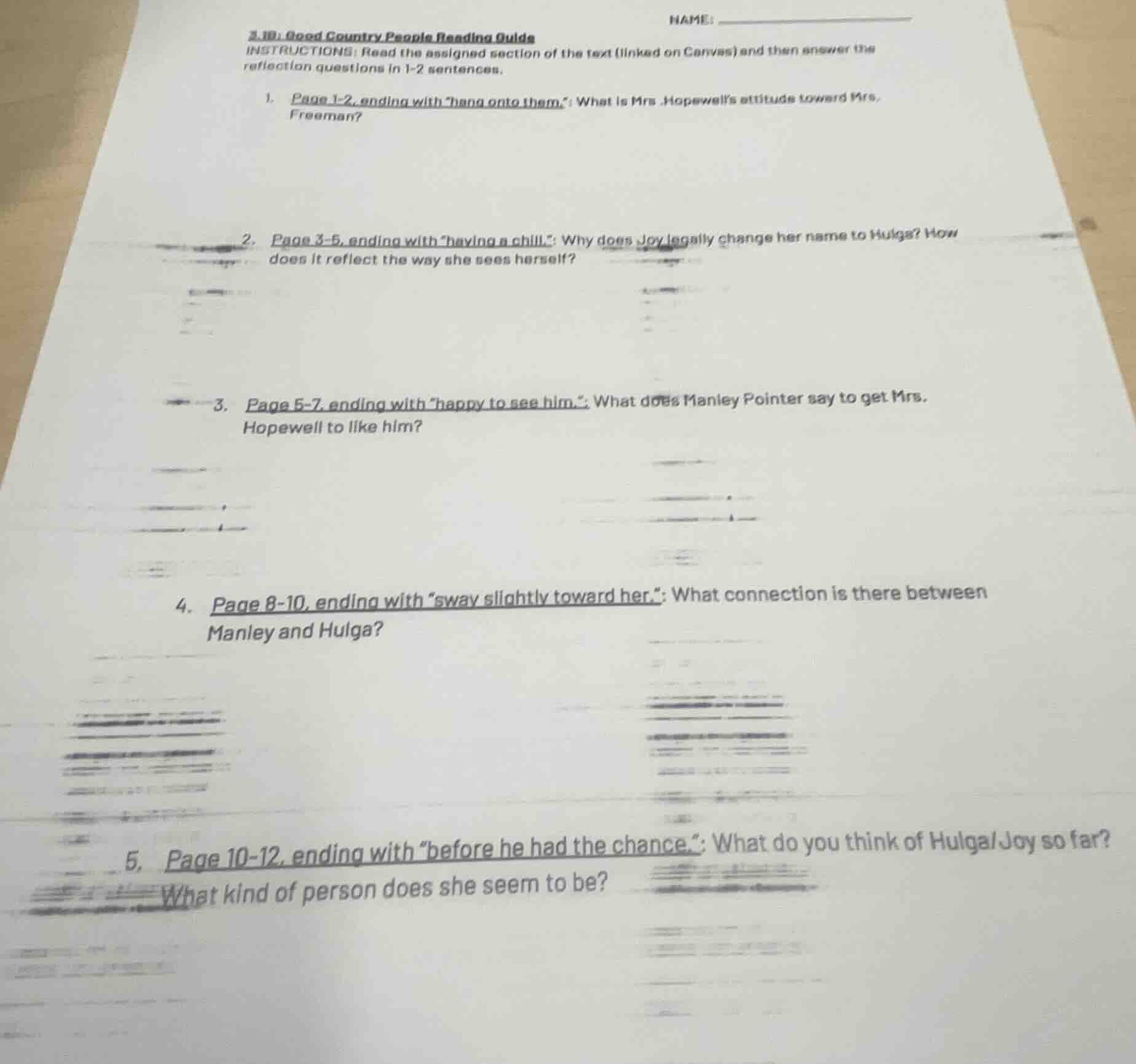
3.10: good country people reading guide
instructions: read the assigned section of the text (linked on canvas) and then answer the reflection questions in 1 - 2 sentences.
- page 1 - 2, ending with “hang onto them.”: what is mrs. hopewell’s attitude toward mrs. freeman?
- page 3 - 5, ending with “having a chill.”: why does joy legally change her name to hulga? how does it reflect the way she sees herself?
- page 5 - 7, ending with “happy to see him.”: what does manley pointer say to get mrs. hopewell to like him?
- page 8 - 10, ending with “sway slightly toward her.”: what connection is there between manley and hulga?
- page 10 - 12, ending with “before he had the chance.”: what do you think of hulga/joy so far? what kind of person does she seem to be?
Brief Explanations
- For question 1: Mrs. Hopewell tolerates Mrs. Freeman but views her as simple-minded and overly talkative, seeing her as a "good country person" to be managed rather than respected.
- For question 2: Joy changes her name to Hulga to reject her mother's idealized, cutesy vision of her; the harsh, ungainly name reflects her self-image as a cynical, intellectual, unromantic woman who rejects traditional femininity.
- For question 3: Manley Pointer pretends to be a humble, devout Bible salesman who admires Mrs. Hopewell's "good country people" values, which flatters her sense of superiority and makes her like him.
- For question 4: Both Hulga and Manley present a facade to the world—Hulga acts as a detached intellectual, while Manley acts as a pious salesman—and they are drawn to each other's perceived authenticity beneath these masks, though neither is truly as they seem.
- For question 5: Hulga/Joy seems to be a bitter, defensive intellectual who hides her insecurities behind a veneer of cynicism; she rejects social norms and her mother's influence to assert her identity, but her harshness masks a deep loneliness.

Snap & solve any problem in the app
Get step-by-step solutions on Sovi AI
Photo-based solutions with guided steps
Explore more problems and detailed explanations
- Mrs. Hopewell tolerates Mrs. Freeman, seeing her as a simple, talkative "good country person" to be managed rather than respected.
- Joy changes her name to Hulga to reject her mother's cutesy ideal of her; the name reflects her self-image as a cynical, unromantic, intellectual woman who rejects traditional femininity.
- Manley pretends to be a humble, devout Bible salesman who praises Mrs. Hopewell's "good country people" values, flattering her and winning her favor.
- Both Hulga and Manley perform false personas (detached intellectual, pious salesman) and are drawn to each other's perceived hidden authenticity, though neither is genuine.
- Hulga/Joy is a bitter, defensive intellectual who hides insecurity behind cynicism; she rejects norms and her mother to assert her identity, but her harshness masks loneliness.