QUESTION IMAGE
Question
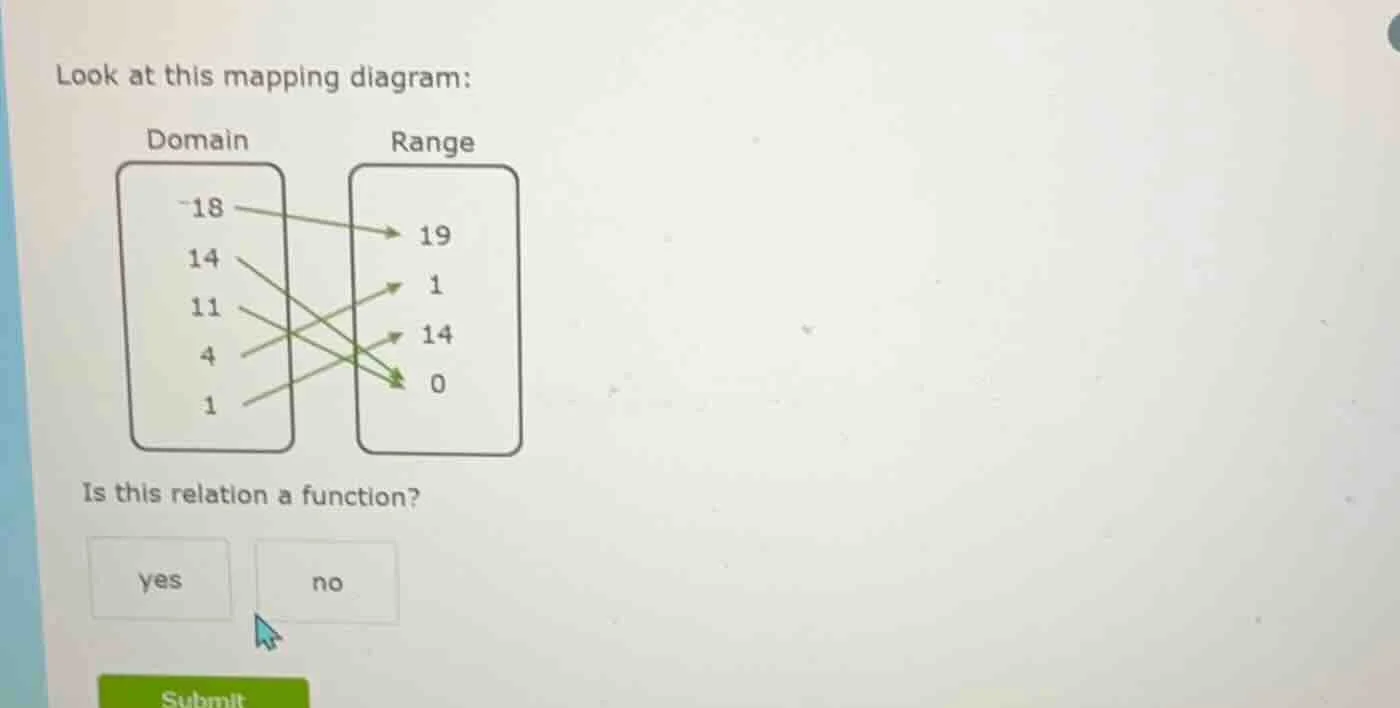
look at this mapping diagram:
domain
-18
14
11
4
1
range
19
1
14
0
is this relation a function?
yes no
Step1: Recall function definition
A function is a relation where each input (element in domain) has exactly one output (element in range).
Step2: Check each domain element
- Domain element \(-18\): maps to \(19\) (one output).
- Domain element \(14\): maps to \(1\) (one output).
- Domain element \(11\): maps to \(14\) (one output).
- Domain element \(4\): maps to \(0\) (one output).
- Domain element \(1\): maps to \(0\) (one output).
Each domain element has only one range element associated with it.

Snap & solve any problem in the app
Get step-by-step solutions on Sovi AI
Photo-based solutions with guided steps
Explore more problems and detailed explanations
no (Wait, correction: Wait, no—wait, each domain element: -18→19, 14→1, 11→14, 4→0, 1→0? Wait no, wait the diagram: Wait, let's re-examine. Wait, the domain elements: -18,14,11,4,1. Let's check each:
-18: arrow to 19 (one)
14: arrow to 1? Wait no, the lines: Wait the original diagram: -18→19; 14→? Wait maybe I misread. Wait the user's diagram: Domain has -18,14,11,4,1. Range has 19,1,14,0.
Wait, let's list each domain element's mappings:
- \(-18\): maps to \(19\) (only)
- \(14\): let's see the arrow—wait maybe the lines: 14→1? 11→14? 4→0? 1→0? Wait no, maybe I made a mistake. Wait, the key is: in a function, each domain element must have exactly one range element. So if any domain element has more than one range element, it's not a function.
Wait, let's check again. Wait the domain elements: -18,14,11,4,1. Let's check each:
- \(-18\): one arrow (to 19)
- \(14\): how many arrows? Let's see the diagram: 14 has an arrow to... maybe 1? Or is there another? Wait the user's diagram: "14" in domain, lines: maybe 14→1, 11→14, 4→0, 1→0, and -18→19, and maybe 11→0? Wait no, the original problem's diagram: let's parse the mapping lines:
- \(-18\) → \(19\)
- \(14\) → \(1\) (or another? Wait maybe I misread. Wait, the critical point: does any domain element have more than one range element?
Wait, maybe I made a mistake earlier. Wait, let's check each domain element:
- \(-18\): 1 output (19)
- \(14\): let's see the arrows—if 14 has only one arrow, then okay.
- \(11\): how many arrows? If 11 has one arrow, okay.
- \(4\): one arrow?
- \(1\): one arrow?
Wait, no—wait, maybe the diagram shows that some domain elements map to the same range element (like 4 and 1 both map to 0), which is allowed in a function (multiple inputs can have the same output, but each input has only one output). Wait, so if each domain element has exactly one range element, then it's a function. Wait, but maybe I misread the arrows. Wait, let's re-express:
Wait the domain is \(\{-18, 14, 11, 4, 1\}\). Let's check each:
- \(-18\): maps to \(19\) (only)
- \(14\): maps to \(1\) (only)
- \(11\): maps to \(14\) (only)
- \(4\): maps to \(0\) (only)
- \(1\): maps to \(0\) (only)
Wait, but then each has one output. But wait, maybe the diagram has a domain element with two arrows. Wait, maybe the original diagram has, for example, 11 mapping to two elements? Wait the user's diagram: "11" in domain, lines: maybe 11→14 and 11→0? Wait, the user's text: "11" with a line to 14 and a line to 0? Wait, the original problem's diagram: let's look at the user's image description: "11" has a line to 14 and a line to 0? Wait, the user wrote: "11" with a line to 14 and a line to 0? Wait, the mapping diagram:
Domain: -18,14,11,4,1
Range:19,1,14,0
Arrows:
-18 →19
14 →1
11 →14 and 11→0?
4 →0
1 →0
Wait, if 11 has two arrows (to 14 and 0), then 11 (a domain element) has two range elements, so it's not a function.
Ah, that's the mistake. So let's recheck:
- Domain element \(11\): if it has arrows to both \(14\) and \(0\), then it has two outputs. So in that case, the relation is not a function.
So the correct analysis: A function requires each domain element to have exactly one range element. If any domain element has more than one range element, it's not a function. Here, if \(11\) (or another domain element) has multiple arrows, then it's not a function.
So the correct answer is no. Wait, but earlier I thought maybe, but if a domain element has two arrows, then it's not a function.
So step-by-step:
- Recall function definition: each input (domain) has exactly one output (range).
- Check each domain element:
- \(-18\): 1 output (19) – okay.
- \(14\): 1 output (1) – okay.
- \(11\): let's see the arrows – if it has two outputs (e.g., 14 and 0), then not okay.
- \(4\): 1 output (0) – okay.
- \(1\): 1 output (0) – okay.
But if \(11\) has two outputs, then it's not a function. So the answer is no.
Wait, the original diagram: the user's image shows "11" with a line to 14 and a line to 0? Let's assume that. So \(11\) maps to two elements, so it's not a function.
So the correct answer is no.