QUESTION IMAGE
Question
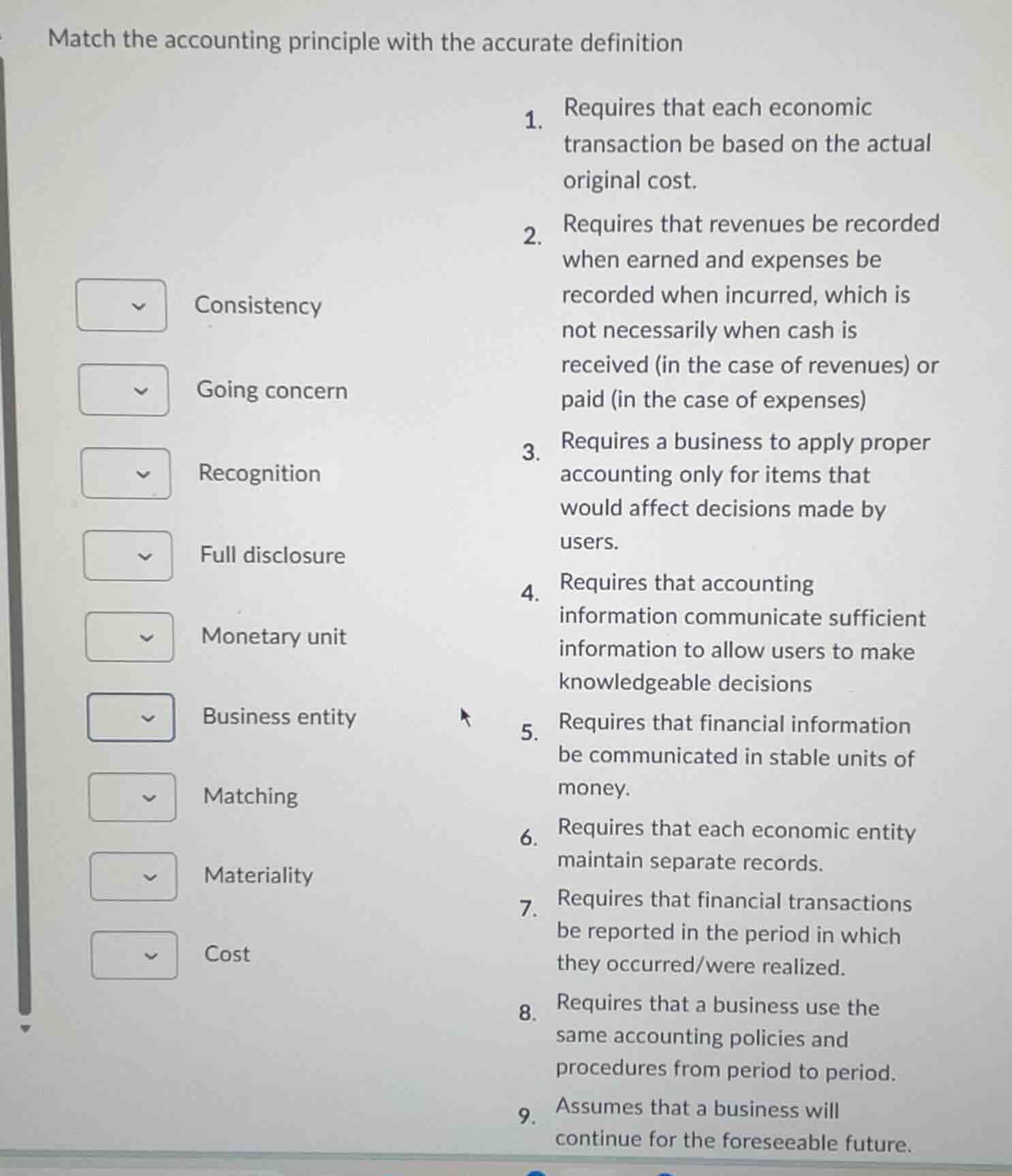
match the accounting principle with the accurate definition
consistency
going concern
recognition
full disclosure
monetary unit
business entity
matching
materiality
cost
- requires that each economic transaction be based on the actual original cost.
- requires that revenues be recorded when earned and expenses be recorded when incurred, which is not necessarily when cash is received (in the case of revenues) or paid (in the case of expenses)
- requires a business to apply proper accounting only for items that would affect decisions made by users.
- requires that accounting information communicate sufficient information to allow users to make knowledgeable decisions
- requires that financial information be communicated in stable units of money.
- requires that each economic entity maintain separate records.
- requires that financial transactions be reported in the period in which they occurred/were realized.
- requires that a business use the same accounting policies and procedures from period to period.
- assumes that a business will continue for the foreseeable future.
Brief Explanations
- Cost principle: Requires transactions to be at actual original cost. So Cost matches with 1.
- Matching principle: Revenues when earned, expenses when incurred (accrual basis). So Matching matches with 2.
- Materiality principle: Only account for items affecting user decisions. So Materiality matches with 3.
- Full disclosure principle: Communicate sufficient info for users to decide. So Full disclosure matches with 4.
- Monetary unit principle: Financial info in stable money units. So Monetary unit matches with 5.
- Business entity principle: Each economic entity has separate records. So Business entity matches with 6.
- Recognition (or maybe another, but based on timing: revenues/expenses when earned/incurred is matching, but the "reported in the period they occurred" could be recognition? Wait, no, the 7th definition: "Requires that financial transactions be reported in the period in which they occurred/were realized" – this is the recognition principle (or maybe revenue recognition, but here the left option is Recognition). So Recognition matches with 7.
- Consistency principle: Same accounting policies/procedures over periods. So Consistency matches with 8.
- Going concern principle: Assumes business continues for foreseeable future. So Going concern matches with 9.

Snap & solve any problem in the app
Get step-by-step solutions on Sovi AI
Photo-based solutions with guided steps
Explore more problems and detailed explanations
- Consistency: 8. Requires that a business use the same accounting policies and procedures from period to period.
- Going concern: 9. Assumes that a business will continue for the foreseeable future.
- Recognition: 7. Requires that financial transactions be reported in the period in which they occurred/were realized.
- Full disclosure: 4. Requires that accounting information communicate sufficient information to allow users to make knowledgeable decisions
- Monetary unit: 5. Requires that financial information be communicated in stable units of money.
- Business entity: 6. Requires that each economic entity maintain separate records.
- Matching: 2. Requires that revenues be recorded when earned and expenses be recorded when incurred, which is not necessarily when cash is received (in the case of revenues) or paid (in the case of expenses)
- Materiality: 3. Requires a business to apply proper accounting only for items that would affect decisions made by users.
- Cost: 1. Requires that each economic transaction be based on the actual original cost.