QUESTION IMAGE
Question
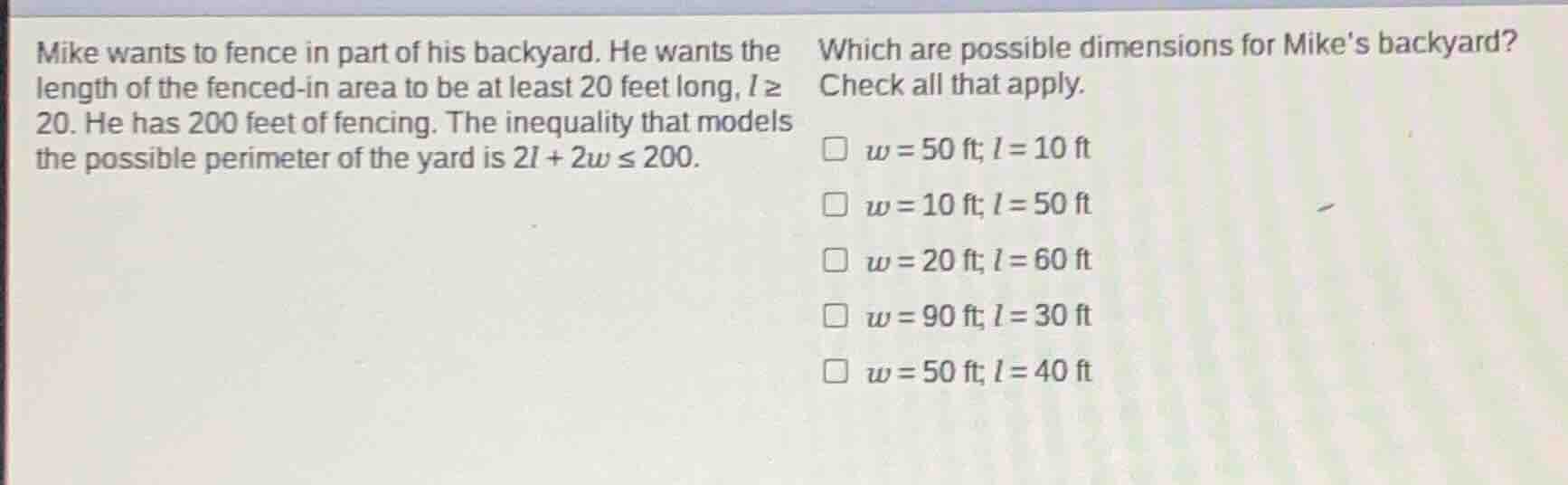
mike wants to fence in part of his backyard. he wants the length of the fenced-in area to be at least 20 feet long, ( l geq 20 ). he has 200 feet of fencing. the inequality that models the possible perimeter of the yard is ( 2l + 2w leq 200 ). which are possible dimensions for mikes backyard? check all that apply. ( square ) ( w = 50 ) ft; ( l = 10 ) ft ( square ) ( w = 10 ) ft; ( l = 50 ) ft ( square ) ( w = 20 ) ft; ( l = 60 ) ft ( square ) ( w = 90 ) ft; ( l = 30 ) ft ( square ) ( w = 50 ) ft; ( l = 40 ) ft
Step1: Check length ≥20 ft
Eliminate options where $l < 20$: reject $w=50\ \text{ft}; l=10\ \text{ft}$.
Step2: Test perimeter inequality $2l + 2w \leq 200$
Simplify to $l + w \leq 100$.
- For $w=10\ \text{ft}; l=50\ \text{ft}$: $50+10=60 \leq 100$, valid.
- For $w=20\ \text{ft}; l=60\ \text{ft}$: $60+20=80 \leq 100$, valid.
- For $w=90\ \text{ft}; l=30\ \text{ft}$: $30+90=120 > 100$, invalid.
- For $w=50\ \text{ft}; l=40\ \text{ft}$: $40+50=90 \leq 100$, valid.

Snap & solve any problem in the app
Get step-by-step solutions on Sovi AI
Photo-based solutions with guided steps
Explore more problems and detailed explanations
w = 10 ft; l = 50 ft
w = 20 ft; l = 60 ft
w = 50 ft; l = 40 ft