QUESTION IMAGE
Question
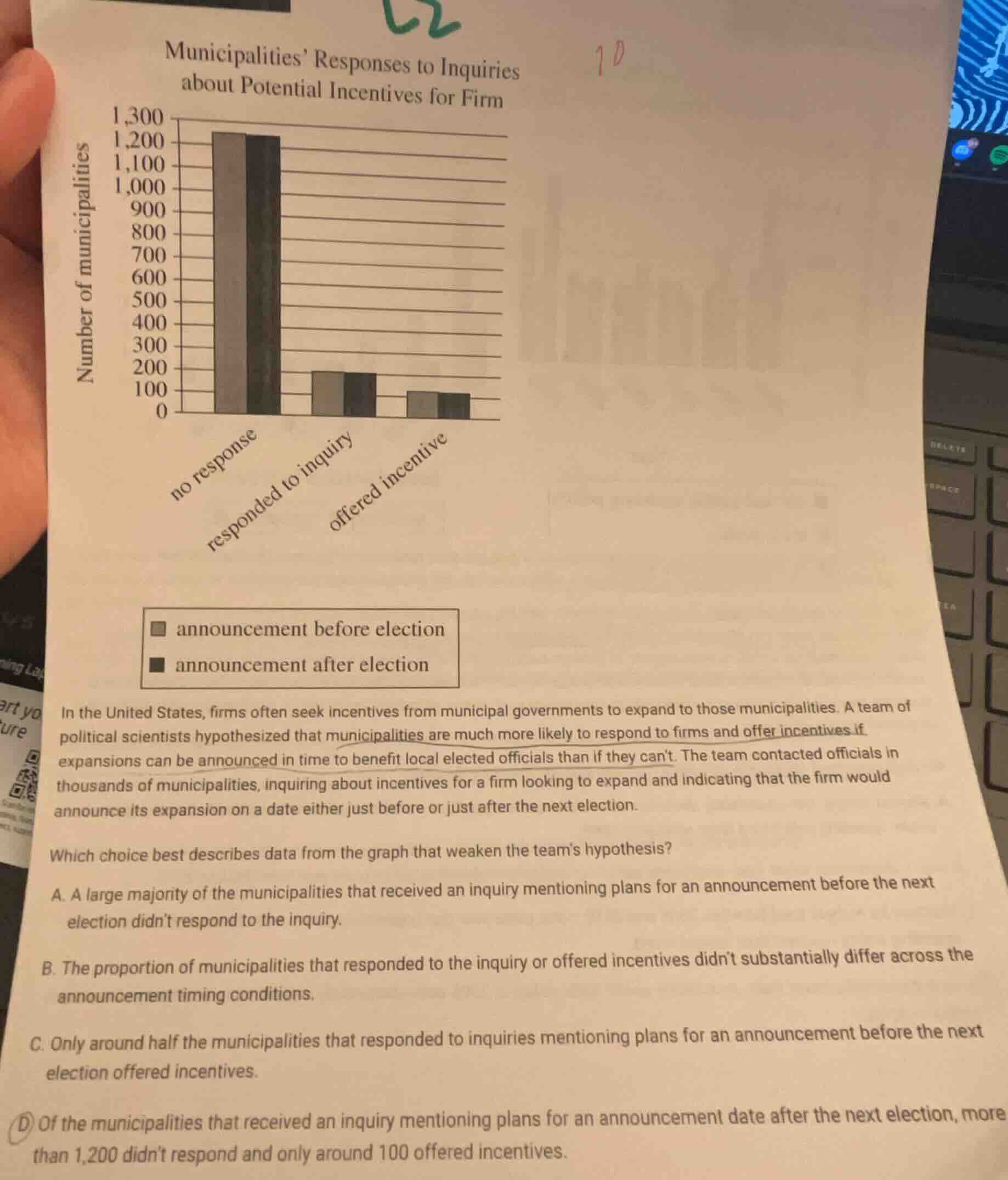
municipalities’ responses to inquiries about potential incentives for firm
in the united states, firms often seek incentives from municipal governments to expand to those municipalities. a team of political scientists hypothesized that municipalities are much more likely to respond to firms and offer incentives if expansions can be announced in time to benefit local elected officials than if they can’t. the team contacted officials in thousands of municipalities, inquiring about incentives for a firm looking to expand and indicating that the firm would announce its expansion on a date either just before or just after the next election.
which choice best describes data from the graph that weaken the team’s hypothesis?
a. a large majority of the municipalities that received an inquiry mentioning plans for an announcement before the next election didn’t respond to the inquiry.
b. the proportion of municipalities that responded to the inquiry or offered incentives didn’t substantially differ across the announcement timing conditions.
c. only around half the municipalities that responded to inquiries mentioning plans for an announcement before the next election offered incentives.
d. of the municipalities that received an inquiry mentioning plans for an announcement date after the next election, more than 1,200 didn’t respond and only around 100 offered incentives.
The team's hypothesis is that municipalities are far more likely to respond/offer incentives when the expansion announcement benefits elected officials (before election) vs. after. To weaken this, data must show no meaningful difference in response/incentive rates between the two timing groups.
- Option A: This aligns with the graph but does not address the comparison to post-election, so it does not weaken the hypothesis.
- Option B: If the proportion of responding/offering municipalities is nearly the same for pre- and post-election announcements, this directly contradicts the hypothesis that timing creates a large difference.
- Option C: This only describes pre-election municipalities and does not compare to post-election, so it does not weaken the hypothesis.
- Option D: This only describes post-election municipalities and does not compare to pre-election, so it does not weaken the hypothesis.

Snap & solve any problem in the app
Get step-by-step solutions on Sovi AI
Photo-based solutions with guided steps
Explore more problems and detailed explanations
B. The proportion of municipalities that responded to the inquiry or offered incentives didn't substantially differ across the announcement timing conditions.