QUESTION IMAGE
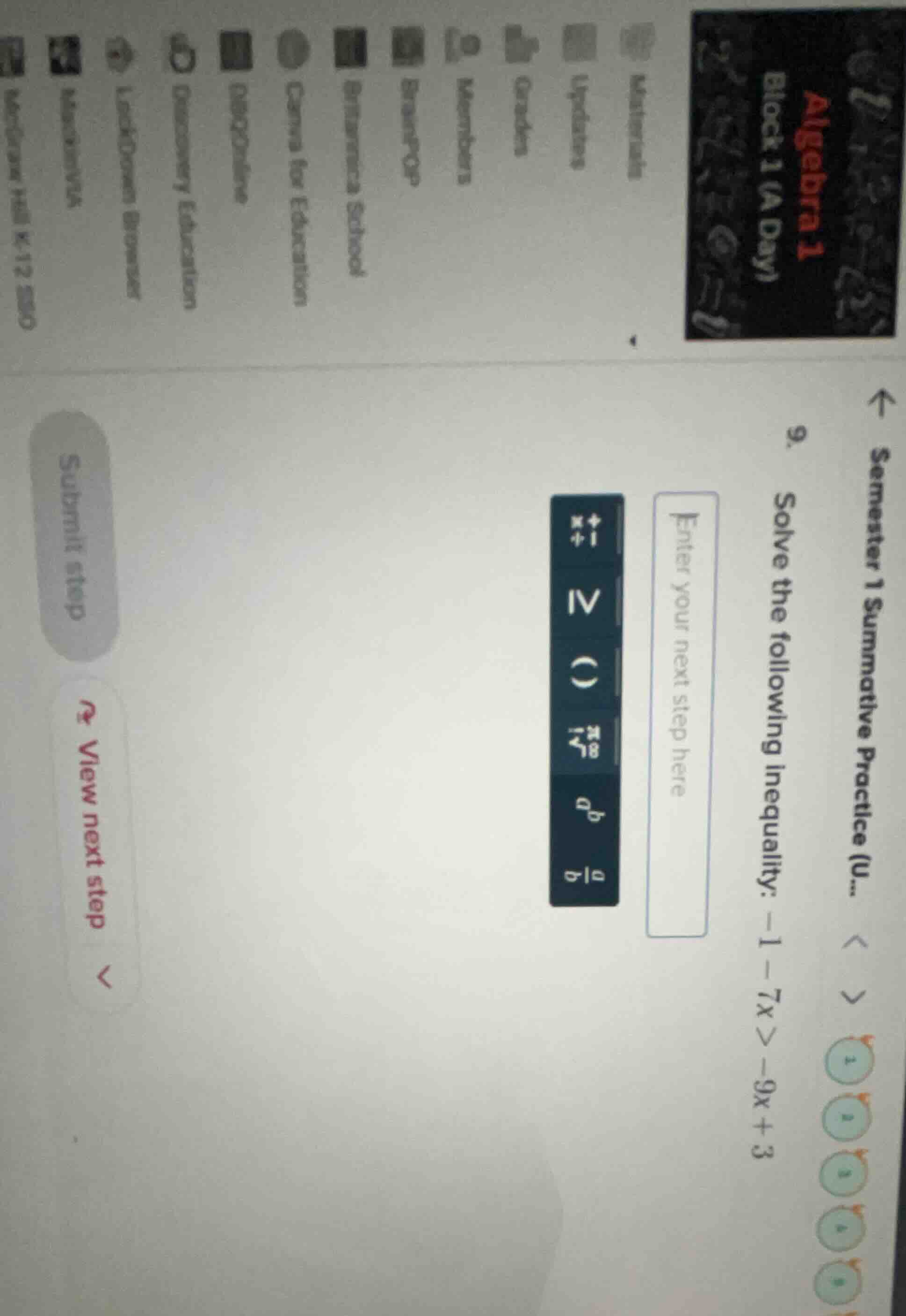
Question
- solve the following inequality: -1 - 7x > -9x + 3
Step1: Add \(7x\) to both sides
To eliminate the \( -7x \) on the left and get all \(x\)-terms on one side, we add \(7x\) to both sides of the inequality \(-1 - 7x > -9x + 3\).
\[
-1 - 7x + 7x > -9x + 3 + 7x
\]
Simplifying both sides, the \(-7x\) and \(+7x\) on the left cancel out, and on the right, \(-9x + 7x = -2x\). So we have:
\[
-1 > -2x + 3
\]
Step2: Subtract 3 from both sides
To isolate the term with \(x\) (the \(-2x\) term), we subtract 3 from both sides of the inequality \(-1 > -2x + 3\).
\[
-1 - 3 > -2x + 3 - 3
\]
Simplifying both sides, \(-1 - 3 = -4\) and the \(+3\) and \(-3\) on the right cancel out. So we get:
\[
-4 > -2x
\]
Step3: Divide both sides by -2 (and reverse the inequality)
To solve for \(x\), we divide both sides of the inequality \(-4 > -2x\) by \(-2\). When dividing an inequality by a negative number, we must reverse the direction of the inequality sign.
\[
\frac{-4}{-2} < \frac{-2x}{-2}
\]
Simplifying both sides, \(\frac{-4}{-2} = 2\) and \(\frac{-2x}{-2} = x\). So we have:
\[
2 < x
\]
Which can also be written as \(x > 2\).

Snap & solve any problem in the app
Get step-by-step solutions on Sovi AI
Photo-based solutions with guided steps
Explore more problems and detailed explanations
\(x > 2\)