QUESTION IMAGE
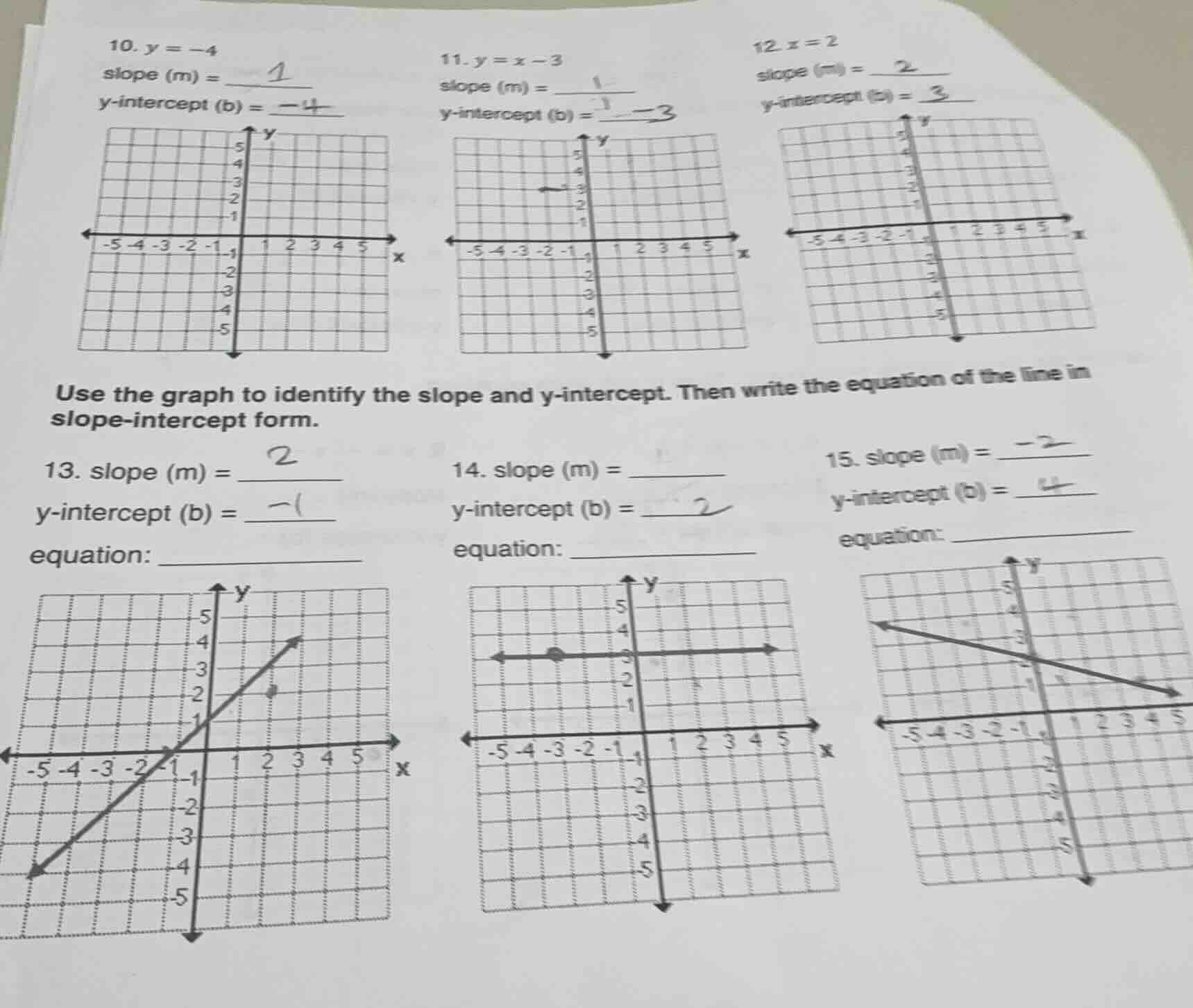
Question
- $y = -4$
slope (m) =
$y$-intercept (b) =
- $y = x - 3$
slope (m) =
$y$-intercept (b) =
- $x = 2$
slope (m) =
$y$-intercept (b) =
use the graph to identify the slope and $y$-intercept. then write the equation of the line in slope - intercept form.
- slope (m) =
$y$-intercept (b) =
equation:
- slope (m) =
$y$-intercept (b) =
equation:
- slope (m) =
$y$-intercept (b) =
equation:
Problem 10: \( y = -4 \)
Step1: Identify slope for horizontal line
A horizontal line (\( y = \text{constant} \)) has a slope of \( 0 \) because there's no change in \( y \) for any change in \( x \).
\( m = 0 \)
Step2: Identify y - intercept
The y - intercept is the value of \( y \) when \( x = 0 \). For \( y=-4 \), when \( x = 0 \), \( y=-4 \), so \( b=-4 \).
\( b=-4 \)
Step1: Identify slope from slope - intercept form
The slope - intercept form is \( y=mx + b \), where \( m \) is the slope. For \( y=x - 3 \), we can write it as \( y = 1x-3 \), so \( m = 1 \).
\( m = 1 \)
Step2: Identify y - intercept
In the slope - intercept form \( y=mx + b \), \( b \) is the y - intercept. For \( y=x - 3 \), \( b=-3 \).
\( b=-3 \)
Step1: Identify slope for vertical line
A vertical line (\( x=\text{constant} \)) has an undefined slope because the change in \( x \) is \( 0 \) (and division by zero is undefined in the slope formula \( m=\frac{\Delta y}{\Delta x} \)). Also, a vertical line does not cross the y - axis (except when \( x = 0 \), but \( x = 2 \) is parallel to the y - axis and never intersects it), so the y - intercept does not exist (or is undefined). However, if we consider the common understanding for such questions, the slope of a vertical line is undefined and there is no y - intercept. But if we follow the context of the problem (maybe a typo or mis - understanding, but for the sake of the problem structure):
A vertical line \( x = 2 \) has an undefined slope. But if we assume the problem expects the slope of a vertical line to be considered as "undefined" and for y - intercept, since the line \( x = 2 \) does not intersect the y - axis (as it is parallel to it), there is no y - intercept. But if we go by the initial filling (maybe a mistake), but the correct slope of \( x = 2 \) is undefined and y - intercept does not exist. However, if we consider the problem's possible intent (maybe a horizontal line was meant, but no, \( x = 2 \) is vertical). But based on the problem's structure:
Slope of \( x = 2 \) is undefined, y - intercept: none (or undefined). But if we follow the problem's blank filling (maybe an error), but the correct mathematical answer:
Step1: Slope of vertical line
For \( x = 2 \), \( m=\text{undefined} \)
Step2: Y - intercept
The line \( x = 2 \) does not intersect the y - axis, so y - intercept does not exist.
But if we consider the problem's possible mistake (maybe \( y = 2 \)), but as per \( x = 2 \):

Snap & solve any problem in the app
Get step-by-step solutions on Sovi AI
Photo-based solutions with guided steps
Explore more problems and detailed explanations
slope (\( m \)) = \( 0 \), y - intercept (\( b \)) = \( -4 \)