QUESTION IMAGE
Question
determining when an equation has infinite solutions
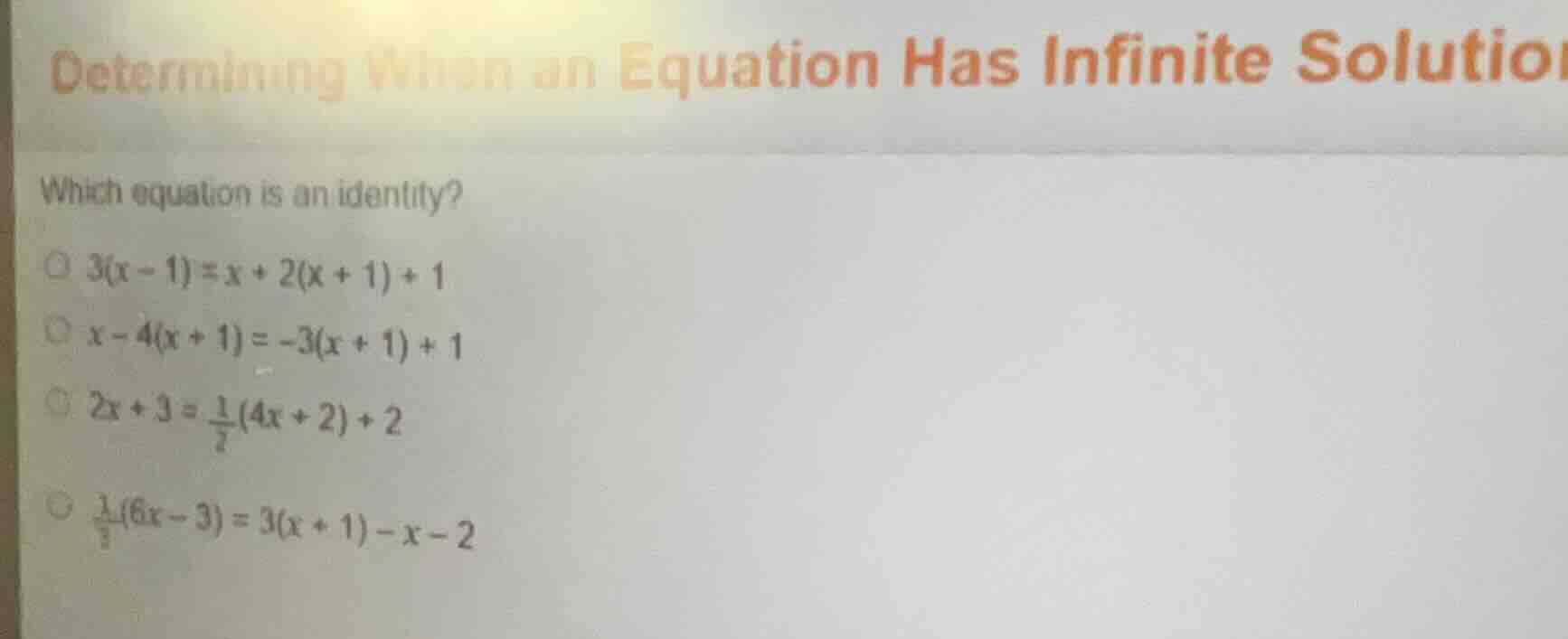
which equation is an identity?
○ $3(x - 1) = x + 2(x + 1) + 1$
○ $x - 4(x + 1) = -3(x + 1) + 1$
○ $2x + 3 = \frac{1}{2}(4x + 2) + 2$
○ $\frac{1}{3}(6x - 3) = 3(x + 1) - x - 2$
Step1: Simplify Option 1
Expand both sides:
Left: $3(x-1)=3x-3$
Right: $x+2(x+1)+1=x+2x+2+1=3x+3$
Result: $3x-3=3x+3 \implies -3=3$ (False)
Step2: Simplify Option 2
Expand both sides:
Left: $x-4(x+1)=x-4x-4=-3x-4$
Right: $-3(x+1)+1=-3x-3+1=-3x-2$
Result: $-3x-4=-3x-2 \implies -4=-2$ (False)
Step3: Simplify Option 3
Expand both sides:
Left: $2x+3$
Right: $\frac{1}{2}(4x+2)+2=2x+1+2=2x+3$
Result: $2x+3=2x+3$ (True for all $x$)
Step4: Verify Option 4 (optional)
Expand both sides:
Left: $\frac{1}{2}(6x-3)=3x-\frac{3}{2}$
Right: $3(x+1)-x-2=3x+3-x-2=2x+1$
Result: $3x-\frac{3}{2}=2x+1 \implies x=\frac{5}{2}$ (Single solution)

Snap & solve any problem in the app
Get step-by-step solutions on Sovi AI
Photo-based solutions with guided steps
Explore more problems and detailed explanations
C. $2x + 3 = \frac{1}{2}(4x + 2) + 2$