QUESTION IMAGE
Question
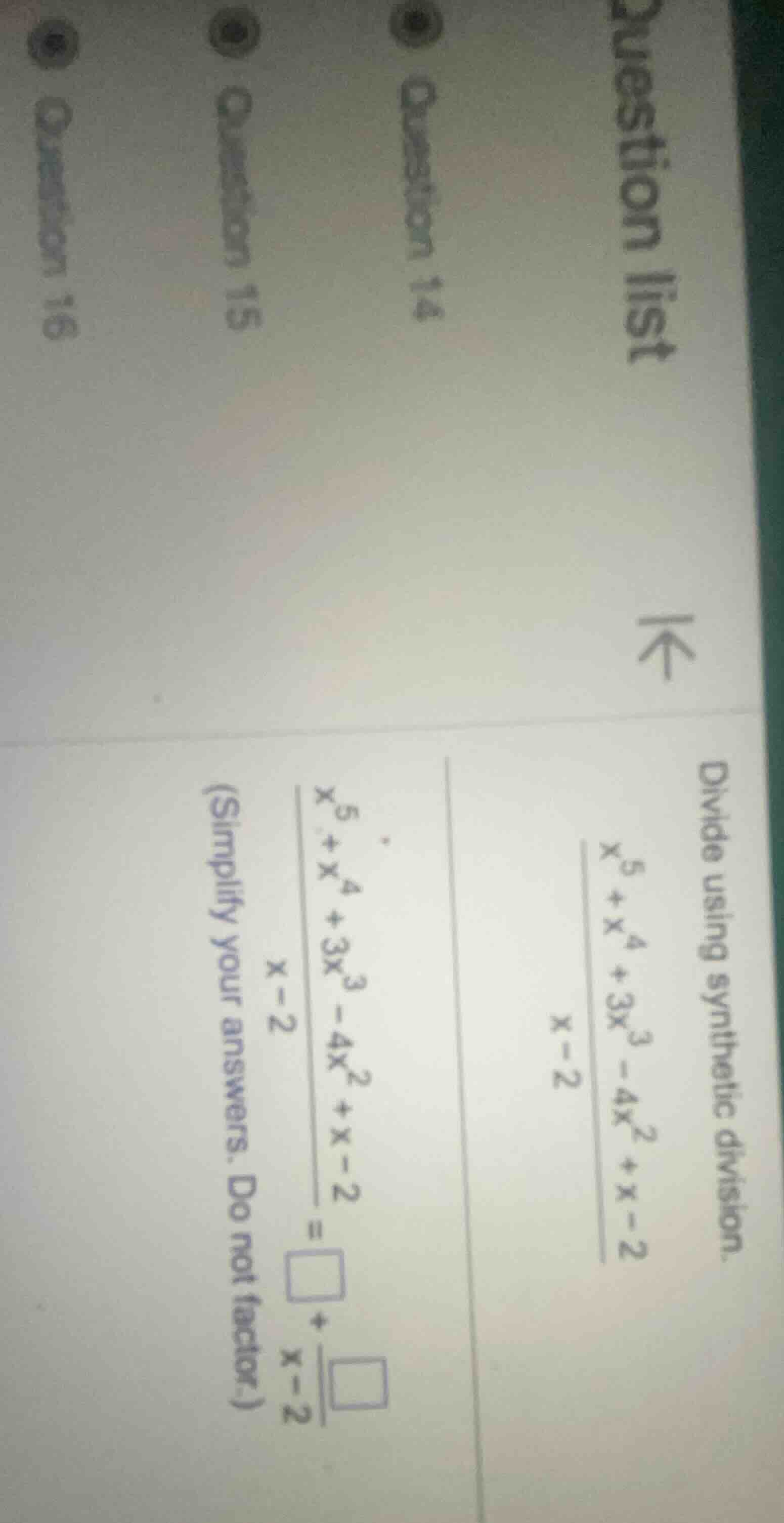
divide using synthetic division.
$dfrac{x^5 + x^4 + 3x^3 - 4x^2 + x - 2}{x - 2}$
$dfrac{x^5 + x^4 + 3x^3 - 4x^2 + x - 2}{x - 2} = square + dfrac{square}{x - 2}$
(simplify your answers. do not factor.)
Step1: Identify the dividend and divisor
The dividend is \(x^5 + x^4 + 3x^3 - 4x^2 + x - 2\) and the divisor is \(x - 2\). For synthetic division, we use the root of the divisor, which is \(x = 2\) (since \(x - 2 = 0\) gives \(x = 2\)).
Step2: Set up synthetic division
Write the coefficients of the dividend: \(1\) (for \(x^5\)), \(1\) (for \(x^4\)), \(3\) (for \(x^3\)), \(-4\) (for \(x^2\)), \(1\) (for \(x\)), \(-2\) (constant term). Bring down the first coefficient:
\[
\]
Wait, no, actually, when we do polynomial long division or synthetic division, we can also perform the division by dividing term by term. Let's try polynomial long division.
Divide \(x^5\) by \(x\) to get \(x^4\). Multiply \(x - 2\) by \(x^4\): \(x^5 - 2x^4\). Subtract from the dividend:
\((x^5 + x^4 + 3x^3 - 4x^2 + x - 2) - (x^5 - 2x^4) = 3x^4 + 3x^3 - 4x^2 + x - 2\)
Step3: Divide the new leading term
Divide \(3x^4\) by \(x\) to get \(3x^3\). Multiply \(x - 2\) by \(3x^3\): \(3x^4 - 6x^3\). Subtract:
\((3x^4 + 3x^3 - 4x^2 + x - 2) - (3x^4 - 6x^3) = 9x^3 - 4x^2 + x - 2\)
Step4: Divide the new leading term
Divide \(9x^3\) by \(x\) to get \(9x^2\). Multiply \(x - 2\) by \(9x^2\): \(9x^3 - 18x^2\). Subtract:
\((9x^3 - 4x^2 + x - 2) - (9x^3 - 18x^2) = 14x^2 + x - 2\)
Step5: Divide the new leading term
Divide \(14x^2\) by \(x\) to get \(14x\). Multiply \(x - 2\) by \(14x\): \(14x^2 - 28x\). Subtract:
\((14x^2 + x - 2) - (14x^2 - 28x) = 29x - 2\)
Step6: Divide the new leading term
Divide \(29x\) by \(x\) to get \(29\). Multiply \(x - 2\) by \(29\): \(29x - 58\). Subtract:
\((29x - 2) - (29x - 58) = 56\)
So the division gives \(x^4 + 3x^3 + 9x^2 + 14x + 29\) with a remainder of \(56\). Wait, but the problem is written as \(\frac{x^5 + x^4 + 3x^3 - 4x^2 + x - 2}{x - 2}=\square+\frac{\square}{x - 2}\). So the quotient is \(x^4 + 3x^3 + 9x^2 + 14x + 29\) and the remainder is \(56\)? Wait, no, my synthetic division earlier was wrong. Let's do synthetic division correctly.
Coefficients: \(1, 1, 3, -4, 1, -2\). Root \(x = 2\):
- Bring down \(1\).
- Multiply \(1 \times 2 = 2\). Add to next coefficient: \(1 + 2 = 3\).
- Multiply \(3 \times 2 = 6\). Add to next coefficient: \(3 + 6 = 9\).
- Multiply \(9 \times 2 = 18\). Add to next coefficient: \(-4 + 18 = 14\).
- Multiply \(14 \times 2 = 28\). Add to next coefficient: \(1 + 28 = 29\).
- Multiply \(29 \times 2 = 58\). Add to last coefficient: \(-2 + 58 = 56\).
Yes, so the quotient is \(x^4 + 3x^3 + 9x^2 + 14x + 29\) and the remainder is \(56\). So \(\frac{x^5 + x^4 + 3x^3 - 4x^2 + x - 2}{x - 2}=x^4 + 3x^3 + 9x^2 + 14x + 29+\frac{56}{x - 2}\). Wait, but the problem's box is for the first square (the quotient) and the second square (the remainder). Let's check the original problem again. The problem is:
\(\frac{x^5 + x^4 + 3x^3 - 4x^2 + x - 2}{x - 2}=\square+\frac{\square}{x - 2}\)
So the first square is the quotient \(x^4 + 3x^3 + 9x^2 + 14x + 29\) and the second square is the remainder \(56\)? Wait, but maybe I made a mistake in the division. Wait, let's check with \(x = 2\). Let's compute the dividend at \(x = 2\): \(2^5 + 2^4 + 3 \times 2^3 - 4 \times 2^2 + 2 - 2 = 32 + 16 + 24 - 16 + 2 - 2 = 32 + 16 = 48; 48 + 24 = 72; 72 - 16 = 56; 56 + 2 - 2 = 56\). And the divisor at \(x = 2\) is \(0\), so the remainder should be \(56\), which matches. And the quotient is the polynomial of degree 4: \(x^4 + 3x^3 + 9x^2 + 14x + 29\). Wait, but the problem's first box is…

Snap & solve any problem in the app
Get step-by-step solutions on Sovi AI
Photo-based solutions with guided steps
Explore more problems and detailed explanations
The first box is \(x^4 + 3x^3 + 9x^2 + 14x + 29\) and the second box is \(56\), so \(\frac{x^5 + x^4 + 3x^3 - 4x^2 + x - 2}{x - 2}=x^4 + 3x^3 + 9x^2 + 14x + 29+\frac{56}{x - 2}\)