QUESTION IMAGE
Question
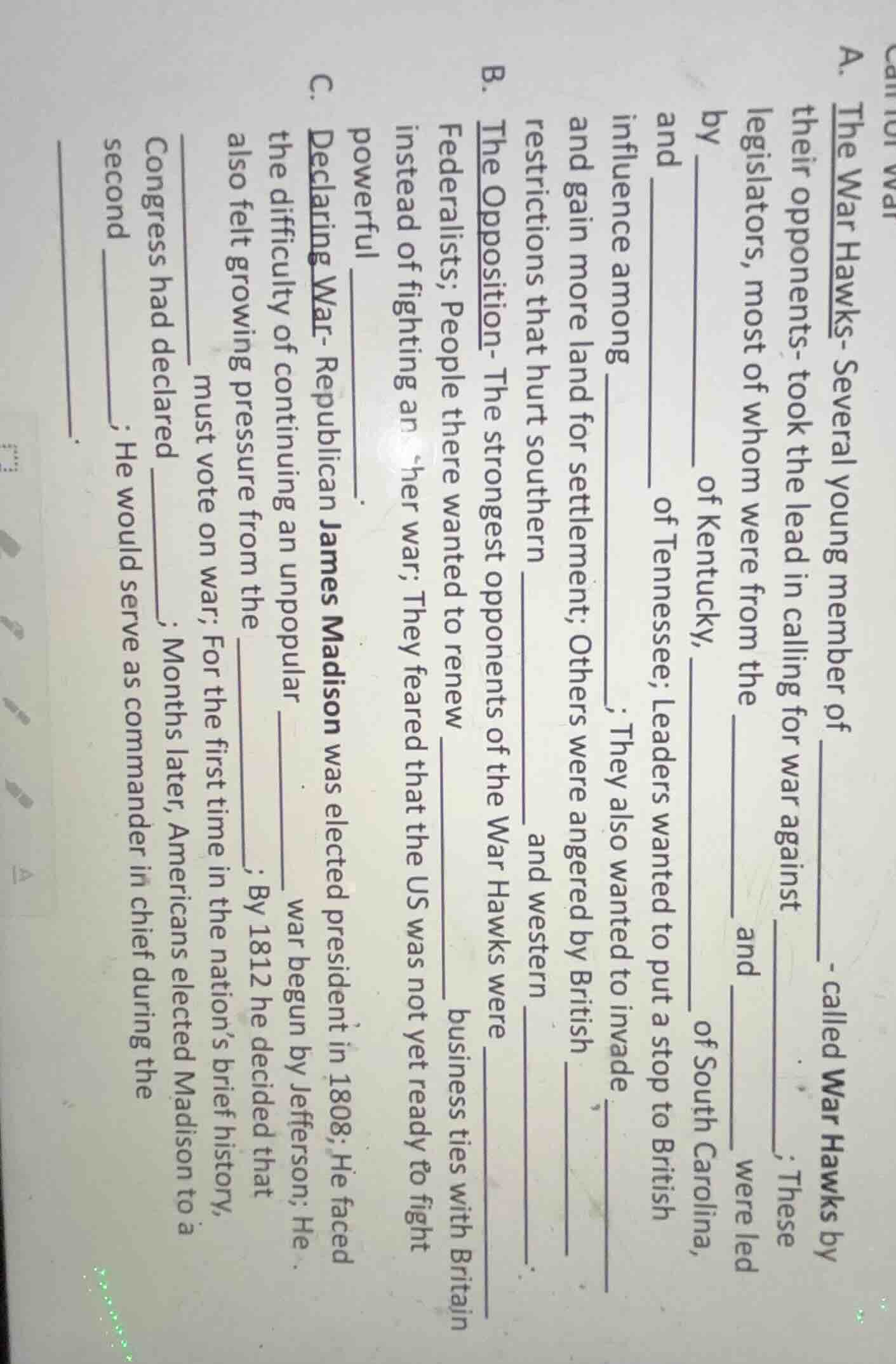
a. the war hawks- several young member of __ -called war hawks by their opponents- took the lead in calling for war against . these legislators, most of whom were from the and , were led by of kentucky, of south carolina, and of tennessee; leaders wanted to put a stop to british influence among ; they also wanted to invade and gain more land for settlement; others were angered by british restrictions that hurt southern and western __.
b. the opposition- the strongest opponents of the war hawks were federalists; people there wanted to renew __ business ties with britain instead of fighting an -her war; they feared that the us was not yet ready to fight powerful __.
c. declaring war- republican james madison was elected president in 1808; he faced the difficulty of continuing an unpopular __ war begun by jefferson; he also felt growing pressure from the ; by 1812 he decided that must vote on war; for the first time in the nation’s brief history, congress had declared . months later, americans elected madison to a second ; he would serve as commander in chief during the __.
To solve this fill - in - the - blank problem about the War of 1812 and related political history, we can use our knowledge of American history:
Part A
- The War Hawks were several young members of Congress (the legislative body in the US) who were called War Hawks by their opponents. They took the lead in calling for war against Britain. Most of these legislators were from the West (the western states) and the South (southern states). Specifically, they were led by the Speaker of the House (a key position in Congress) of Kentucky, Henry Clay, and the Governor (or a leading political figure) of Tennessee, Andrew Jackson. Leaders wanted to put a stop to British influence among Native Americans (as the British were supporting Native American resistance to US expansion). They also wanted to invade Canada and gain more land for settlement. Others were angered by British impressment (the practice of forcing American sailors into British service) restrictions that hurt southern plantations (agricultural estates, mainly producing cash crops like cotton) and western settlers (people who had moved to the western territories).
- So the filled - in blanks for part A would be: Congress, Britain, West, South, Speaker of the House, Henry Clay, Governor, Andrew Jackson, Native Americans, Canada, impressment, plantations, settlers.
Part B
- The strongest opponents of the War Hawks were the Federalists. People who were Federalists wanted to renew trade (business ties) with Britain instead of fighting a war. They feared that the US was not yet ready to fight a powerful nation (Britain was a major world power at that time).
- So the filled - in blanks for part B would be: Federalists, trade, nation.
Part C
- Republican James Madison was elected president in 1808. He faced the difficulty of continuing an unpopular war (the war that Jefferson had begun, likely referring to the tensions and small - scale conflicts leading up to the War of 1812) and also felt growing pressure from the War Hawks. By 1812 he decided that Congress must vote on war. For the first time in the nation’s brief history, Congress had declared war (the War of 1812). Months later, Americans elected Madison to a second term (period in office). He would serve as commander in chief during the War of 1812.
- So the filled - in blanks for part C would be: War, War Hawks, war, term, War of 1812.
Final Answers (Filled - in Blanks)
Part A
- The War Hawks - Several young member of \(\boldsymbol{\text{Congress}}\) - called War Hawks by their opponents - took the lead in calling for war against \(\boldsymbol{\text{Britain}}\). These legislators, most of whom were from the \(\boldsymbol{\text{West}}\) and \(\boldsymbol{\text{South}}\), were led by the \(\boldsymbol{\text{Speaker of the House}}\) of Kentucky, \(\boldsymbol{\text{Henry Clay}}\), and the \(\boldsymbol{\text{Governor}}\) of Tennessee, \(\boldsymbol{\text{Andrew Jackson}}\); Leaders wanted to put a stop to British influence among \(\boldsymbol{\text{Native Americans}}\); They also wanted to invade \(\boldsymbol{\text{Canada}}\) and gain more land for settlement; Others were angered by British \(\boldsymbol{\text{impressment}}\) restrictions that hurt southern \(\boldsymbol{\text{plantations}}\) and western \(\boldsymbol{\text{settlers}}\).
Part B
- The Opposition - The strongest opponents of the War Hawks were \(\boldsymbol{\text{Federalists}}\); People there wanted to renew \(\boldsymbol{\text{trade}}\) business ti…

Snap & solve any problem in the app
Get step-by-step solutions on Sovi AI
Photo-based solutions with guided steps
Explore more problems and detailed explanations
To solve this fill - in - the - blank problem about the War of 1812 and related political history, we can use our knowledge of American history:
Part A
- The War Hawks were several young members of Congress (the legislative body in the US) who were called War Hawks by their opponents. They took the lead in calling for war against Britain. Most of these legislators were from the West (the western states) and the South (southern states). Specifically, they were led by the Speaker of the House (a key position in Congress) of Kentucky, Henry Clay, and the Governor (or a leading political figure) of Tennessee, Andrew Jackson. Leaders wanted to put a stop to British influence among Native Americans (as the British were supporting Native American resistance to US expansion). They also wanted to invade Canada and gain more land for settlement. Others were angered by British impressment (the practice of forcing American sailors into British service) restrictions that hurt southern plantations (agricultural estates, mainly producing cash crops like cotton) and western settlers (people who had moved to the western territories).
- So the filled - in blanks for part A would be: Congress, Britain, West, South, Speaker of the House, Henry Clay, Governor, Andrew Jackson, Native Americans, Canada, impressment, plantations, settlers.
Part B
- The strongest opponents of the War Hawks were the Federalists. People who were Federalists wanted to renew trade (business ties) with Britain instead of fighting a war. They feared that the US was not yet ready to fight a powerful nation (Britain was a major world power at that time).
- So the filled - in blanks for part B would be: Federalists, trade, nation.
Part C
- Republican James Madison was elected president in 1808. He faced the difficulty of continuing an unpopular war (the war that Jefferson had begun, likely referring to the tensions and small - scale conflicts leading up to the War of 1812) and also felt growing pressure from the War Hawks. By 1812 he decided that Congress must vote on war. For the first time in the nation’s brief history, Congress had declared war (the War of 1812). Months later, Americans elected Madison to a second term (period in office). He would serve as commander in chief during the War of 1812.
- So the filled - in blanks for part C would be: War, War Hawks, war, term, War of 1812.
Final Answers (Filled - in Blanks)
Part A
- The War Hawks - Several young member of \(\boldsymbol{\text{Congress}}\) - called War Hawks by their opponents - took the lead in calling for war against \(\boldsymbol{\text{Britain}}\). These legislators, most of whom were from the \(\boldsymbol{\text{West}}\) and \(\boldsymbol{\text{South}}\), were led by the \(\boldsymbol{\text{Speaker of the House}}\) of Kentucky, \(\boldsymbol{\text{Henry Clay}}\), and the \(\boldsymbol{\text{Governor}}\) of Tennessee, \(\boldsymbol{\text{Andrew Jackson}}\); Leaders wanted to put a stop to British influence among \(\boldsymbol{\text{Native Americans}}\); They also wanted to invade \(\boldsymbol{\text{Canada}}\) and gain more land for settlement; Others were angered by British \(\boldsymbol{\text{impressment}}\) restrictions that hurt southern \(\boldsymbol{\text{plantations}}\) and western \(\boldsymbol{\text{settlers}}\).
Part B
- The Opposition - The strongest opponents of the War Hawks were \(\boldsymbol{\text{Federalists}}\); People there wanted to renew \(\boldsymbol{\text{trade}}\) business ties with Britain instead of fighting a war; They feared that the US was not yet ready to fight a powerful \(\boldsymbol{\text{nation}}\).
Part C
- Declaring War - Republican James Madison was elected president in 1808; He faced the difficulty of continuing an unpopular \(\boldsymbol{\text{war}}\) begun by Jefferson; He also felt growing pressure from the \(\boldsymbol{\text{War Hawks}}\); By 1812 he decided that Congress must vote on war; For the first time in the nation’s brief history, Congress had declared \(\boldsymbol{\text{war}}\); Months later, Americans elected Madison to a second \(\boldsymbol{\text{term}}\); He would serve as commander in chief during the \(\boldsymbol{\text{War of 1812}}\).