QUESTION IMAGE
Question
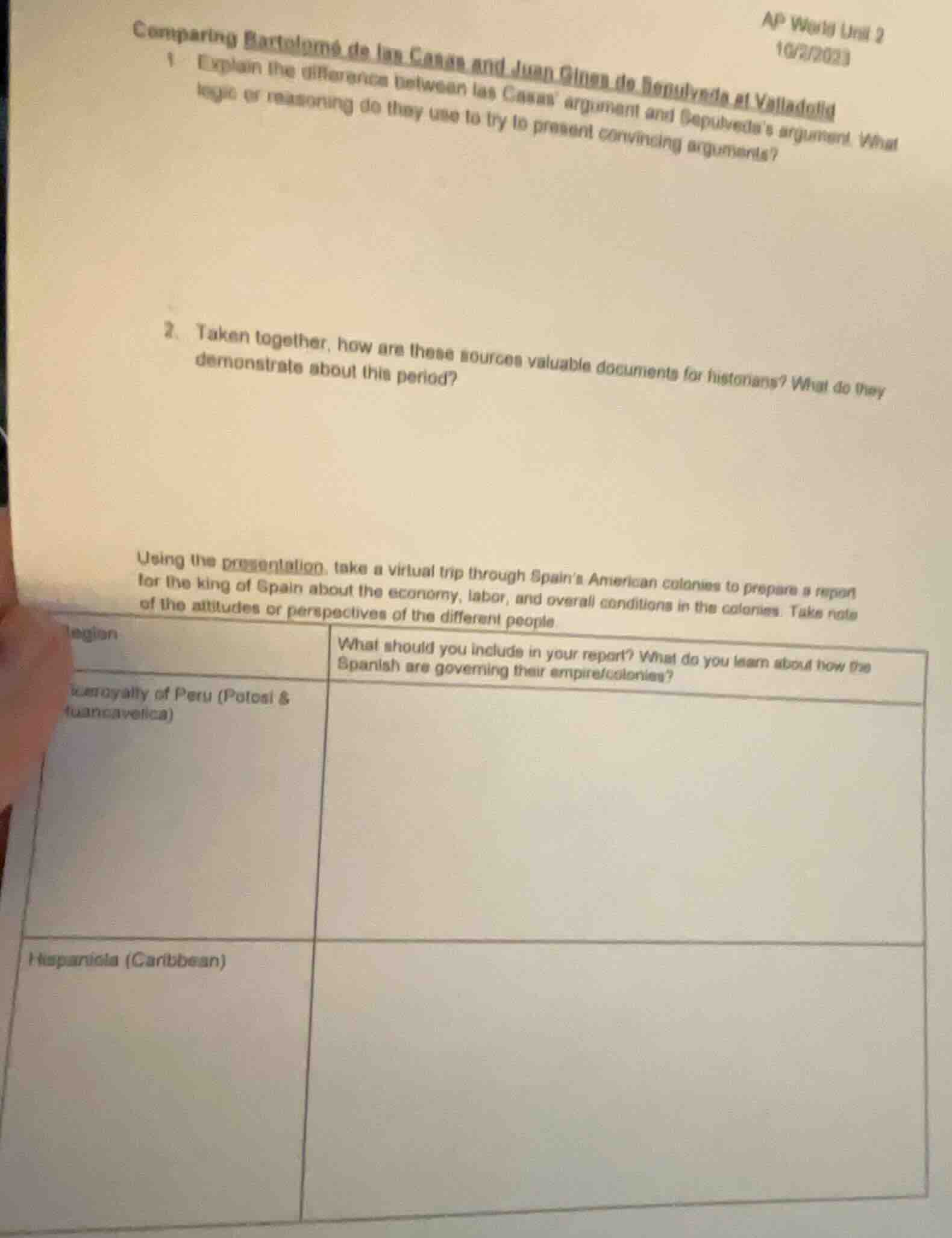
comparing bartolomé de las casas and juan ginés de sepúlveda at valladolid
ap world unit 2
10/2/2023
1 explain the difference between las casas’ argument and sepúlveda’s argument. what logic or reasoning do they use to try to present convincing arguments?
2 taken together, how are these sources valuable documents for historians? what do they demonstrate about this period?
using the presentation, take a virtual trip through spain’s american colonies to prepare a report for the king of spain about the economy, labor, and overall conditions in the colonies. take note of the attitudes or perspectives of the different people
region\twhat should you include in your report? what do you learn about how the spanish are governing their empire/colonies?
viceroyalty of peru (potosi & huancavelica)
hispaniola (caribbean)
For Question 1:
Las Casas argued for the humanity and rights of Indigenous peoples, using firsthand accounts of Spanish atrocities and framing Indigenous groups as rational, moral beings deserving protection under Spanish law and Christian ethics. Sepúlveda argued that Indigenous peoples were "barbaric," natural slaves, using Aristotle's theory of natural hierarchy and claiming Spanish rule was a civilizing, just mission to bring order and Christianity.
For Question 2:
These sources are valuable as they reveal competing elite Spanish perspectives on colonial ethics and governance, showing the ideological tensions within the Spanish Empire over Indigenous treatment. They demonstrate that there was not a single, unified Spanish colonial ideology, and highlight how religious and philosophical frameworks shaped colonial policy debates.
For the Report Table:
Viceroyalty of Peru (Potosi & Huancavelica):
Include details of the silver mining economy, the brutal mita labor system (forced Indigenous labor in mines), the extraction-focused governance model, and perspectives: Indigenous peoples faced exploitation and death, Spanish administrators prioritized wealth extraction for the crown, and colonial officials enriched themselves. This shows Spanish governance was centered on extracting raw resources through coercive labor systems.
Hispaniola (Caribbean):
Include details of the early encomienda system, the collapse of Indigenous populations due to disease and overwork, the shift to African slavery, and perspectives: Indigenous peoples were decimated by Spanish exploitation, Spanish settlers sought quick wealth through agriculture and resource extraction, and the crown struggled to control settler violence. This shows early Spanish colonial governance was marked by unregulated exploitation that led to demographic collapse, forcing a shift to chattel slavery.

Snap & solve any problem in the app
Get step-by-step solutions on Sovi AI
Photo-based solutions with guided steps
Explore more problems and detailed explanations
- Las Casas: Argued Indigenous peoples were rational, moral beings, using firsthand atrocity accounts and Christian ethics to demand their protection. Sepúlveda: Framed Indigenous peoples as "barbaric natural slaves," using Aristotle's hierarchy to justify Spanish colonial rule as a civilizing mission.
- These sources are valuable for historians as they expose ideological tensions in Spanish colonialism, showing competing elite views on Indigenous treatment, and demonstrate that colonial policy was shaped by fierce ethical and philosophical debates rather than a single unified agenda.
3.
- Viceroyalty of Peru (Potosi & Huancavelica): Report should include silver mining dominance, the coercive mita labor system, high Indigenous mortality, and crown focus on wealth extraction. Spanish governance here was extractivist, using forced labor to funnel resources to Spain, with little regard for Indigenous welfare.
- Hispaniola (Caribbean): Report should include the encomienda system, Indigenous demographic collapse from disease/overwork, early shift to African slavery, and unregulated settler exploitation. Spanish governance here was initially chaotic and exploitative, leading to irreversible demographic change that redefined colonial labor systems.