QUESTION IMAGE
Question
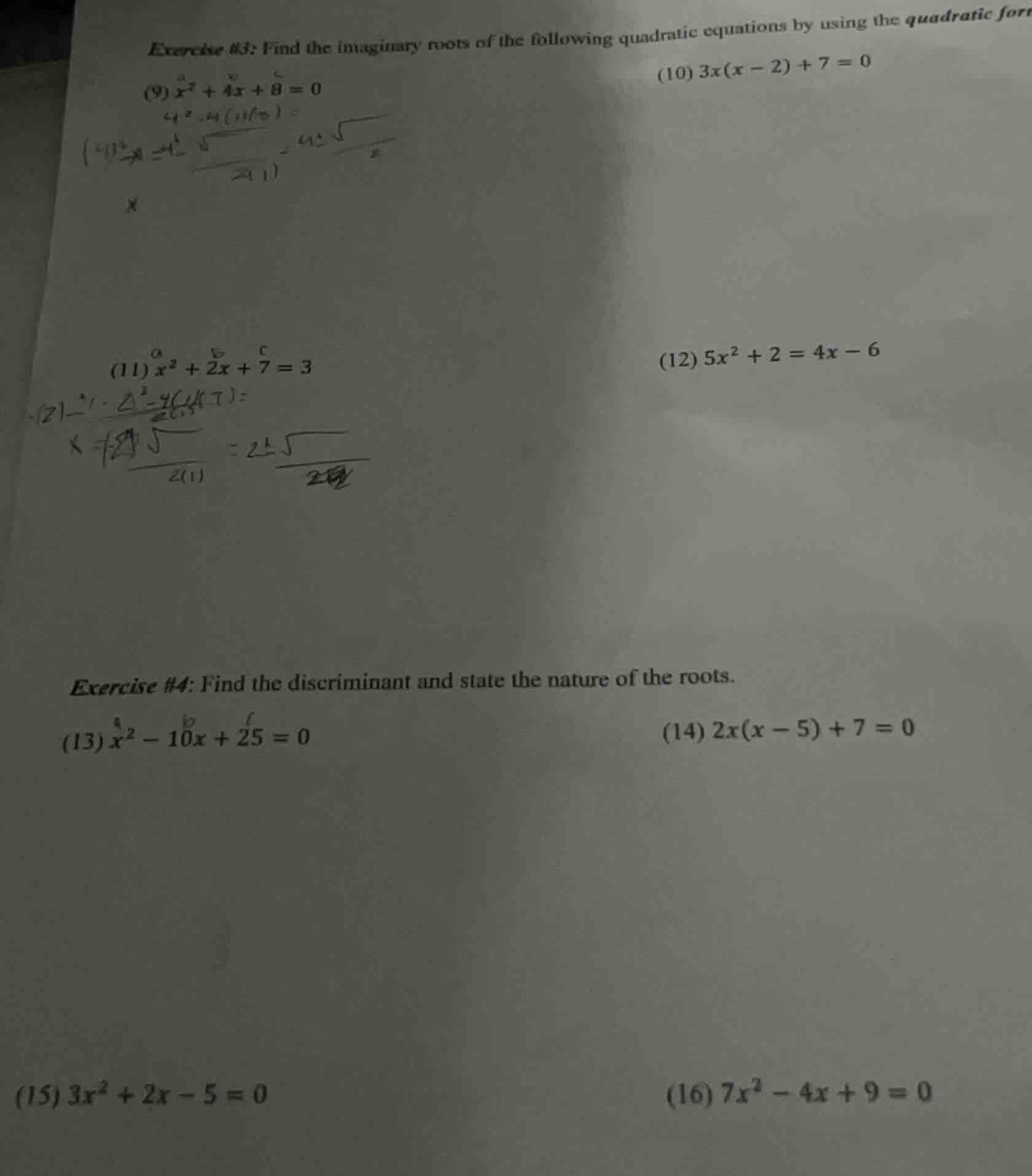
exercise #3: find the imaginary roots of the following quadratic equations by using the quadratic form
(9) $x^2 + 4x + 8 = 0$
(10) $3x(x - 2) + 7 = 0$
(11) $x^2 + 2x + 7 = 3$
(12) $5x^2 + 2 = 4x - 6$
exercise #4: find the discriminant and state the nature of the roots.
(13) $x^2 - 10x + 25 = 0$
(14) $2x(x - 5) + 7 = 0$
(15) $3x^2 + 2x - 5 = 0$
(16) $7x^2 - 4x + 9 = 0$
Exercise #3: Find the imaginary roots using the quadratic formula
Quadratic formula for $ax^2+bx+c=0$: $x=\frac{-b\pm\sqrt{b^2-4ac}}{2a}$, where $i=\sqrt{-1}$
---
(9) $x^2 + 4x + 8 = 0$
Step1: Identify a,b,c
$a=1,\ b=4,\ c=8$
Step2: Calculate discriminant
$\Delta = 4^2 - 4(1)(8) = 16-32=-16$
Step3: Apply quadratic formula
$x=\frac{-4\pm\sqrt{-16}}{2(1)}=\frac{-4\pm4i}{2}$
Step4: Simplify the expression
$x=-2\pm2i$
Step1: Identify a,b,c
$a=1,\ b=-10,\ c=25$
Step2: Calculate discriminant
$\Delta=(-10)^2-4(1)(25)=100-100=0$
Step3: State root nature
$\Delta=0$, so one repeated real root
Step1: Rewrite in standard form
$2x^2-10x+7=0$, so $a=2,\ b=-10,\ c=7$
Step2: Calculate discriminant
$\Delta=(-10)^2-4(2)(7)=100-56=44$
Step3: State root nature
$\Delta>0$, so two distinct real roots

Snap & solve any problem in the app
Get step-by-step solutions on Sovi AI
Photo-based solutions with guided steps
Explore more problems and detailed explanations
$x=-2+2i$ and $x=-2-2i$
---
(10) $3x(x - 2) + 7 = 0$
Step1: Rewrite in standard form
$3x^2-6x+7=0$, so $a=3,\ b=-6,\ c=7$
Step2: Calculate discriminant
$\Delta = (-6)^2 - 4(3)(7) = 36-84=-48$
Step3: Simplify square root
$\sqrt{-48}=\sqrt{16\times(-3)}=4i\sqrt{3}$
Step4: Apply quadratic formula
$x=\frac{6\pm4i\sqrt{3}}{2(3)}=\frac{6\pm4i\sqrt{3}}{6}$
Step5: Simplify the fraction
$x=\frac{3\pm2i\sqrt{3}}{3}=1\pm\frac{2i\sqrt{3}}{3}$