QUESTION IMAGE
Question
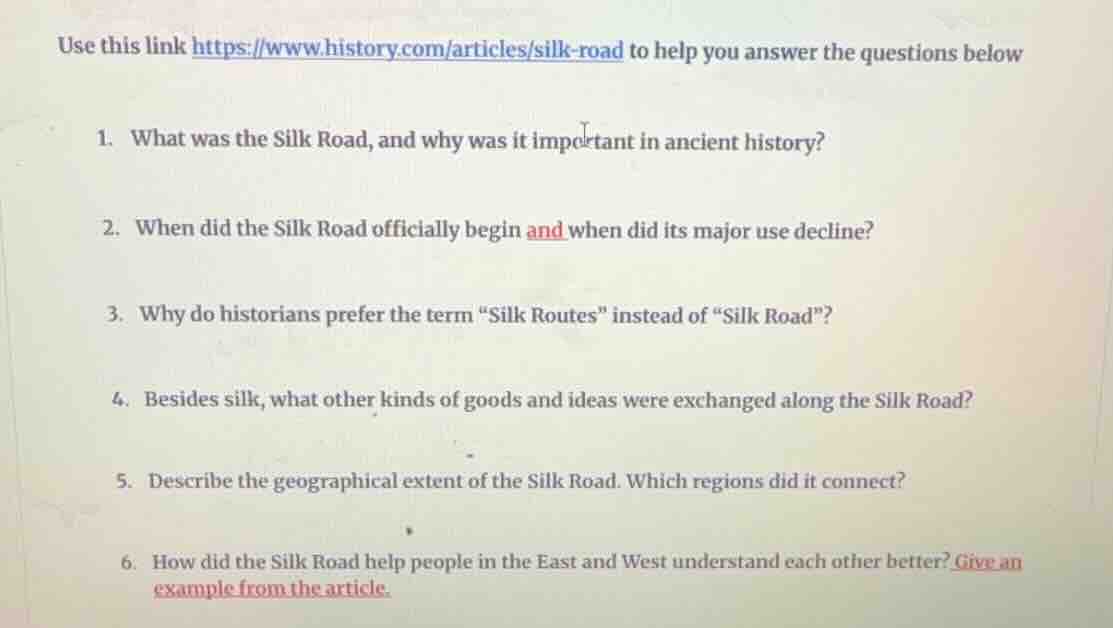
use this link https://www.history.com/articles/silk-road to help you answer the questions below
- what was the silk road, and why was it important in ancient history?
- when did the silk road officially begin and when did its major use decline?
- why do historians prefer the term \silk routes\ instead of \silk road\?
- besides silk, what other kinds of goods and ideas were exchanged along the silk road?
- describe the geographical extent of the silk road. which regions did it connect?
- how did the silk road help people in the east and west understand each other better? give an example from the article.
To answer these questions, we can refer to the provided link (https://www.history.com/articles/silk - road) and extract relevant information:
Question 1
The Silk Road was a network of trade routes that connected the East and the West. It was important in ancient history because it facilitated the exchange of goods (like silk, spices, precious metals), ideas (religions such as Buddhism, Christianity, Islam; technologies), and cultures between different civilizations. It promoted economic growth, cultural diffusion, and the development of cities along the routes.
According to historical sources (and likely the article), the Silk Road officially began around the 2nd century BCE during the Han Dynasty when Emperor Wu sent Zhang Qian on a mission. Its major use declined around the 15th century CE with the rise of sea - based trade routes and political changes in the regions it traversed.
Historians prefer "Silk Routes" over "Silk Road" because the trade network was not a single road but a complex web of interconnected routes. The term "routes" more accurately reflects the multiple paths that merchants, travelers, and missionaries took, which varied over time and geography.

Snap & solve any problem in the app
Get step-by-step solutions on Sovi AI
Photo-based solutions with guided steps
Explore more problems and detailed explanations
The Silk Road was a network of trade routes linking the East and West. It was important as it enabled the exchange of goods (e.g., silk, spices), ideas (e.g., religions, technologies), and cultures, fostering economic growth, cultural diffusion, and city development.