QUESTION IMAGE
Question
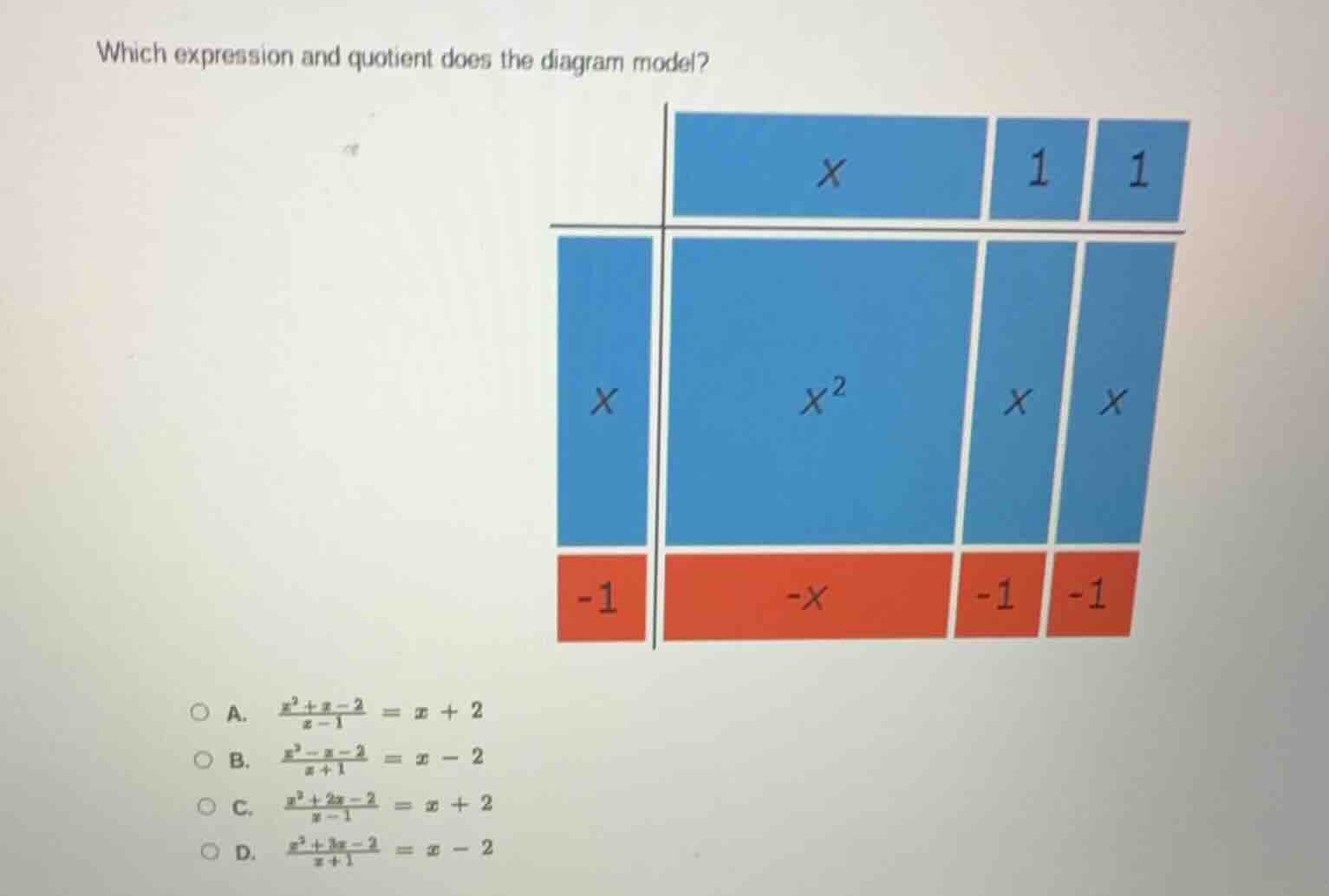
which expression and quotient does the diagram model?
a. $\frac{x^2 + x - 2}{x - 1} = x + 2$
b. $\frac{x^2 - x - 2}{x + 1} = x - 2$
c. $\frac{x^2 + 2x - 2}{x - 1} = x + 2$
d. $\frac{x^2 + 3x - 2}{x + 1} = x - 2$
Step1: Analyze the area of the large rectangle
The large rectangle is divided into smaller rectangles. Let's find the length and width. From the diagram, the horizontal top part has \(x + 1+ 1=x + 2\)? Wait, no, looking at the vertical and horizontal divisions. Wait, the left - hand side vertical has \(x\) and \(- 1\), so the height (vertical side) is \(x-1\)? No, wait, let's calculate the area of the blue and red regions.
The area of the figure can be calculated by adding the areas of the small rectangles. The blue region (positive area) has: \(x^{2}\) (the big square), \(x\) (top left), \(x\) (middle right), \(x\) (right - most), 1 (top middle), 1 (top right). Wait, no, maybe a better way: the horizontal length (top) is \(x + 1+1=x + 2\)? No, wait, the vertical side (left) is \(x-1\)? Wait, no, let's check the options.
Let's expand the numerator of each option and see which one matches the diagram's area.
Option B: \(\frac{x^{2}-x - 2}{x + 1}\). Let's factor the numerator: \(x^{2}-x - 2=(x - 2)(x+1)\). Then \(\frac{(x - 2)(x + 1)}{x + 1}=x - 2\) (for \(x
eq - 1\)).
Now, let's check the area of the diagram. The big square is \(x^{2}\), the blue rectangles: \(x^{2}\), two \(x\) rectangles (wait, no, in the diagram, the vertical side on the left is \(x\) and \(-1\), and the horizontal top is \(x\), \(1\), \(1\). Wait, maybe the length of the large rectangle is \(x + 1\) (since the top has \(x\), \(1\), \(1\)? No, wait, the middle row (the big square row) has \(x^{2}\), \(x\), \(x\), and the bottom row has \(-x\), \(-1\), \(-1\). Let's sum the areas:
\(x^{2}+x + x - x-1 - 1=x^{2}-x - 2\). And the width of the rectangle (the side that we are dividing by) is \(x + 1\) (since the top horizontal has \(x\), \(1\), \(1\)? No, wait, the horizontal length (the divisor) is \(x + 1\)? Wait, the area of the figure is \(x^{2}+x + x - x-1 - 1=x^{2}-x - 2\), and if we divide by \(x + 1\), we get \(x - 2\).
Let's verify by polynomial long division. Divide \(x^{2}-x - 2\) by \(x + 1\).
Divide the first term of the dividend \(x^{2}\) by the first term of the divisor \(x\), we get \(x\). Multiply \(x+1\) by \(x\): \(x(x + 1)=x^{2}+x\). Subtract this from the dividend: \((x^{2}-x - 2)-(x^{2}+x)=x^{2}-x - 2 - x^{2}-x=-2x - 2\). Now divide \(-2x\) by \(x\) (first term of divisor), we get \(-2\). Multiply \(x + 1\) by \(-2\): \(-2(x + 1)=-2x-2\). Subtract: \((-2x - 2)-(-2x - 2)=0\). So \(\frac{x^{2}-x - 2}{x + 1}=x - 2\), which matches option B.
Step2: Check other options
- Option A: \(\frac{x^{2}+x - 2}{x - 1}\). Factor numerator: \(x^{2}+x - 2=(x + 2)(x - 1)\), then \(\frac{(x + 2)(x - 1)}{x - 1}=x + 2\) (for \(x
eq1\)). But the diagram's area is not \(x^{2}+x - 2\), so A is wrong.
- Option C: \(\frac{x^{2}+2x - 2}{x - 1}\). The numerator \(x^{2}+2x - 2\) does not factor nicely with \(x - 1\) to give \(x + 2\) (since \((x + 2)(x - 1)=x^{2}+x - 2
eq x^{2}+2x - 2\)), so C is wrong.
- Option D: \(\frac{x^{2}+3x - 2}{x + 1}\). Dividing \(x^{2}+3x - 2\) by \(x + 1\) gives \(x + 2+\frac{0}{x + 1}\)? No, \((x + 1)(x + 2)=x^{2}+3x + 2
eq x^{2}+3x - 2\), so D is wrong.

Snap & solve any problem in the app
Get step-by-step solutions on Sovi AI
Photo-based solutions with guided steps
Explore more problems and detailed explanations
B. \(\frac{x^{2}-x - 2}{x + 1}=x - 2\)