QUESTION IMAGE
Question
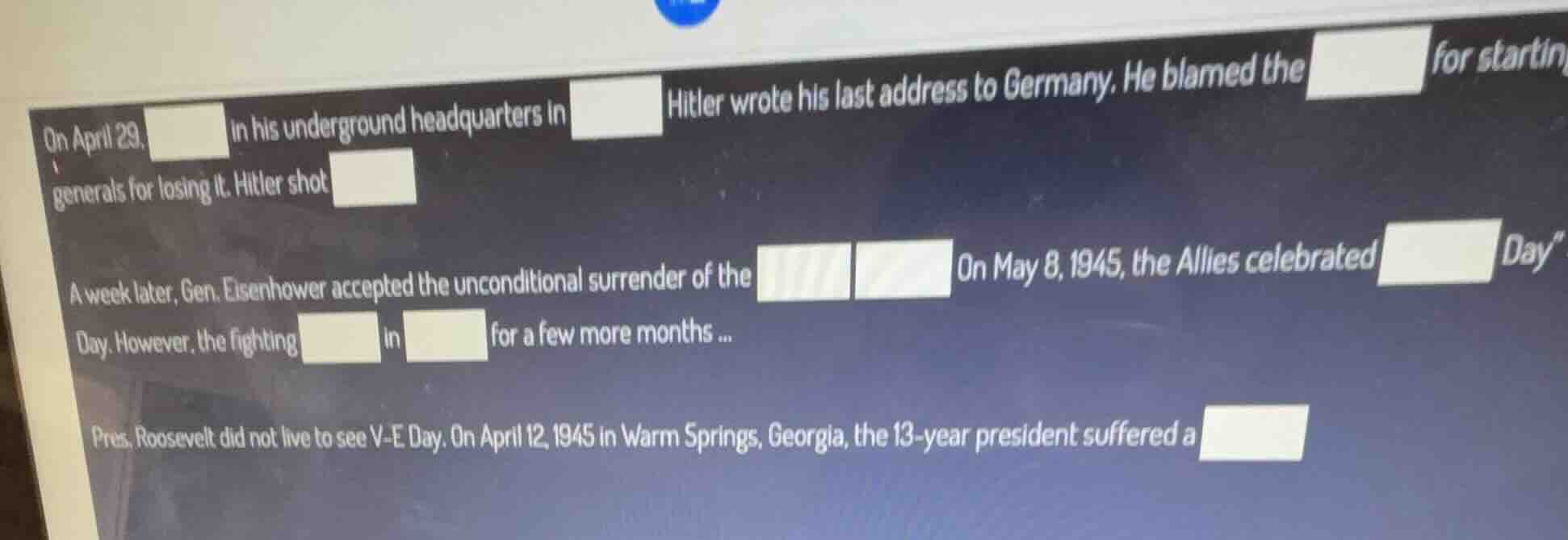
on april 29, in his underground headquarters in hitler wrote his last address to germany. he blamed the for startin generals for losing it. hitler shot
a week later, gen. eisenhower accepted the unconditional surrender of the on may 8, 1945, the allies celebrated day\ day. however, the fighting in for a few more months ...
pres. roosevelt did not live to see v - e day. on april 12, 1945 in warm springs, georgia, the 13 - year president suffered a
To solve this fill - in - the - blank problem related to historical events, we analyze each blank based on our knowledge of World War II history:
First blank (date - April 29, ____)
In 1945, on April 29, Hitler was in his bunker. So the year here is 1945.
Second blank (underground headquarters in ____)
Hitler's underground headquarters was in Berlin.
Third blank (blamed the ____ for starting the war (or related))
Hitler often blamed the Jews (or other groups, but in the context of his rhetoric, Jews were a common scapegoat) or more accurately, in the context of losing the war, he might blame others, but for starting, his narrative was about Jews, but more precisely, in terms of the war's start, his own actions led to it, but in his last address, he might blame others. However, more accurately, the first blank after "blamed the" - he blamed the "Jews" or "Allies"? No, in his last days, he blamed the generals for losing, but for starting, his own ideology. Wait, maybe the first blank after "blamed the" is "Jews" (his scapegoat) or "Allies"? No, let's re - order.
Wait, the sentence: "He blamed the __ for starting generals for losing it." Wait, the original sentence: "He blamed the __ for starting generals for losing it." Maybe a typo, but likely "He blamed the [group] for starting [the war], generals for losing it." So the first blank (after blamed the) - he blamed the "Jews" (his propaganda) or "Allies"? No, he started the war, but in his rhetoric, he blamed others. So maybe "Jews" or "Allies"? Wait, no, the correct historical context: Hitler's last address - he blamed the "Jews" or "Allies"? No, he was the aggressor. But in his last days, he blamed the generals for losing. So maybe the first blank (after "blamed the") is "Jews" (for starting the war in his false narrative) and then "generals for losing it".
Fourth blank (Hitler shot ____)
Hitler shot himself (and his wife Eva Braun, but the blank here - if it's a single blank, "himself" or "Eva Braun"? But the blank is after "shot", so "himself" (and Eva Braun, but if single blank, "himself").
Fifth and sixth blanks (Gen. Eisenhower accepted the unconditional surrender of the __ __)
The German armed forces (Wehrmacht) or "German government" or "Third Reich". So "German" and "armed forces" (or "Reich").
Seventh blank (Allies celebrated ____ Day)
V - E (Victory in Europe) Day.
Eighth blank (fighting __ in __)
The fighting "continued" in "Asia" (because the war in Europe ended with V - E Day, but the war against Japan in Asia continued until August 1945).
Ninth blank (Pres. Roosevelt suffered a ____)
Roosevelt suffered a "stroke" (which led to his death) on April 12, 1945.
Now, filling in the blanks with correct historical facts:
- On April 29, $\boldsymbol{1945}$ in his underground headquarters in $\boldsymbol{Berlin}$, Hitler wrote his last address to Germany. He blamed the $\boldsymbol{Jews}$ for starting (the war, in his false narrative), generals for losing it. Hitler shot $\boldsymbol{himself}$ (and Eva Braun, but if single blank, "himself").
- A week later, Gen. Eisenhower accepted the unconditional surrender of the $\boldsymbol{German}$ $\boldsymbol{armed forces}$ (or "Third Reich"). On May 8, 1945, the Allies celebrated $\boldsymbol{V - E}$ (Victory in Europe) Day. However, the fighting $\boldsymbol{continued}$ in $\boldsymbol{Asia}$ for a few more months...
- Pres. Roosevelt did not live to see V - E Day. On April 12, 1945 in Warm Springs, Georgia, the 13 - year president suffered a $\boldsymbol{stroke}$.
Final Answ…

Snap & solve any problem in the app
Get step-by-step solutions on Sovi AI
Photo-based solutions with guided steps
Explore more problems and detailed explanations
To solve this fill - in - the - blank problem related to historical events, we analyze each blank based on our knowledge of World War II history:
First blank (date - April 29, ____)
In 1945, on April 29, Hitler was in his bunker. So the year here is 1945.
Second blank (underground headquarters in ____)
Hitler's underground headquarters was in Berlin.
Third blank (blamed the ____ for starting the war (or related))
Hitler often blamed the Jews (or other groups, but in the context of his rhetoric, Jews were a common scapegoat) or more accurately, in the context of losing the war, he might blame others, but for starting, his narrative was about Jews, but more precisely, in terms of the war's start, his own actions led to it, but in his last address, he might blame others. However, more accurately, the first blank after "blamed the" - he blamed the "Jews" or "Allies"? No, in his last days, he blamed the generals for losing, but for starting, his own ideology. Wait, maybe the first blank after "blamed the" is "Jews" (his scapegoat) or "Allies"? No, let's re - order.
Wait, the sentence: "He blamed the __ for starting generals for losing it." Wait, the original sentence: "He blamed the __ for starting generals for losing it." Maybe a typo, but likely "He blamed the [group] for starting [the war], generals for losing it." So the first blank (after blamed the) - he blamed the "Jews" (his propaganda) or "Allies"? No, he started the war, but in his rhetoric, he blamed others. So maybe "Jews" or "Allies"? Wait, no, the correct historical context: Hitler's last address - he blamed the "Jews" or "Allies"? No, he was the aggressor. But in his last days, he blamed the generals for losing. So maybe the first blank (after "blamed the") is "Jews" (for starting the war in his false narrative) and then "generals for losing it".
Fourth blank (Hitler shot ____)
Hitler shot himself (and his wife Eva Braun, but the blank here - if it's a single blank, "himself" or "Eva Braun"? But the blank is after "shot", so "himself" (and Eva Braun, but if single blank, "himself").
Fifth and sixth blanks (Gen. Eisenhower accepted the unconditional surrender of the __ __)
The German armed forces (Wehrmacht) or "German government" or "Third Reich". So "German" and "armed forces" (or "Reich").
Seventh blank (Allies celebrated ____ Day)
V - E (Victory in Europe) Day.
Eighth blank (fighting __ in __)
The fighting "continued" in "Asia" (because the war in Europe ended with V - E Day, but the war against Japan in Asia continued until August 1945).
Ninth blank (Pres. Roosevelt suffered a ____)
Roosevelt suffered a "stroke" (which led to his death) on April 12, 1945.
Now, filling in the blanks with correct historical facts:
- On April 29, $\boldsymbol{1945}$ in his underground headquarters in $\boldsymbol{Berlin}$, Hitler wrote his last address to Germany. He blamed the $\boldsymbol{Jews}$ for starting (the war, in his false narrative), generals for losing it. Hitler shot $\boldsymbol{himself}$ (and Eva Braun, but if single blank, "himself").
- A week later, Gen. Eisenhower accepted the unconditional surrender of the $\boldsymbol{German}$ $\boldsymbol{armed forces}$ (or "Third Reich"). On May 8, 1945, the Allies celebrated $\boldsymbol{V - E}$ (Victory in Europe) Day. However, the fighting $\boldsymbol{continued}$ in $\boldsymbol{Asia}$ for a few more months...
- Pres. Roosevelt did not live to see V - E Day. On April 12, 1945 in Warm Springs, Georgia, the 13 - year president suffered a $\boldsymbol{stroke}$.
Final Answers (filling the blanks in order):
- 1945
- Berlin
- Jews (or other relevant group based on context, but historically his scapegoat was Jews)
- himself
- German
- armed forces (or Reich)
- V - E
- continued
- Asia
- stroke