QUESTION IMAGE
Question
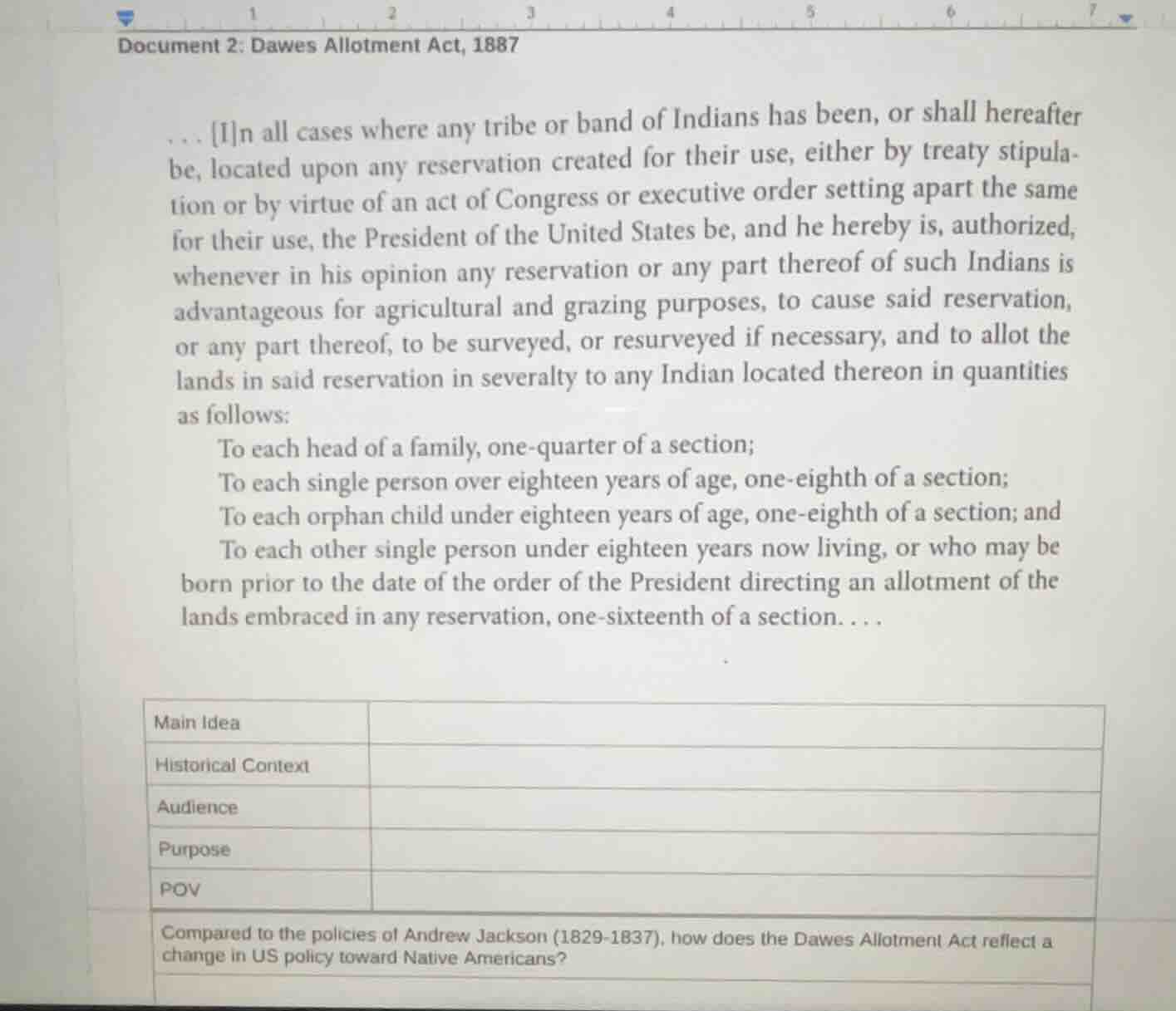
document 2: dawes allotment act, 1887... in all cases where any tribe or band of indians has been, or shall hereafter be, located upon any reservation created for their use, either by treaty stipulation or by virtue of an act of congress or executive order setting apart the same for their use, the president of the united states be, and he hereby is, authorized, whenever in his opinion any reservation or any part thereof of such indians is advantageous for agricultural and grazing purposes, to cause said reservation, or any part thereof, to be surveyed, or resurveyed if necessary, and to allot the lands in said reservation in severalty to any indian located thereon in quantities as follows: to each head of a family, one - quarter of a section; to each single person over eighteen years of age, one - eighth of a section; to each orphan child under eighteen years of age, one - eighth of a section; and to each other single person under eighteen years now living, or who may be born prior to the date of the order of the president directing an allotment of the lands embraced in any reservation, one - sixteenth of a section....
main idea
historical context
audience
purpose
pov
compared to the policies of andrew jackson (1829 - 1837), how does the dawes allotment act reflect a change in us policy toward native americans?
Main Idea
The Dawes Allotment Act of 1887 authorizes the President to survey Native American reservations (for agricultural/grazing use) and allot land in severalty to individual Indians, with specific acreage amounts based on family/individual status (e.g., head of family gets ¼ section, single adult ⅛, etc.).
Late 19th - century US, during the era of westward expansion and assimilationist policies toward Native Americans. The US government sought to break up tribal landholdings (communal ownership) and encourage Native Americans to adopt Euro - American agricultural practices and individual landownership, as part of a broader push for assimilation into mainstream US society.
Primarily the President of the United States (who is authorized to act), as well as government officials involved in surveying and allotting land, and Native American tribes/individuals affected by the act (to inform them of land allocation rules). Also, potentially Congress (to understand the act’s provisions) and the general public interested in Native American policy.

Snap & solve any problem in the app
Get step-by-step solutions on Sovi AI
Photo-based solutions with guided steps
Explore more problems and detailed explanations
The Dawes Allotment Act (1887) authorizes the President to survey Native American reservations (for agricultural/grazing use) and allot land in severalty to individual Indians, with specific acreage amounts based on family/individual status (e.g., head of family gets ¼ section, single adult ⅛, etc.).