QUESTION IMAGE
Question
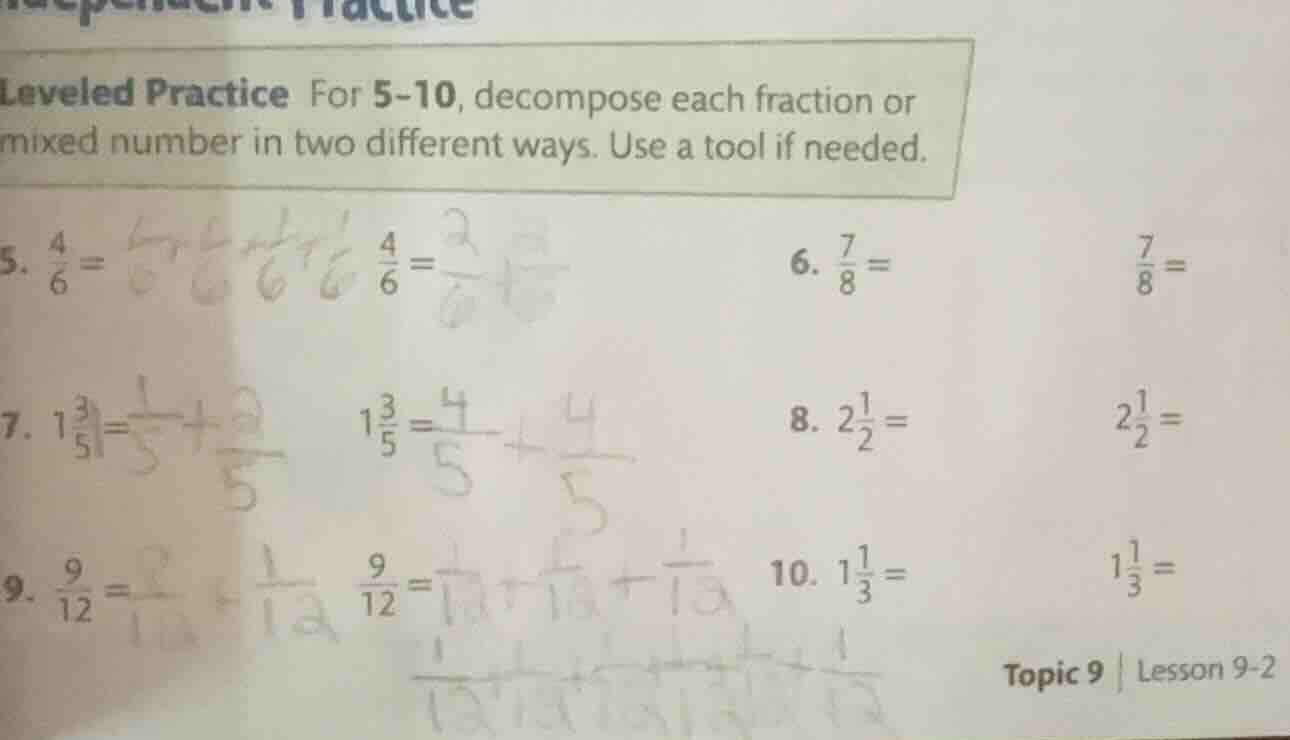
leveled practice for 5-10, decompose each fraction or mixed number in two different ways. use a tool if needed.
- \\(\frac{4}{6}=\\) \\(\frac{4}{6}=\\) 6. \\(\frac{7}{8}=\\) \\(\frac{7}{8}=\\)
- \\(1\frac{3}{5}=\\) \\(1\frac{3}{5}=\\) 8. \\(2\frac{1}{2}=\\) \\(2\frac{1}{2}=\\)
- \\(\frac{9}{12}=\\) \\(\frac{9}{12}=\\) 10. \\(1\frac{1}{3}=\\) \\(1\frac{1}{3}=\\)
topic 9 | lesson 9-2
Let's solve each problem by decomposing the fraction or mixed number in two different ways. We'll use the concept of adding fractions with the same denominator.
Problem 5: $\boldsymbol{\frac{4}{6}}$
To decompose a fraction, we can express it as the sum of two fractions with the same denominator.
Way 1:
We know that $\frac{1}{6} + \frac{3}{6} = \frac{1 + 3}{6} = \frac{4}{6}$. So, $\frac{4}{6} = \frac{1}{6} + \frac{3}{6}$.
Way 2:
Also, $\frac{2}{6} + \frac{2}{6} = \frac{2 + 2}{6} = \frac{4}{6}$. So, $\frac{4}{6} = \frac{2}{6} + \frac{2}{6}$. (We can simplify $\frac{2}{6}$ to $\frac{1}{3}$, but the problem just asks for decomposition, so keeping the denominator 6 is fine.)
Problem 6: $\boldsymbol{\frac{7}{8}}$
Way 1:
$\frac{1}{8} + \frac{6}{8} = \frac{1 + 6}{8} = \frac{7}{8}$. So, $\frac{7}{8} = \frac{1}{8} + \frac{6}{8}$.
Way 2:
$\frac{2}{8} + \frac{5}{8} = \frac{2 + 5}{8} = \frac{7}{8}$. Simplifying $\frac{2}{8}$ to $\frac{1}{4}$ is optional, but we can write $\frac{7}{8} = \frac{2}{8} + \frac{5}{8}$. (Or $\frac{3}{8} + \frac{4}{8}$, since $3 + 4 = 7$.)
Problem 7: $\boldsymbol{1\frac{3}{5}}$ (a mixed number)
First, recall that a mixed number $1\frac{3}{5}$ can be written as $1 + \frac{3}{5}$. Now, we can decompose the whole number part and the fractional part, or decompose the fractional part.
Way 1:
Decompose the fractional part: $\frac{3}{5} = \frac{1}{5} + \frac{2}{5}$. So, $1\frac{3}{5} = 1 + \frac{1}{5} + \frac{2}{5}$. But we can also write it as the sum of two mixed numbers or two fractions. Wait, actually, a mixed number is a whole number plus a fraction. So another way:
$1\frac{3}{5} = \frac{5}{5} + \frac{3}{5}$ (since $1 = \frac{5}{5}$), but that's just the improper fraction. Wait, no, the problem says "decompose each fraction or mixed number". So for a mixed number, we can decompose it into the sum of two mixed numbers or the sum of a whole number and a fraction, or the sum of two fractions (by converting the mixed number to an improper fraction first).
First, convert $1\frac{3}{5}$ to an improper fraction: $1\frac{3}{5} = \frac{5 \times 1 + 3}{5} = \frac{8}{5}$.
Way 1 (using improper fraction):
$\frac{8}{5} = \frac{1}{5} + \frac{7}{5}$. But $\frac{7}{5}$ is $1\frac{2}{5}$, so $1\frac{3}{5} = \frac{1}{5} + 1\frac{2}{5}$.
Way 2:
$\frac{8}{5} = \frac{2}{5} + \frac{6}{5}$. $\frac{6}{5}$ is $1\frac{1}{5}$, so $1\frac{3}{5} = \frac{2}{5} + 1\frac{1}{5}$.
Or, using the mixed number directly: $1\frac{3}{5} = 1 + \frac{1}{5} + \frac{2}{5}$ (as the whole number 1 plus two fractions), but maybe better to write as two mixed numbers or two fractions. Alternatively, $1\frac{3}{5} = \frac{4}{5} + \frac{4}{5}$ (since $4 + 4 = 8$, and $\frac{8}{5} = 1\frac{3}{5}$). Let's check: $\frac{4}{5} + \frac{4}{5} = \frac{8}{5} = 1\frac{3}{5}$. Yes, that works. So:
Way 1: $1\frac{3}{5} = 1 + \frac{1}{5} + \frac{2}{5}$ (but maybe the problem expects two parts, so let's adjust). Wait, the problem says "decompose each fraction or mixed number in two different ways". For a mixed number, we can decompose it into the sum of two mixed numbers or the sum of a whole number and a fraction, or the sum of two fractions (by converting to improper).
Let's do it properly:
Way 1:
$1\frac{3}{5} = 1 + \frac{3}{5}$ (the original form, but we need another way). Wait, no, we need two different decompositions. Let's use the improper fraction $\frac{8}{5}$.
Way 1:
$\frac{8}{5} = \frac{3}{5} + \frac{5}{5}$ (since $3 + 5 = 8$). $\frac{5}{5} = 1$, so $\frac{8}{5} = \frac{3}{5} + 1$, which is $1\frac…

Snap & solve any problem in the app
Get step-by-step solutions on Sovi AI
Photo-based solutions with guided steps
Explore more problems and detailed explanations
Let's solve each problem by decomposing the fraction or mixed number in two different ways. We'll use the concept of adding fractions with the same denominator.
Problem 5: $\boldsymbol{\frac{4}{6}}$
To decompose a fraction, we can express it as the sum of two fractions with the same denominator.
Way 1:
We know that $\frac{1}{6} + \frac{3}{6} = \frac{1 + 3}{6} = \frac{4}{6}$. So, $\frac{4}{6} = \frac{1}{6} + \frac{3}{6}$.
Way 2:
Also, $\frac{2}{6} + \frac{2}{6} = \frac{2 + 2}{6} = \frac{4}{6}$. So, $\frac{4}{6} = \frac{2}{6} + \frac{2}{6}$. (We can simplify $\frac{2}{6}$ to $\frac{1}{3}$, but the problem just asks for decomposition, so keeping the denominator 6 is fine.)
Problem 6: $\boldsymbol{\frac{7}{8}}$
Way 1:
$\frac{1}{8} + \frac{6}{8} = \frac{1 + 6}{8} = \frac{7}{8}$. So, $\frac{7}{8} = \frac{1}{8} + \frac{6}{8}$.
Way 2:
$\frac{2}{8} + \frac{5}{8} = \frac{2 + 5}{8} = \frac{7}{8}$. Simplifying $\frac{2}{8}$ to $\frac{1}{4}$ is optional, but we can write $\frac{7}{8} = \frac{2}{8} + \frac{5}{8}$. (Or $\frac{3}{8} + \frac{4}{8}$, since $3 + 4 = 7$.)
Problem 7: $\boldsymbol{1\frac{3}{5}}$ (a mixed number)
First, recall that a mixed number $1\frac{3}{5}$ can be written as $1 + \frac{3}{5}$. Now, we can decompose the whole number part and the fractional part, or decompose the fractional part.
Way 1:
Decompose the fractional part: $\frac{3}{5} = \frac{1}{5} + \frac{2}{5}$. So, $1\frac{3}{5} = 1 + \frac{1}{5} + \frac{2}{5}$. But we can also write it as the sum of two mixed numbers or two fractions. Wait, actually, a mixed number is a whole number plus a fraction. So another way:
$1\frac{3}{5} = \frac{5}{5} + \frac{3}{5}$ (since $1 = \frac{5}{5}$), but that's just the improper fraction. Wait, no, the problem says "decompose each fraction or mixed number". So for a mixed number, we can decompose it into the sum of two mixed numbers or the sum of a whole number and a fraction, or the sum of two fractions (by converting the mixed number to an improper fraction first).
First, convert $1\frac{3}{5}$ to an improper fraction: $1\frac{3}{5} = \frac{5 \times 1 + 3}{5} = \frac{8}{5}$.
Way 1 (using improper fraction):
$\frac{8}{5} = \frac{1}{5} + \frac{7}{5}$. But $\frac{7}{5}$ is $1\frac{2}{5}$, so $1\frac{3}{5} = \frac{1}{5} + 1\frac{2}{5}$.
Way 2:
$\frac{8}{5} = \frac{2}{5} + \frac{6}{5}$. $\frac{6}{5}$ is $1\frac{1}{5}$, so $1\frac{3}{5} = \frac{2}{5} + 1\frac{1}{5}$.
Or, using the mixed number directly: $1\frac{3}{5} = 1 + \frac{1}{5} + \frac{2}{5}$ (as the whole number 1 plus two fractions), but maybe better to write as two mixed numbers or two fractions. Alternatively, $1\frac{3}{5} = \frac{4}{5} + \frac{4}{5}$ (since $4 + 4 = 8$, and $\frac{8}{5} = 1\frac{3}{5}$). Let's check: $\frac{4}{5} + \frac{4}{5} = \frac{8}{5} = 1\frac{3}{5}$. Yes, that works. So:
Way 1: $1\frac{3}{5} = 1 + \frac{1}{5} + \frac{2}{5}$ (but maybe the problem expects two parts, so let's adjust). Wait, the problem says "decompose each fraction or mixed number in two different ways". For a mixed number, we can decompose it into the sum of two mixed numbers or the sum of a whole number and a fraction, or the sum of two fractions (by converting to improper).
Let's do it properly:
Way 1:
$1\frac{3}{5} = 1 + \frac{3}{5}$ (the original form, but we need another way). Wait, no, we need two different decompositions. Let's use the improper fraction $\frac{8}{5}$.
Way 1:
$\frac{8}{5} = \frac{3}{5} + \frac{5}{5}$ (since $3 + 5 = 8$). $\frac{5}{5} = 1$, so $\frac{8}{5} = \frac{3}{5} + 1$, which is $1\frac{3}{5} = 1 + \frac{3}{5}$ (original), so that's not different. Wait, maybe I made a mistake. Let's think again.
A mixed number $1\frac{3}{5}$ can be decomposed as the sum of two mixed numbers:
Way 1:
$1\frac{3}{5} = 1\frac{1}{5} + \frac{2}{5}$? No, $\frac{2}{5}$ is not a mixed number. Wait, no, the decomposition can be into two fractions (with the same denominator) or a whole number and a fraction, or two mixed numbers.
Wait, the problem says "decompose each fraction or mixed number". So for a mixed number, we can decompose it into the sum of two fractions (by converting to improper) or the sum of a whole number and a fraction, or two mixed numbers.
Let's try:
Way 1:
$1\frac{3}{5} = 1 + \frac{1}{5} + \frac{2}{5}$ (but that's three parts). No, the problem says "two different ways", so two parts.
Ah, right! A mixed number is a whole number plus a fraction. So we can decompose the whole number part and the fractional part, or decompose the fractional part.
Wait, the fractional part is $\frac{3}{5}$. We can decompose $\frac{3}{5}$ into $\frac{1}{5} + \frac{2}{5}$. So:
Way 1:
$1\frac{3}{5} = 1 + \frac{1}{5} + \frac{2}{5}$ (but that's three terms). No, the problem probably wants two terms. So maybe:
Way 1:
$1\frac{3}{5} = \frac{5}{5} + \frac{3}{5}$ (since $1 = \frac{5}{5}$), but that's just converting to improper. No, that's not helpful. Wait, maybe the problem allows decomposing into two fractions (with the same denominator) by converting the mixed number to an improper fraction.
Convert $1\frac{3}{5}$ to $\frac{8}{5}$. Now, decompose $\frac{8}{5}$:
Way 1:
$\frac{8}{5} = \frac{2}{5} + \frac{6}{5}$ (since $2 + 6 = 8$). $\frac{6}{5} = 1\frac{1}{5}$, so $1\frac{3}{5} = \frac{2}{5} + 1\frac{1}{5}$.
Way 2:
$\frac{8}{5} = \frac{4}{5} + \frac{4}{5}$ (since $4 + 4 = 8$). So $1\frac{3}{5} = \frac{4}{5} + \frac{4}{5}$. (Because $\frac{4}{5} + \frac{4}{5} = \frac{8}{5} = 1\frac{3}{5}$.)
Problem 8: $\boldsymbol{2\frac{1}{2}}$ (a mixed number)
First, convert to improper fraction: $2\frac{1}{2} = \frac{2 \times 2 + 1}{2} = \frac{5}{2}$.
Way 1:
Decompose $\frac{5}{2}$ into two fractions: $\frac{5}{2} = \frac{1}{2} + \frac{4}{2}$. $\frac{4}{2} = 2$, so $\frac{5}{2} = \frac{1}{2} + 2$, which is $2\frac{1}{2} = 2 + \frac{1}{2}$ (original), so that's not different. Wait, no, we need two different decompositions.
Way 1:
$\frac{5}{2} = \frac{2}{2} + \frac{3}{2}$. $\frac{2}{2} = 1$, $\frac{3}{2} = 1\frac{1}{2}$, so $2\frac{1}{2} = 1 + 1\frac{1}{2}$.
Way 2:
$\frac{5}{2} = \frac{3}{2} + \frac{2}{2}$. $\frac{3}{2} = 1\frac{1}{2}$, $\frac{2}{2} = 1$, so $2\frac{1}{2} = 1\frac{1}{2} + 1$ (same as Way 1, just reversed). Wait, maybe better to use the mixed number directly.
$2\frac{1}{2} = 2 + \frac{1}{2}$ (original). Another way: $2\frac{1}{2} = 1 + 1\frac{1}{2}$ (since $1 + 1\frac{1}{2} = 2\frac{1}{2}$). Or, using fractions: $2\frac{1}{2} = \frac{4}{2} + \frac{1}{2}$ (since $2 = \frac{4}{2}$), which is the same as $2 + \frac{1}{2}$. Wait, maybe I'm overcomplicating. Let's use the improper fraction $\frac{5}{2}$.
Way 1:
$\frac{5}{2} = \frac{1}{2} + \frac{4}{2}$ (which is $2\frac{1}{2} = \frac{1}{2} + 2$).
Way 2:
$\frac{5}{2} = \frac{3}{2} + \frac{2}{2}$ (which is $2\frac{1}{2} = 1\frac{1}{2} + 1$).
Problem 9: $\boldsymbol{\frac{9}{12}}$
Simplify first: $\frac{9}{12} = \frac{3}{4}$, but we can decompose it as is.
Way 1:
$\frac{9}{12} = \frac{1}{12} + \frac{8}{12}$ (since $1 + 8 = 9$). $\frac{8}{12} = \frac{2}{3}$, so $\frac{9}{12} = \frac{1}{12} + \frac{2}{3}$.
Way 2:
$\frac{9}{12} = \frac{3}{12} + \frac{6}{12}$ (since $3 + 6 = 9$). Simplifying, $\frac{3}{12} = \frac{1}{4}$ and $\frac{6}{12} = \frac{1}{2}$, so $\frac{9}{12} = \frac{1}{4} + \frac{1}{2}$.
Problem 10: $\boldsymbol{1\frac{1}{3}}$ (a mixed number)
Convert to improper fraction: $1\frac{1}{3} = \frac{3 \times 1 + 1}{3} = \frac{4}{3}$.
Way 1:
$\frac{4}{3} = \frac{1}{3} + \frac{3}{3}$ (since $1 + 3 = 4$). $\frac{3}{3} = 1$, so $1\frac{1}{3} = \frac{1}{3} + 1$.
Way 2:
$\frac{4}{3} = \frac{2}{3} + \frac{2}{3}$ (since $2 + 2 = 4$). So $1\frac{1}{3} = \frac{2}{3} + \frac{2}{3}$. (Because $\frac{2}{3} + \frac{2}{3} = \frac{4}{3} = 1\frac{1}{3}$.)
Let's summarize the decompositions:
5. $\boldsymbol{\frac{4}{6}}$
- Way 1: $\frac{4}{6} = \frac{1}{6} + \frac{3}{6}$
- Way 2: $\frac{4}{6} = \frac{2}{6} + \frac{2}{6}$ (or $\frac{1}{3} + \frac{1}{3}$ after simplifying)
6. $\boldsymbol{\frac{7}{8}}$
- Way 1: $\frac{7}{8} = \frac{1}{8} + \frac{6}{8}$
- Way 2: $\frac{7}{8} = \frac{3}{8} + \frac{4}{8}$ (or $\frac{2}{8} + \frac{5}{8}$)
7. $\boldsymbol{1\frac{3}{5}}$
- Way 1: $1\frac{3}{5} = 1 + \frac{1}{5} + \frac{2}{5}$ (but better as two parts: $1\frac{3}{5} = \frac{3}{5} + 1$ or $1\frac{3}{5} = \frac{4}{5} + \frac{4}{5}$)
- Way 2: $1\frac{3}{5} = 1\frac{1}{5} + \frac{2}{5}$ (or $1\frac{3}{5} = 1\frac{2}{5} + \frac{1}{5}$)
8. $\boldsymbol{2\frac{1}{2}}$
- Way 1: $2\frac{1}{2} = 2 + \frac{1}{2}$
- Way 2: $2\frac{1}{2} = 1 + 1\frac{1}{2}$ (or $\frac{4}{2} + \frac{1}{2}$)
9. $\boldsymbol{\frac{9}{12}}$
- Way 1: $\frac{9}{12} = \frac{1}{12} + \frac{8}{12}$
- Way 2: $\frac{9}{12} = \frac{3}{12} + \frac{6}{12}$ (or $\frac{1}{4} + \frac{1}{2}$ after simplifying)
10. $\boldsymbol{1\frac{1}{3}}$
- Way 1: $1\frac{1}{3} = 1 + \frac{1}{3}$
- Way 2: $1\frac{1}{3} = \frac{2}{3} + \frac{2}{3}$ (or $\frac{1}{3} + 1$)
These are the two different ways to decompose each fraction or mixed number. The key is to express the number as the sum of two fractions (or mixed numbers) with the same denominator (or compatible denominators) that add up to the original number.