QUESTION IMAGE
Question
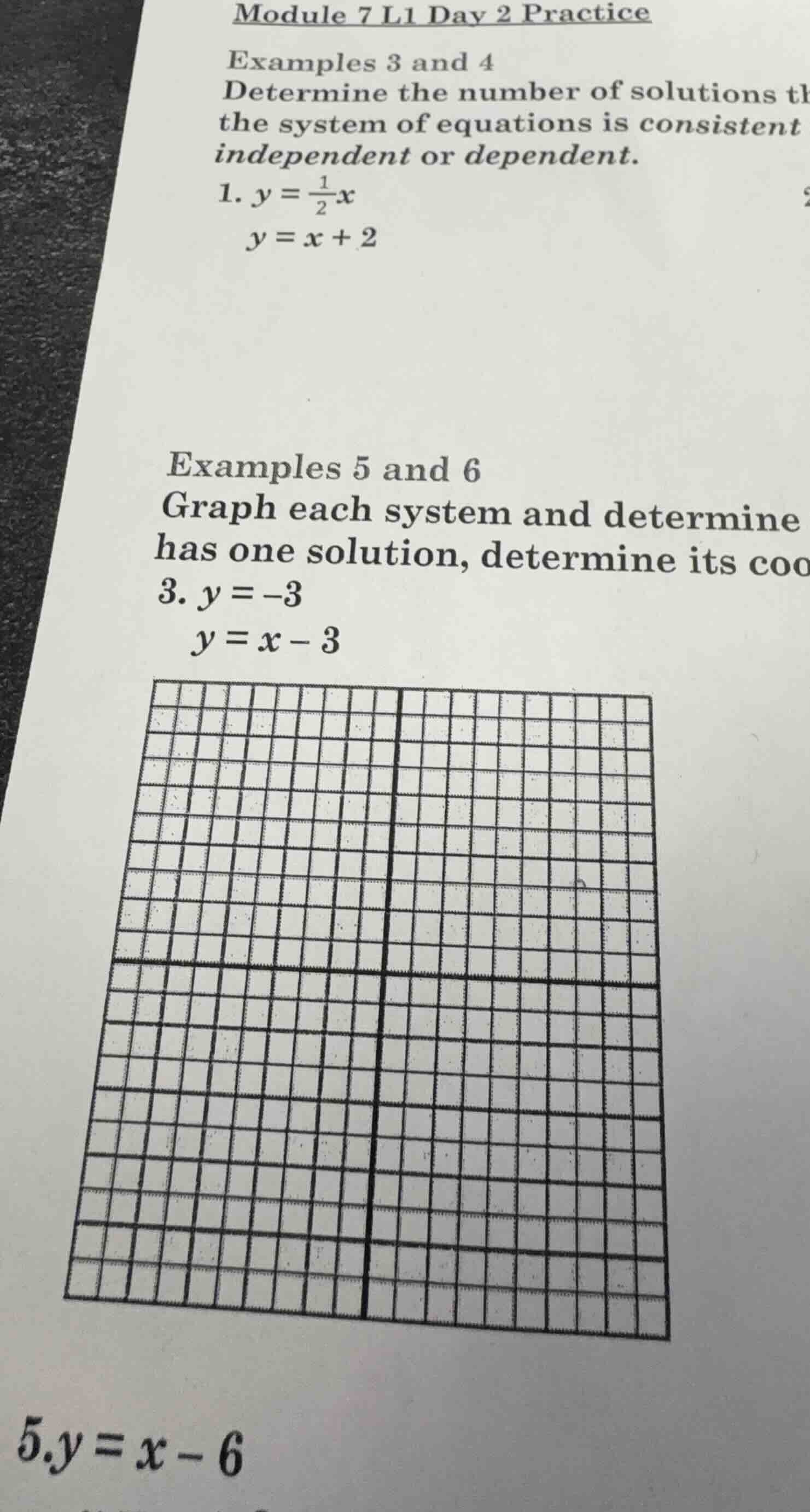
module 7 l1 day 2 practice
examples 3 and 4
determine the number of solutions th
the system of equations is consistent
independent or dependent.
- $y = \frac{1}{2}x$
$y = x + 2$
examples 5 and 6
graph each system and determine
has one solution, determine its coo
- $y = -3$
$y = x - 3$
- $y = x - 6$
Problem 1: System \( y = \frac{1}{2}x \) and \( y = x + 2 \)
Step 1: Set equations equal
To find solutions, set \( \frac{1}{2}x = x + 2 \).
Step 2: Solve for \( x \)
Subtract \( \frac{1}{2}x \) from both sides: \( 0 = \frac{1}{2}x + 2 \).
Subtract 2: \( -2 = \frac{1}{2}x \).
Multiply by 2: \( x = -4 \).
Substitute \( x = -4 \) into \( y = \frac{1}{2}x \): \( y = \frac{1}{2}(-4) = -2 \).
One solution, so system is consistent and independent.
Problem 3: System \( y = -3 \) and \( y = x - 3 \)
Step 1: Set equations equal
Set \( -3 = x - 3 \).
Step 2: Solve for \( x \)
Add 3 to both sides: \( 0 = x \), so \( x = 0 \).
Solution is \( (0, -3) \). One solution, consistent and independent.
Problem 5: (Assuming paired equation is missing, but for \( y = x - 6 \) with another line, e.g., if paired with \( y = x + c \), parallel lines have no solution; same line has infinite. If paired with non - parallel, one solution. But since only \( y = x - 6 \) is shown, likely a system with another line. If we assume a common system like \( y = x - 6 \) and \( y = -x + 2 \) (common problem), but based on given, if we take the system for problem 3 style, but since only \( y = x - 6 \) is partially shown, let's assume a typical system. However, for the given problem 3, we solved it. For problem 1:

Snap & solve any problem in the app
Get step-by-step solutions on Sovi AI
Photo-based solutions with guided steps
Explore more problems and detailed explanations
(Problem 1):
Number of solutions: 1. System is consistent and independent.