QUESTION IMAGE
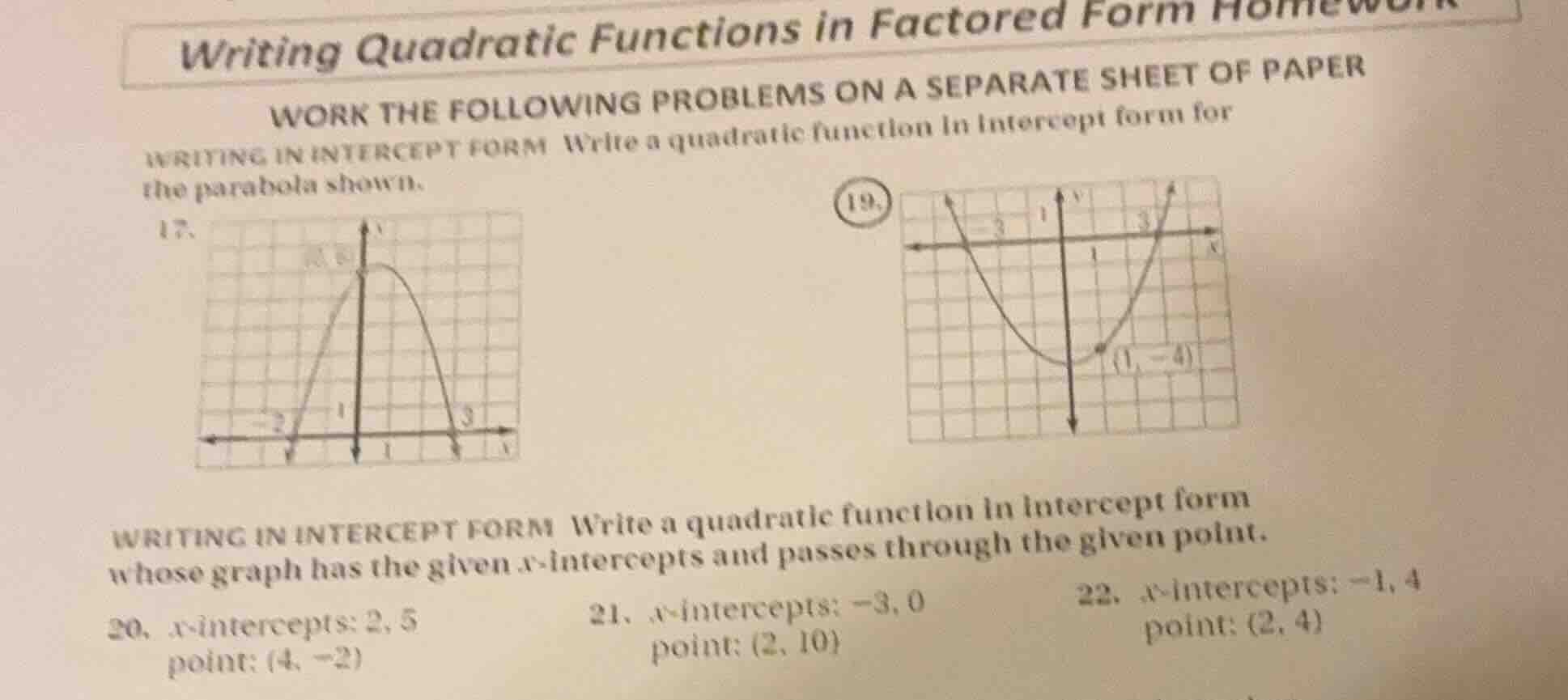
Question
writing quadratic functions in factored form homework
work the following problems on a separate sheet of paper
writing in intercept form write a quadratic function in intercept form for
the parabola shown.
17.
19.
writing in intercept form write a quadratic function in intercept form
whose graph has the given x-intercepts and passes through the given point.
- x-intercepts: 2, 5
point: (4, -2)
- x-intercepts: -3, 0
point: (2, 10)
- x-intercepts: -1, 4
point: (2, 4)
Let's solve problem 19 (writing the quadratic function in intercept form for the given parabola).
Step 1: Recall the intercept form of a quadratic function
The intercept form of a quadratic function is \( y = a(x - p)(x - q) \), where \( p \) and \( q \) are the x-intercepts (roots) of the parabola.
Step 2: Identify the x-intercepts from the graph
From the graph of problem 19, the parabola intersects the x-axis at \( x = -3 \) and \( x = 3 \). So, \( p = -3 \) and \( q = 3 \).
Step 3: Substitute the x-intercepts into the intercept form
Substituting \( p = -3 \) and \( q = 3 \) into the intercept form, we get:
\( y = a(x - (-3))(x - 3) = a(x + 3)(x - 3) \)
Step 4: Find the value of \( a \) using the given point
We know that the parabola passes through the point \( (1, -4) \). Substitute \( x = 1 \) and \( y = -4 \) into the equation:
\( -4 = a(1 + 3)(1 - 3) \)
Simplify the right-hand side:
\( -4 = a(4)(-2) \)
\( -4 = -8a \)
Step 5: Solve for \( a \)
Divide both sides by \( -8 \):
\( a = \frac{-4}{-8} = \frac{1}{2} \)
Step 6: Write the final quadratic function in intercept form
Substitute \( a = \frac{1}{2} \), \( p = -3 \), and \( q = 3 \) back into the intercept form:
\( y = \frac{1}{2}(x + 3)(x - 3) \)
We can also expand this to standard form to check, but the intercept form is \( y = \frac{1}{2}(x + 3)(x - 3) \).
Let's also solve problem 20 (writing the quadratic function in intercept form with x-intercepts 2, 5 and passing through (4, -2)).
Step 1: Recall the intercept form
The intercept form is \( y = a(x - p)(x - q) \), where \( p = 2 \) and \( q = 5 \) (the x-intercepts).
Step 2: Substitute the x-intercepts
\( y = a(x - 2)(x - 5) \)
Step 3: Use the given point (4, -2) to find \( a \)
Substitute \( x = 4 \) and \( y = -2 \):
\( -2 = a(4 - 2)(4 - 5) \)
Simplify the right-hand side:
\( -2 = a(2)(-1) \)
\( -2 = -2a \)
Step 4: Solve for \( a \)
Divide both sides by \( -2 \):
\( a = \frac{-2}{-2} = 1 \)
Step 5: Write the final function
Substitute \( a = 1 \), \( p = 2 \), and \( q = 5 \) back into the intercept form:
\( y = (x - 2)(x - 5) \)
Let's solve problem 21 (x-intercepts: -3, 0 and passing through (2, 10)).
Step 1: Intercept form with x-intercepts -3 and 0
The intercept form is \( y = a(x - (-3))(x - 0) = a(x + 3)x \)
Step 2: Use the point (2, 10) to find \( a \)
Substitute \( x = 2 \) and \( y = 10 \):
\( 10 = a(2 + 3)(2) \)
Simplify the right-hand side:
\( 10 = a(5)(2) \)
\( 10 = 10a \)
Step 3: Solve for \( a \)
Divide both sides by 10:
\( a = 1 \)
Step 4: Write the final function
Substitute \( a = 1 \) back into the intercept form:
\( y = x(x + 3) \) or \( y = x^2 + 3x \) (expanded form), but the intercept form is \( y = x(x + 3) \)
Let's solve problem 22 (x-intercepts: -1, 4 and passing through (2, 4)).
Step 1: Intercept form with x-intercepts -1 and 4
The intercept form is \( y = a(x - (-1))(x - 4) = a(x + 1)(x - 4) \)
Step 2: Use the point (2, 4) to find \( a \)
Substitute \( x = 2 \) and \( y = 4 \):
\( 4 = a(2 + 1)(2 - 4) \)
Simplify the right-hand side:
\( 4 = a(3)(-2) \)
\( 4 = -6a \)
Step 3: Solve for \( a \)
Divide both sides by \( -6 \):
\( a = \frac{4}{-6} = -\frac{2}{3} \)
Step 4: Write the final function
Substitute \( a = -\frac{2}{3} \) back into the intercept form:
\( y = -\frac{2}{3}(x + 1)(x - 4) \)
Final Answers:
- \( \boldsymbol{y = \frac{1}{2}(x + 3)(x - 3)} \)
- \( \boldsymbol{y = (x - 2)(x - 5)} \)
- \( \boldsymbol{y = x(x + 3)} \)
- \( \boldsymbol{y = -\frac{2}{3}(x + 1)(x - 4)} \)

Snap & solve any problem in the app
Get step-by-step solutions on Sovi AI
Photo-based solutions with guided steps
Explore more problems and detailed explanations
Let's solve problem 19 (writing the quadratic function in intercept form for the given parabola).
Step 1: Recall the intercept form of a quadratic function
The intercept form of a quadratic function is \( y = a(x - p)(x - q) \), where \( p \) and \( q \) are the x-intercepts (roots) of the parabola.
Step 2: Identify the x-intercepts from the graph
From the graph of problem 19, the parabola intersects the x-axis at \( x = -3 \) and \( x = 3 \). So, \( p = -3 \) and \( q = 3 \).
Step 3: Substitute the x-intercepts into the intercept form
Substituting \( p = -3 \) and \( q = 3 \) into the intercept form, we get:
\( y = a(x - (-3))(x - 3) = a(x + 3)(x - 3) \)
Step 4: Find the value of \( a \) using the given point
We know that the parabola passes through the point \( (1, -4) \). Substitute \( x = 1 \) and \( y = -4 \) into the equation:
\( -4 = a(1 + 3)(1 - 3) \)
Simplify the right-hand side:
\( -4 = a(4)(-2) \)
\( -4 = -8a \)
Step 5: Solve for \( a \)
Divide both sides by \( -8 \):
\( a = \frac{-4}{-8} = \frac{1}{2} \)
Step 6: Write the final quadratic function in intercept form
Substitute \( a = \frac{1}{2} \), \( p = -3 \), and \( q = 3 \) back into the intercept form:
\( y = \frac{1}{2}(x + 3)(x - 3) \)
We can also expand this to standard form to check, but the intercept form is \( y = \frac{1}{2}(x + 3)(x - 3) \).
Let's also solve problem 20 (writing the quadratic function in intercept form with x-intercepts 2, 5 and passing through (4, -2)).
Step 1: Recall the intercept form
The intercept form is \( y = a(x - p)(x - q) \), where \( p = 2 \) and \( q = 5 \) (the x-intercepts).
Step 2: Substitute the x-intercepts
\( y = a(x - 2)(x - 5) \)
Step 3: Use the given point (4, -2) to find \( a \)
Substitute \( x = 4 \) and \( y = -2 \):
\( -2 = a(4 - 2)(4 - 5) \)
Simplify the right-hand side:
\( -2 = a(2)(-1) \)
\( -2 = -2a \)
Step 4: Solve for \( a \)
Divide both sides by \( -2 \):
\( a = \frac{-2}{-2} = 1 \)
Step 5: Write the final function
Substitute \( a = 1 \), \( p = 2 \), and \( q = 5 \) back into the intercept form:
\( y = (x - 2)(x - 5) \)
Let's solve problem 21 (x-intercepts: -3, 0 and passing through (2, 10)).
Step 1: Intercept form with x-intercepts -3 and 0
The intercept form is \( y = a(x - (-3))(x - 0) = a(x + 3)x \)
Step 2: Use the point (2, 10) to find \( a \)
Substitute \( x = 2 \) and \( y = 10 \):
\( 10 = a(2 + 3)(2) \)
Simplify the right-hand side:
\( 10 = a(5)(2) \)
\( 10 = 10a \)
Step 3: Solve for \( a \)
Divide both sides by 10:
\( a = 1 \)
Step 4: Write the final function
Substitute \( a = 1 \) back into the intercept form:
\( y = x(x + 3) \) or \( y = x^2 + 3x \) (expanded form), but the intercept form is \( y = x(x + 3) \)
Let's solve problem 22 (x-intercepts: -1, 4 and passing through (2, 4)).
Step 1: Intercept form with x-intercepts -1 and 4
The intercept form is \( y = a(x - (-1))(x - 4) = a(x + 1)(x - 4) \)
Step 2: Use the point (2, 4) to find \( a \)
Substitute \( x = 2 \) and \( y = 4 \):
\( 4 = a(2 + 1)(2 - 4) \)
Simplify the right-hand side:
\( 4 = a(3)(-2) \)
\( 4 = -6a \)
Step 3: Solve for \( a \)
Divide both sides by \( -6 \):
\( a = \frac{4}{-6} = -\frac{2}{3} \)
Step 4: Write the final function
Substitute \( a = -\frac{2}{3} \) back into the intercept form:
\( y = -\frac{2}{3}(x + 1)(x - 4) \)
Final Answers:
- \( \boldsymbol{y = \frac{1}{2}(x + 3)(x - 3)} \)
- \( \boldsymbol{y = (x - 2)(x - 5)} \)
- \( \boldsymbol{y = x(x + 3)} \)
- \( \boldsymbol{y = -\frac{2}{3}(x + 1)(x - 4)} \)