QUESTION IMAGE
Question
exponential decay functions
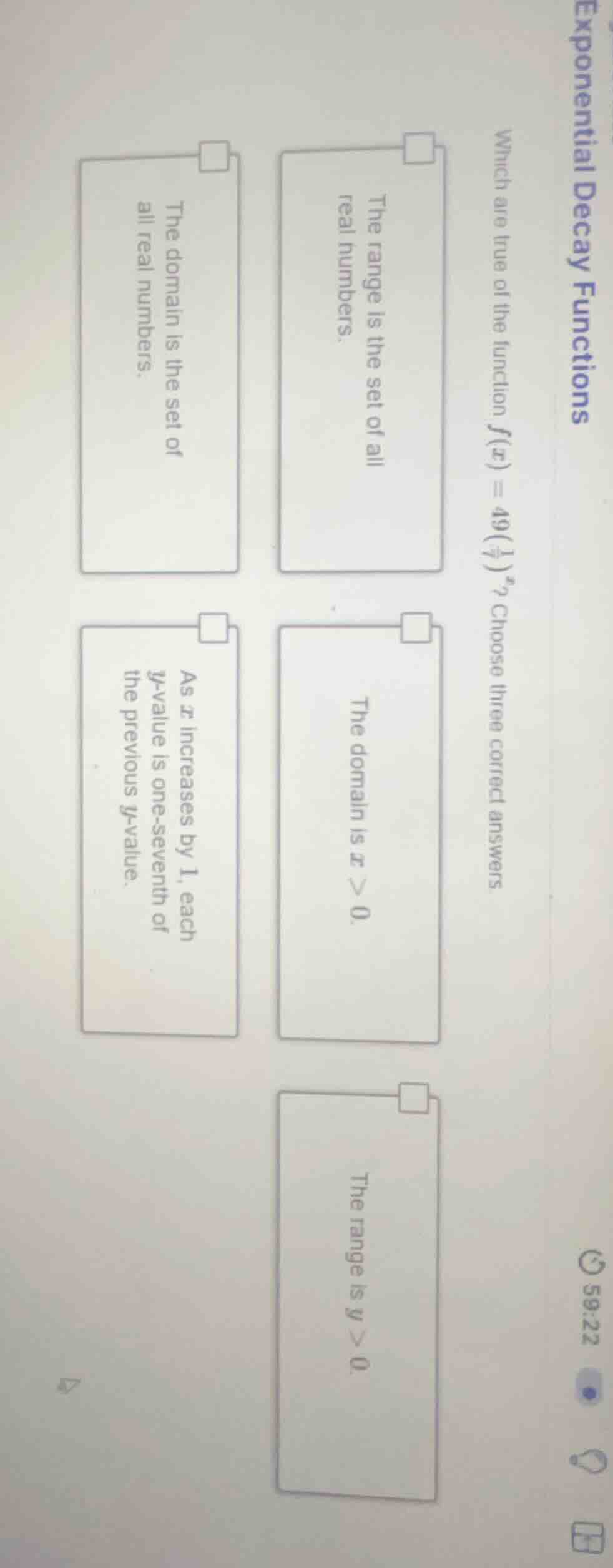
which are true of the function $f(x) = 49(\frac{1}{7})^x$? choose three correct answers.
the range is the set of all real numbers.
the domain is $x > 0$.
the range is $y > 0$.
the domain is the set of all real numbers.
as $x$ increases by 1, each $y$-value is one - seventh of the previous $y$-value.
- Domain of Exponential Function: For any exponential function of the form \( f(x)=a(b)^x \), where \( a
eq0 \) and \( b>0, b
eq1 \), the domain is all real numbers because we can raise \( b \) to any real - valued power. In the function \( f(x) = 49(\frac{1}{7})^x \), \( a = 49\) and \( b=\frac{1}{7}\) (which satisfies \( b>0,b
eq1 \)), so the domain is all real numbers. So the statement "The domain is the set of all real numbers" is true. The statement "The domain is \( x > 0\)" is false.
- Range of Exponential Function: For an exponential function \( f(x)=a(b)^x \) with \( a>0 \) and \( 0 < b<1 \) (exponential decay), as \( x\to-\infty \), \( (b)^x\to\infty \), so \( f(x)=a(b)^x\to\infty \); as \( x\to\infty \), \( (b)^x\to0 \), so \( f(x)=a(b)^x\to0 \). So the range is \( y>0 \), not all real numbers. So the statement "The range is the set of all real numbers" is false and "The range is \( y > 0\)" is true.
- Behavior of Exponential Decay Function: For the function \( f(x)=49(\frac{1}{7})^x \), when \( x \) increases by 1, we have \( f(x + 1)=49(\frac{1}{7})^{x + 1}=49(\frac{1}{7})^x\times\frac{1}{7}=f(x)\times\frac{1}{7} \). So as \( x \) increases by 1, each \( y \) - value is one - seventh of the previous \( y \) - value. This statement is true.

Snap & solve any problem in the app
Get step-by-step solutions on Sovi AI
Photo-based solutions with guided steps
Explore more problems and detailed explanations
- The domain is the set of all real numbers.
- As \( x \) increases by 1, each \( y \)-value is one - seventh of the previous \( y \)-value.
- The range is \( y>0 \).