QUESTION IMAGE
Question
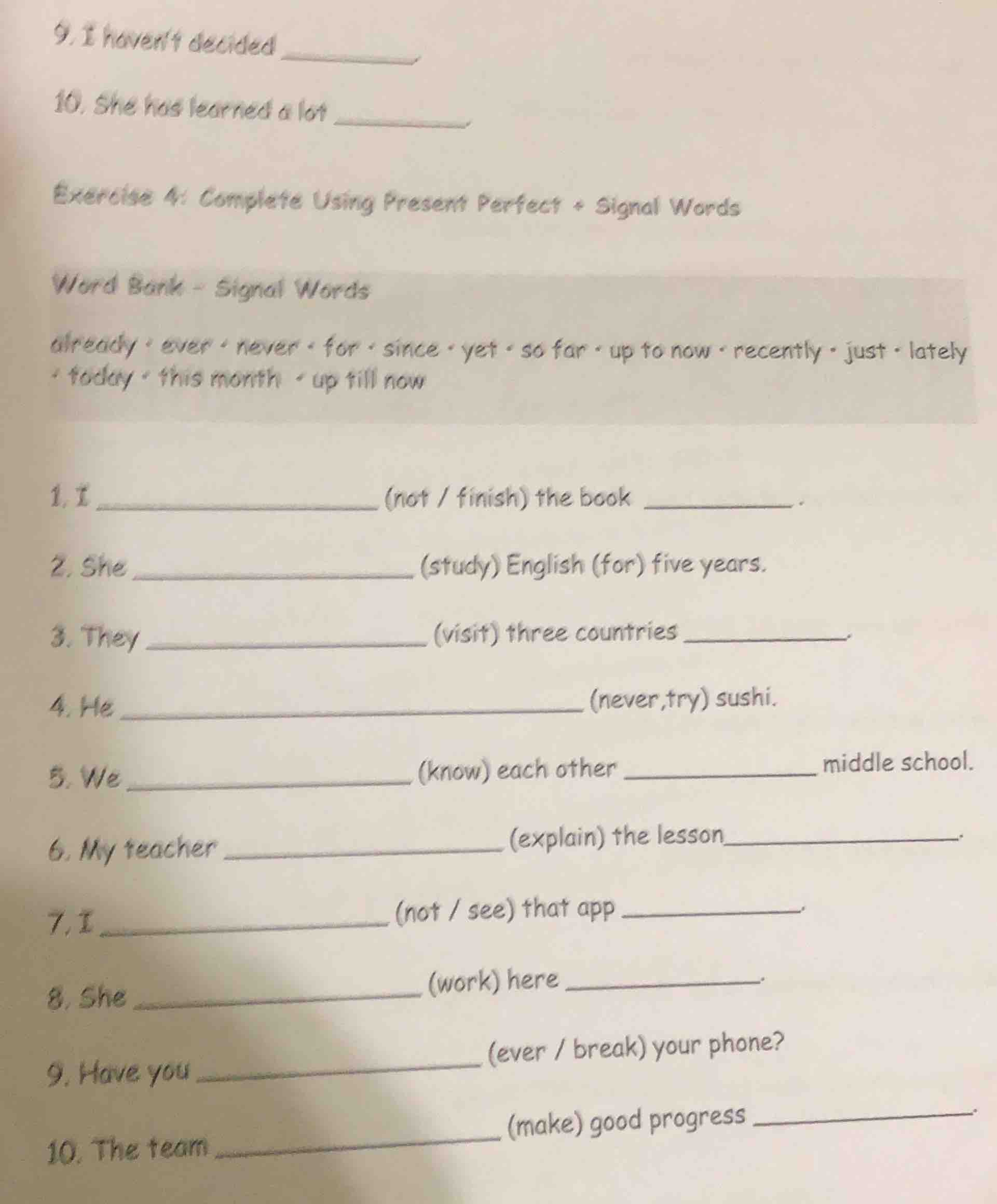
- i havent decided ____. 10. she has learned a lot __. exercise 4: complete using present perfect + signal words word bank - signal words already · ever · never · for · since · yet · so far · up to now · recently · just · lately · today · this month · up till now 1. i ________________ (not / finish) the book ________. 2. she ________________ (study) english (for) five years. 3. they ________________ (visit) three countries ________. 4. he ____________________________ (never,try) sushi. 5. we ________________ (know) each other ____________ middle school. 6. my teacher ________________ (explain) the lesson____________. 7. i ________________ (not / see) that app ________. 8. she ________________ (work) here ________. 9. have you ________________ (ever / break) your phone? 10. the team ________________ (make) good progress __________.
Question 1
Step1: Determine the tense and negative form
The sentence is in present perfect tense, and it's negative. The structure for present perfect negative is "haven't/hasn't + past participle". For the subject "I", we use "haven't", and the past participle of "finish" is "finished".
Step2: Choose the signal word
The signal word "yet" is used in negative sentences or questions to mean "up to now". So we choose "yet".
Step1: Determine the tense
The sentence is in present perfect tense. The structure is "has/have + past participle". For the subject "She" (third - person singular), we use "has", and the past participle of "study" is "studied".
Step2: Use the given signal word
The given signal word is "for", which is used to indicate a period of time.
Step1: Determine the tense
The sentence is in present perfect tense. The structure is "have + past participle" (for the subject "They", a plural subject). The past participle of "visit" is "visited".
Step2: Choose the signal word
We can choose a signal word like "so far" which is used with present perfect to mean "up to this point in time".

Snap & solve any problem in the app
Get step-by-step solutions on Sovi AI
Photo-based solutions with guided steps
Explore more problems and detailed explanations
I haven't finished the book yet.