QUESTION IMAGE
Question
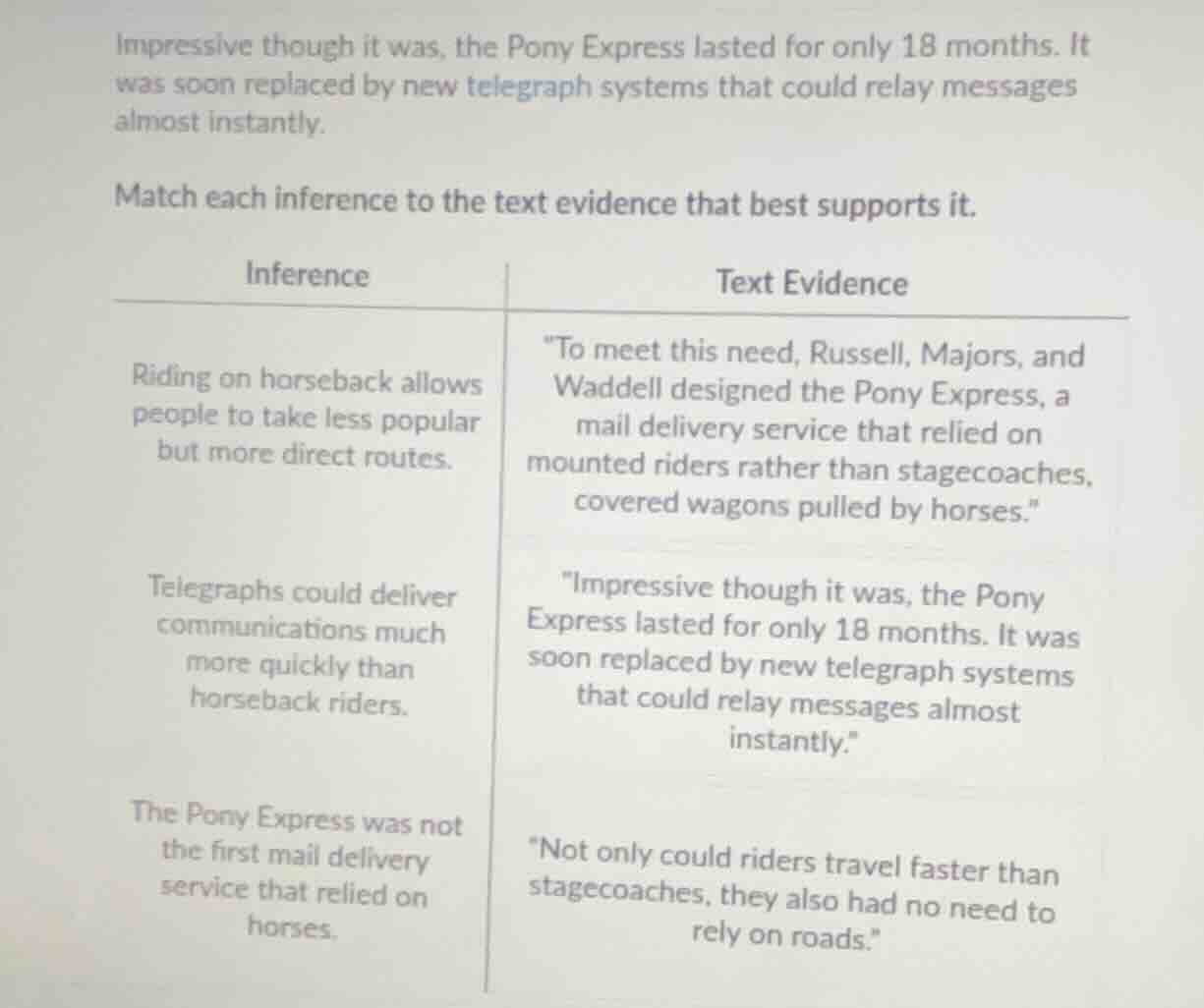
impressive though it was, the pony express lasted for only 18 months. it was soon replaced by new telegraph systems that could relay messages almost instantly.
match each inference to the text evidence that best supports it.
| inference | text evidence |
|---|---|
| telegraphs could deliver communications much more quickly than horseback riders. | \impressive though it was, the pony express lasted for only 18 months. it was soon replaced by new telegraph systems that could relay messages almost instantly.\ |
| the pony express was not the first mail delivery service that relied on horses. |
ot only could riders travel faster than stagecoaches, they also had no need to rely on roads.\ |
Brief Explanations
- For the inference about horseback using direct routes, the text evidence notes riders didn't need roads, enabling non-popular direct paths.
- The telegraph speed inference is supported by the text stating telegraphs relayed messages almost instantly and replaced the 18-month-long Pony Express.
- The Pony Express not being the first horse-reliant mail service is supported by the text mentioning it replaced stagecoaches/horse-drawn covered wagons, which were earlier horse-based mail options.

Snap & solve any problem in the app
Get step-by-step solutions on Sovi AI
Photo-based solutions with guided steps
Explore more problems and detailed explanations
- Riding on horseback allows people to take less popular but more direct routes. → "Not only could riders travel faster than stagecoaches, they also had no need to rely on roads."
- Telegraphs could deliver communications much more quickly than horseback riders. → "Impressive though it was, the Pony Express lasted for only 18 months. It was soon replaced by new telegraph systems that could relay messages almost instantly."
- The Pony Express was not the first mail delivery service that relied on horses. → "To meet this need, Russell, Majors, and Waddell designed the Pony Express, a mail delivery service that relied on mounted riders rather than stagecoaches, covered wagons pulled by horses."