QUESTION IMAGE
Question
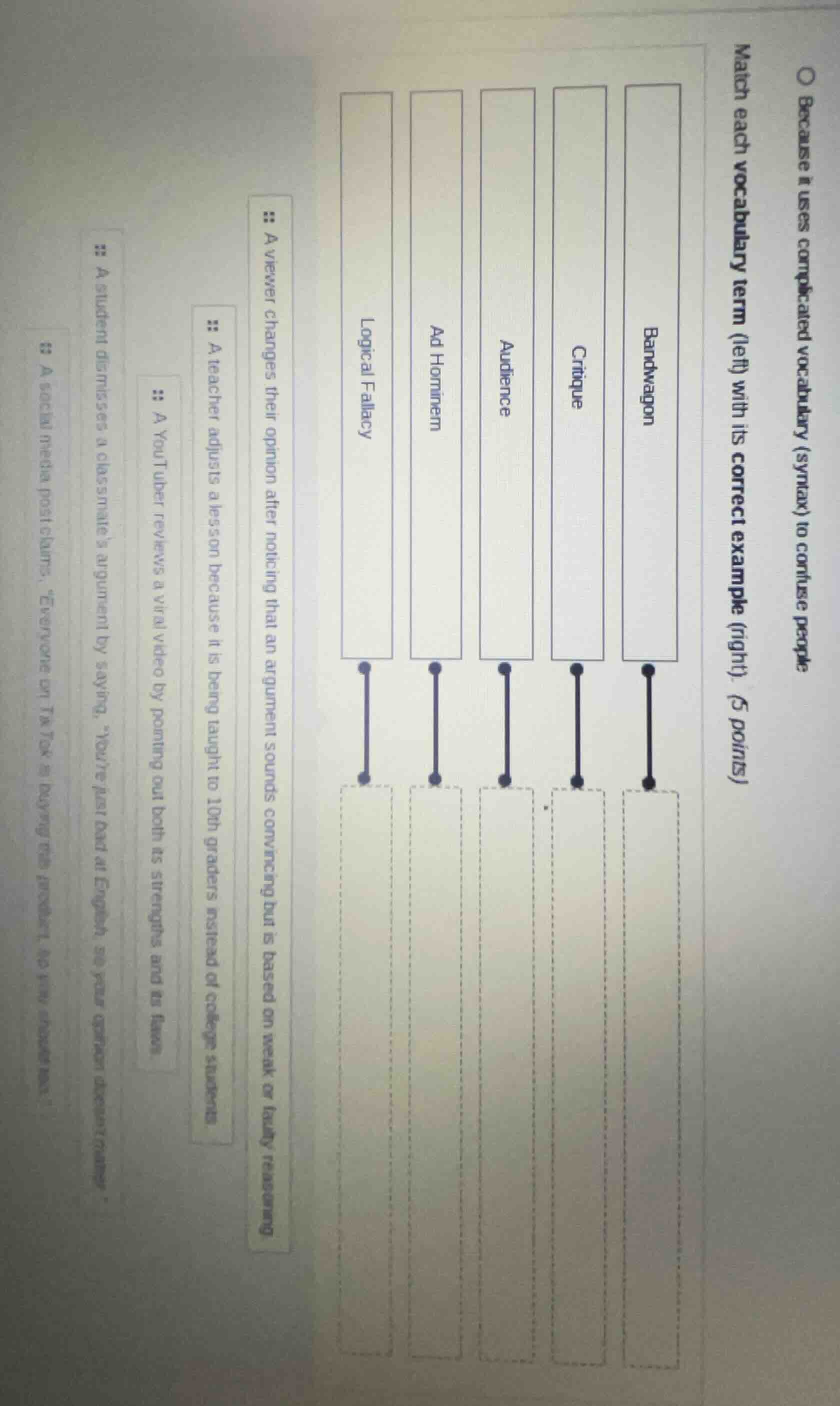
match each vocabulary term (left) with its correct example (right). (5 points)
vocabulary terms: bandwagon, critique, audience, ad hominem, logical fallacy
examples:
- a viewer changes their opinion after noticing that an argument sounds convincing but is based on weak or faulty reasoning.
- a teacher adjusts a lesson because it is being taught to 10th graders instead of college students.
- a youtuber reviews a viral video by pointing out both its strengths and its flaws.
- a student dismisses a classmate’s argument by saying, “you’re just bad at english so your opinion doesn’t matter.”
- a social media post claims, “everyone on tiktok is buying this product, so you should too.”
Response
To solve this matching problem, we analyze each vocabulary term and example:
1. Bandwagon
- Definition: Following a trend or doing something because others are.
- Example: "A social media post claims, 'Everyone on TikTok is buying this product, so why shouldn’t you?'" (encourages joining a trend).
2. Critique
- Definition: Evaluating by pointing out strengths/weaknesses.
- Example: "A YouTuber reviews a viral video by pointing out both its strengths and its flaws."
3. Audience
- Definition: The group a message is aimed at.
- Example: "A teacher adjusts a lesson because it is being taught to 10th graders instead of college students." (adjusting for the audience).
4. Ad Hominem
- Definition: Attacking a person’s character instead of their argument.
- Example: "A student dismisses a classmate’s argument by saying, 'You’re just bad at English so your opinion doesn’t matter.'" (attacks the student, not the argument).
5. Logical Fallacy
- Definition: A flaw in reasoning (weak/illogical argument).
- Example: "A viewer changes their opinion after noticing that an argument sounds convincing but is based on weak or faulty reasoning." (identifies a logical fallacy).
Final Matches:
- Bandwagon → A social media post claims, "Everyone on TikTok is buying this product, so why shouldn’t you?"
- Critique → A YouTuber reviews a viral video by pointing out both its strengths and its flaws.
- Audience → A teacher adjusts a lesson because it is being taught to 10th graders instead of college students.
- Ad Hominem → A student dismisses a classmate’s argument by saying, "You’re just bad at English so your opinion doesn’t matter."
- Logical Fallacy → A viewer changes their opinion after noticing that an argument sounds convincing but is based on weak or faulty reasoning.

Snap & solve any problem in the app
Get step-by-step solutions on Sovi AI
Photo-based solutions with guided steps
Explore more problems and detailed explanations
To solve this matching problem, we analyze each vocabulary term and example:
1. Bandwagon
- Definition: Following a trend or doing something because others are.
- Example: "A social media post claims, 'Everyone on TikTok is buying this product, so why shouldn’t you?'" (encourages joining a trend).
2. Critique
- Definition: Evaluating by pointing out strengths/weaknesses.
- Example: "A YouTuber reviews a viral video by pointing out both its strengths and its flaws."
3. Audience
- Definition: The group a message is aimed at.
- Example: "A teacher adjusts a lesson because it is being taught to 10th graders instead of college students." (adjusting for the audience).
4. Ad Hominem
- Definition: Attacking a person’s character instead of their argument.
- Example: "A student dismisses a classmate’s argument by saying, 'You’re just bad at English so your opinion doesn’t matter.'" (attacks the student, not the argument).
5. Logical Fallacy
- Definition: A flaw in reasoning (weak/illogical argument).
- Example: "A viewer changes their opinion after noticing that an argument sounds convincing but is based on weak or faulty reasoning." (identifies a logical fallacy).
Final Matches:
- Bandwagon → A social media post claims, "Everyone on TikTok is buying this product, so why shouldn’t you?"
- Critique → A YouTuber reviews a viral video by pointing out both its strengths and its flaws.
- Audience → A teacher adjusts a lesson because it is being taught to 10th graders instead of college students.
- Ad Hominem → A student dismisses a classmate’s argument by saying, "You’re just bad at English so your opinion doesn’t matter."
- Logical Fallacy → A viewer changes their opinion after noticing that an argument sounds convincing but is based on weak or faulty reasoning.