QUESTION IMAGE
Question
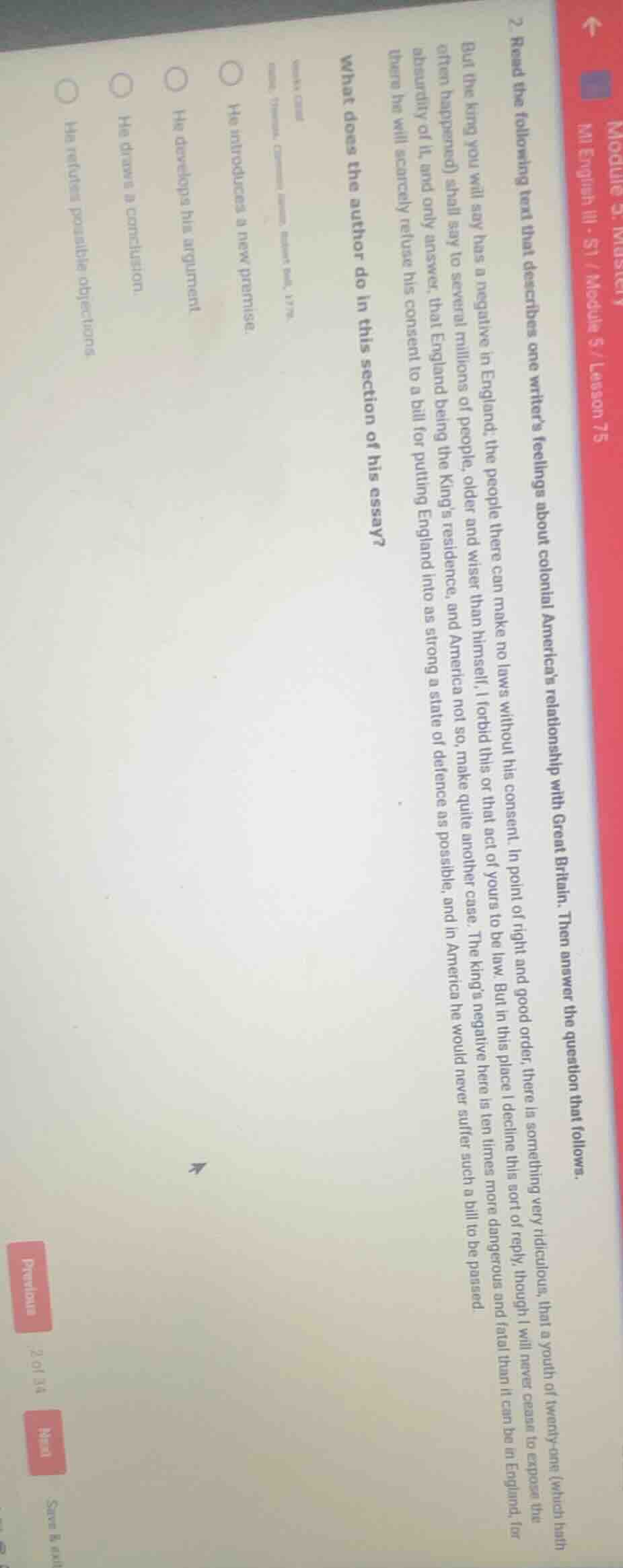
- read the following text that describes one writers feelings about colonial americas relationship with great britain. then answer the question that follows. but the king you will say has a negative in england; the people there can make no laws without his consent. in point of right and good order, there is something very ridiculous, that a youth of twenty - one (which has often happened) shall say to several millions of people, older and wiser than himself, i forbid this or that act of yours to be law. but in this place i decline this sort of reply, though i will never cease to expose the absurdity of it, and only answer, that england being the kings residence, and america not so, make quite another case. the king he will scarcely refuse his consent to a bill for putting england into as strong a state of defence as possible, and in america he would never suffer such a bill to be passed. what does the author do in this section of his essay? a. he introduces a new premise. b. he develops his argument. c. he draws a conclusion. d. he refutes possible objections.
The author is discussing the king's negative stance in England and contrasting it with the situation in America, and then presents a counter - argument or develops his own argument about the absurdity of the king's actions and the difference in how such a bill would be received in England versus America. Among the options, "He develops his argument" fits as he is elaborating on the implications of the king's negative and the differences between England and America's situations to support his point about colonial America's relationship with Great Britain. "He introduces a new premise" is incorrect as he is not introducing a new basic assumption but building on the existing situation. "He draws a conclusion" is incorrect as he is in the middle of making his case, not concluding. "He refutes possible objections" is incorrect as there's no indication of refuting objections here.

Snap & solve any problem in the app
Get step-by-step solutions on Sovi AI
Photo-based solutions with guided steps
Explore more problems and detailed explanations
He develops his argument