QUESTION IMAGE
Question
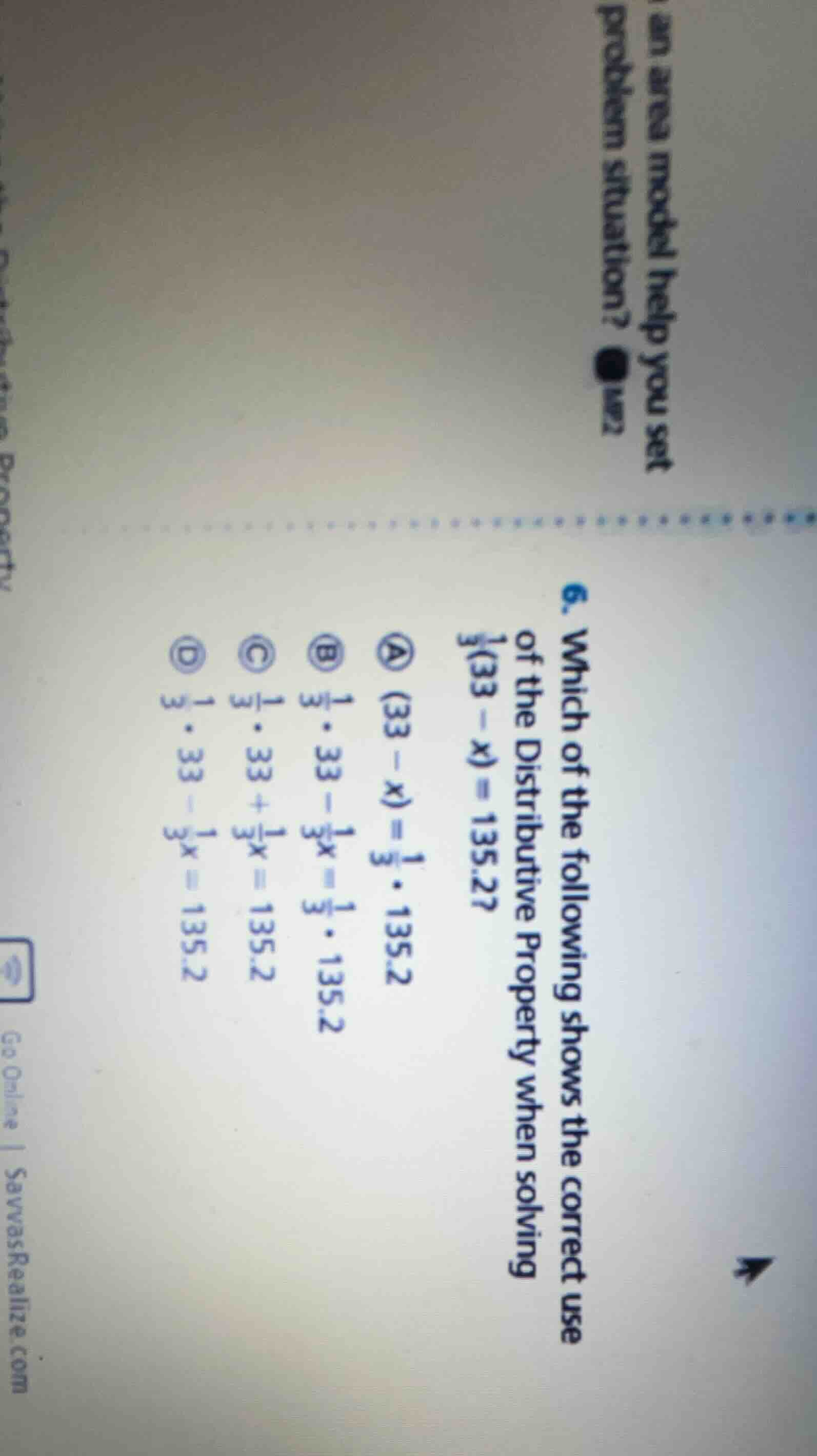
- which of the following shows the correct use of the distributive property when solving \\(\frac{1}{3}(333 - x) = 135.2\\)?
a \\((33 - x) = \frac{1}{3} \cdot 135.2\\)
b \\(\frac{1}{3} \cdot 33 - \frac{1}{3}x = \frac{1}{3} \cdot 135.2\\)
c \\(\frac{1}{3} \cdot 33 + \frac{1}{3}x = 135.2\\)
d \\(\frac{1}{3} \cdot 33 - \frac{1}{3}x = 135.2\\)
The distributive property states that \( a(b - c)=ab - ac \). For the equation \( \frac{1}{3}(33 - x)=135.2 \), applying the distributive property means distributing \( \frac{1}{3} \) to both \( 33 \) and \( -x \).
Step1: Recall Distributive Property
The distributive property is \( a(b - c)=ab - ac \). Here, \( a = \frac{1}{3} \), \( b = 33 \), and \( c = x \).
Step2: Apply Distributive Property
Applying the property to \( \frac{1}{3}(33 - x) \), we get \( \frac{1}{3}\times33-\frac{1}{3}x \). So the equation becomes \( \frac{1}{3}\cdot33-\frac{1}{3}x = 135.2 \), which matches option D.

Snap & solve any problem in the app
Get step-by-step solutions on Sovi AI
Photo-based solutions with guided steps
Explore more problems and detailed explanations
D. \( \frac{1}{3}\cdot33-\frac{1}{3}x = 135.2 \)