QUESTION IMAGE
Question
#11
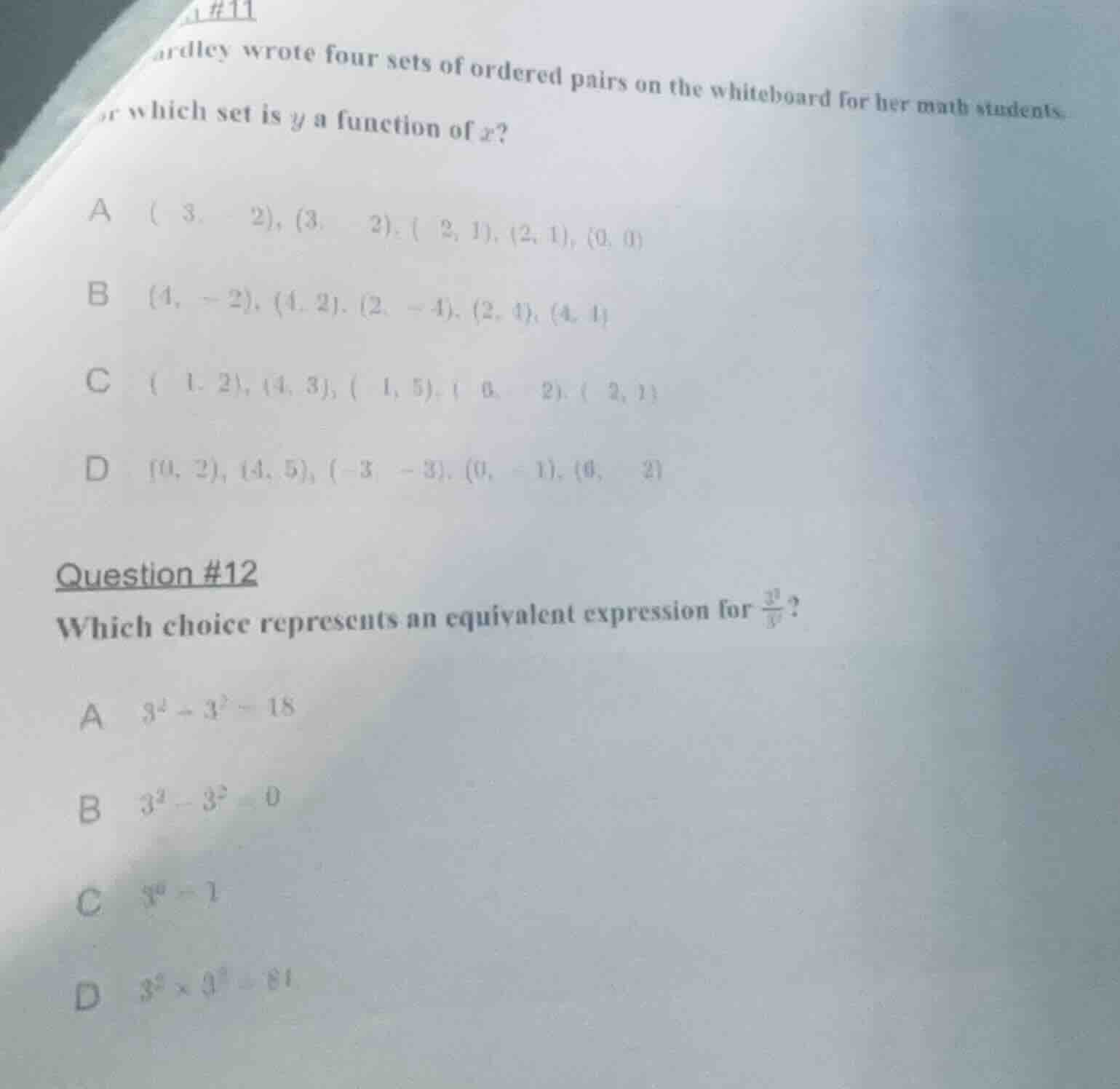
ardley wrote four sets of ordered pairs on the whiteboard for her math students.
for which set is y a function of x?
a (-3, -2), (3, -2), (-2, 1), (2, 1), (0, 0)
b (4, -2), (4, 2), (2, -4), (2, 4), (4, 1)
c (-1, 2), (4, 3), (-1, 5), (-0, -2), (-2, 1)
d (0, 2), (4, 5), (-3, -3), (0, -1), (6, -2)
question #12
which choice represents an equivalent expression for \\(\frac{3^4}{3^4}\\)?
a \\(3^2 + 3^2 = 18\\)
b \\(3^2 - 3^2 = 0\\)
c \\(3^0 = 1\\)
d \\(3^2 \times 3^2 = 81\\)
Question #11
To determine if \( y \) is a function of \( x \), we use the definition of a function: each input \( x \) must have exactly one output \( y \). We check each set of ordered pairs:
Step1: Analyze Set A
The ordered pairs in Set A are \((-3, -2)\), \((3, -2)\), \((-2, 1)\), \((2, 1)\), \((0, 0)\).
Each \( x \)-value (\(-3\), \(3\), \(-2\), \(2\), \(0\)) appears only once, so each \( x \) has exactly one \( y \).
Step2: Analyze Set B
The ordered pairs in Set B are \((4, -2)\), \((4, 2)\), \((2, -4)\), \((2, 4)\), \((4, 1)\).
The \( x \)-value \( 4 \) appears with \( y = -2 \), \( y = 2 \), and \( y = 1 \); \( x = 2 \) appears with \( y = -4 \) and \( y = 4 \). So \( x \) values repeat with different \( y \)-values.
Step3: Analyze Set C
The ordered pairs in Set C are \((-1, 2)\), \((4, 3)\), \((-1, 5)\), \((-6, -2)\), \((-2, 1)\).
The \( x \)-value \( -1 \) appears with \( y = 2 \) and \( y = 5 \), so \( x = -1 \) has multiple \( y \)-values.
Step4: Analyze Set D
The ordered pairs in Set D are \((0, 2)\), \((4, 5)\), \((-3, -3)\), \((0, -1)\), \((6, -2)\).
The \( x \)-value \( 0 \) appears with \( y = 2 \) and \( y = -1 \), so \( x = 0 \) has multiple \( y \)-values.
We use the exponent rule for division: \( \frac{a^m}{a^n} = a^{m - n} \). For \( \frac{3^4}{3^4} \):
Step1: Apply the Exponent Rule
\( \frac{3^4}{3^4} = 3^{4 - 4} = 3^0 \).
Step2: Simplify \( 3^0 \)
By the definition of exponents, \( a^0 = 1 \) (for \( a
eq 0 \)), so \( 3^0 = 1 \).
Now we check the options:
- Option A: \( 3^2 + 3^2 = 9 + 9 = 18 \) (not 1).
- Option B: \( 3^2 - 3^2 = 9 - 9 = 0 \) (not 1).
- Option C: \( 3^0 = 1 \) (matches).
- Option D: \( 3^2 \times 3^2 = 9 \times 9 = 81 \) (not 1).

Snap & solve any problem in the app
Get step-by-step solutions on Sovi AI
Photo-based solutions with guided steps
Explore more problems and detailed explanations
A. \((-3, -2)\), \((3, -2)\), \((-2, 1)\), \((2, 1)\), \((0, 0)\)