QUESTION IMAGE
Question
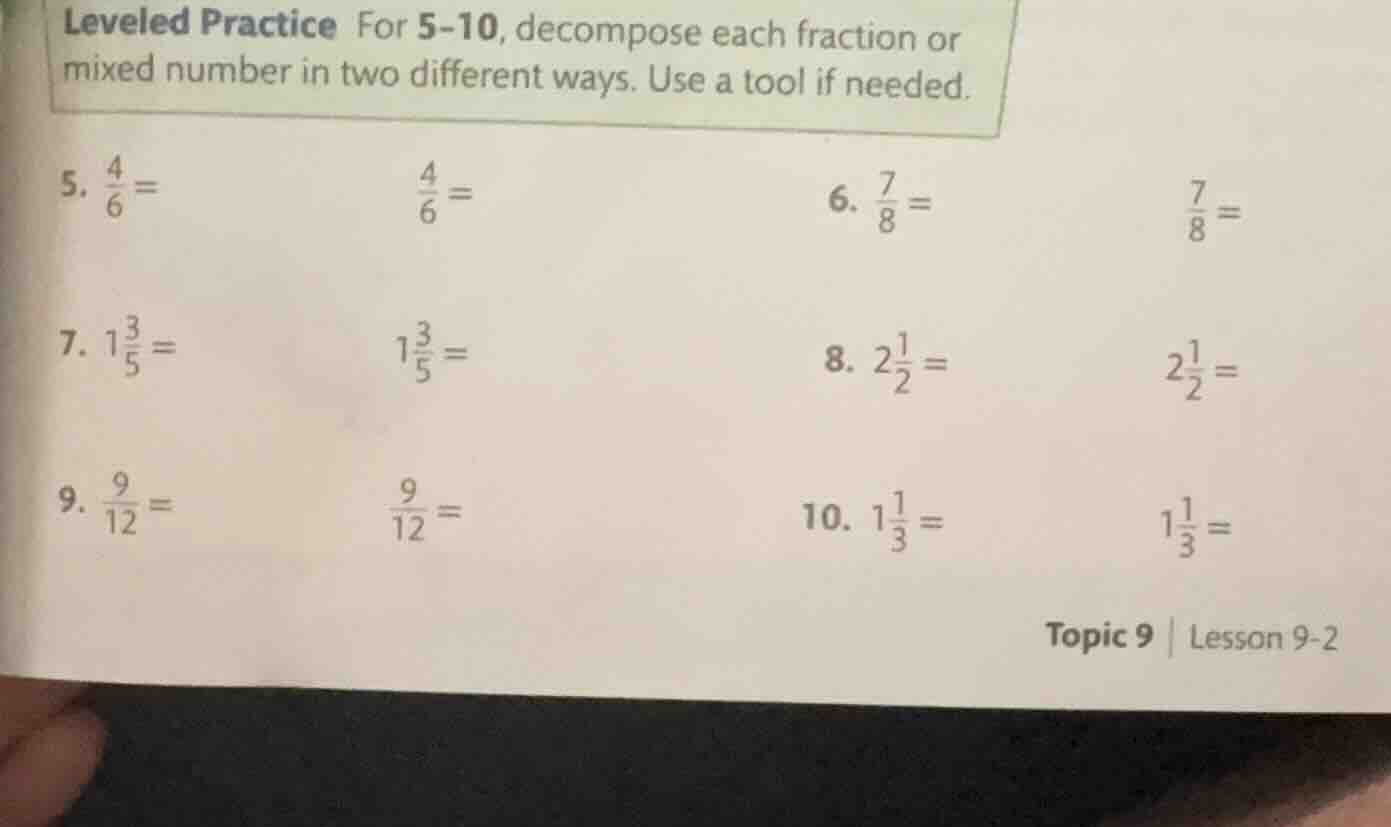
leveled practice for 5-10, decompose each fraction or mixed number in two different ways. use a tool if needed.
- $\frac{4}{6}=$ $\frac{4}{6}=$ 6. $\frac{7}{8}=$ $\frac{7}{8}=$
- $1\frac{3}{5}=$ $1\frac{3}{5}=$ 8. $2\frac{1}{2}=$ $2\frac{1}{2}=$
- $\frac{9}{12}=$ $\frac{9}{12}=$ 10. $1\frac{1}{3}=$ $1\frac{1}{3}=$
topic 9 | lesson 9-2
Question 5: Decompose $\boldsymbol{\frac{4}{6}}$
Step 1: Decompose into unit fractions
A unit fraction has a numerator of 1. So, we can write $\frac{4}{6}$ as the sum of 4 unit fractions with denominator 6.
$\frac{4}{6} = \frac{1}{6} + \frac{1}{6} + \frac{1}{6} + \frac{1}{6}$
Step 2: Decompose into two fractions
We can split the numerator 4 into two parts, say 1 and 3. Then,
$\frac{4}{6} = \frac{1}{6} + \frac{3}{6}$ (and $\frac{3}{6}$ can be simplified to $\frac{1}{2}$, but we can leave it as $\frac{3}{6}$ for decomposition)
Step 1: Decompose into unit fractions
Using unit fractions (numerator 1), we sum 7 unit fractions with denominator 8.
$\frac{7}{8} = \frac{1}{8} + \frac{1}{8} + \frac{1}{8} + \frac{1}{8} + \frac{1}{8} + \frac{1}{8} + \frac{1}{8}$
Step 2: Decompose into two fractions
Split the numerator 7 into, for example, 3 and 4. Then,
$\frac{7}{8} = \frac{3}{8} + \frac{4}{8}$
Step 1: Decompose into a whole number and a fraction
A mixed number $1\frac{3}{5}$ can be written as the sum of the whole number part and the fractional part: $1 + \frac{3}{5}$
Step 2: Decompose the fractional part further (or decompose into improper fraction and then split)
First, convert the mixed number to an improper fraction: $1\frac{3}{5} = \frac{5 + 3}{5} = \frac{8}{5}$. Now, split $\frac{8}{5}$ into two fractions, e.g., $\frac{5}{5} + \frac{3}{5}$, and $\frac{5}{5} = 1$, so $1\frac{3}{5} = 1 + \frac{3}{5}$ (wait, no, another way: split $\frac{8}{5}$ into $\frac{1}{5} + \frac{7}{5}$, but maybe better to split the improper fraction into a whole number and a fraction or two fractions. Wait, alternatively, $1\frac{3}{5} = \frac{5}{5} + \frac{3}{5}$ (since $\frac{5}{5}=1$), and also, we can write $\frac{8}{5} = \frac{2}{5} + \frac{6}{5}$, but maybe simpler: $1\frac{3}{5} = 1 + \frac{1}{5} + \frac{2}{5}$ (decomposing the fractional part into two unit fractions or other fractions). Wait, let's correct:
First way: $1\frac{3}{5} = 1 + \frac{3}{5}$
Second way: Convert to improper fraction $\frac{8}{5}$, then split numerator 8 into 5 and 3: $\frac{8}{5} = \frac{5}{5} + \frac{3}{5} = 1 + \frac{3}{5}$ (no, that's same as first way). Wait, split 8 into 1 and 7: $\frac{8}{5} = \frac{1}{5} + \frac{7}{5}$, and $\frac{7}{5} = 1\frac{2}{5}$, so $1\frac{3}{5} = \frac{1}{5} + 1\frac{2}{5}$. But maybe better: $1\frac{3}{5} = \frac{5}{5} + \frac{3}{5}$ (which is $1 + \frac{3}{5}$) and $1\frac{3}{5} = \frac{1}{5} + \frac{2}{5} + \frac{5}{5}$ (but that's three parts). Wait, the problem says "two different ways". So first way: $1 + \frac{3}{5}$. Second way: Decompose the fractional part $\frac{3}{5}$ into two fractions, e.g., $\frac{1}{5} + \frac{2}{5}$, so $1\frac{3}{5} = 1 + \frac{1}{5} + \frac{2}{5}$. But maybe the problem allows decomposing into a whole number and a sum of fractions, or into two fractions (including improper). Let's do:
First way: $1\frac{3}{5} = 1 + \frac{3}{5}$
Second way: $1\frac{3}{5} = \frac{5}{5} + \frac{3}{5}$ (same as first, since $\frac{5}{5}=1$). Wait, maybe I made a mistake. Let's try again. The mixed number $1\frac{3}{5}$ can be decomposed as:
- $1 + \frac{3}{5}$
- $\frac{5}{5} + \frac{3}{5}$ (which is the same as above, but $\frac{5}{5}=1$). Alternatively, convert to improper fraction $\frac{8}{5}$, then split into $\frac{4}{5} + \frac{4}{5}$ (since $\frac{4}{5} + \frac{4}{5} = \frac{8}{5}$). Yes, that's a good way: $\frac{8}{5} = \frac{4}{5} + \frac{4}{5}$, so $1\frac{3}{5} = \frac{4}{5} + \frac{4}{5}$ (but wait, $\frac{4}{5} + \frac{4}{5} = \frac{8}{5} = 1\frac{3}{5}$, correct). So:
First way: $1 + \frac{3}{5}$
Second way: $\frac{4}{5} + \frac{4}{5}$

Snap & solve any problem in the app
Get step-by-step solutions on Sovi AI
Photo-based solutions with guided steps
Explore more problems and detailed explanations
$\frac{4}{6} = \frac{1}{6} + \frac{1}{6} + \frac{1}{6} + \frac{1}{6}$; $\frac{4}{6} = \frac{1}{6} + \frac{3}{6}$