when cell frequencies are small and 2x2 tables are used in the chi square test, an adjustment to the value…
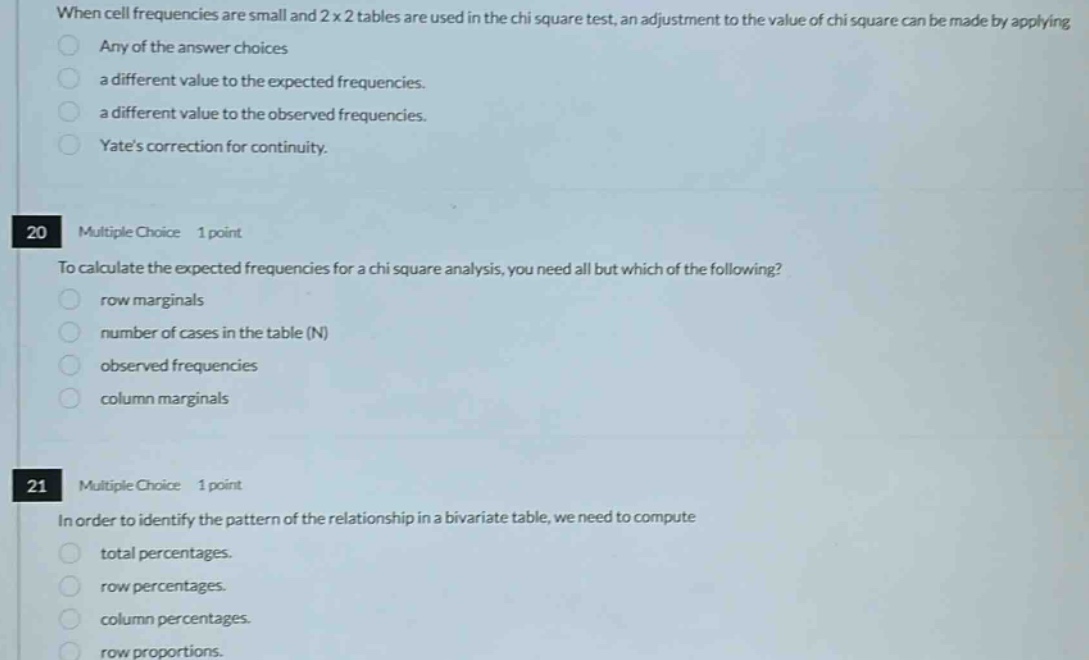
when cell frequencies are small and 2x2 tables are used in the chi square test, an adjustment to the value of chi square can be made by applying any of the answer choices a different value to the expected frequencies. a different value to the observed frequencies. yates correction for continuity. 20 multiple choice 1 point to calculate the expected frequencies for a chi square analysis, you need all but which of the following? row marginals number of cases in the table (n) observed frequencies column marginals 21 multiple choice 1 point in order to identify the pattern of the relationship in a bivariate table, we need to compute total percentages. row percentages. column percentages. row proportions.
Answer
Brief Explanations:
- When cell - frequencies are small and 2x2 tables are used in the chi - square test, Yate's correction for continuity is used to adjust the chi - square value. Changing the expected or observed frequencies is not the standard correction method.
- To calculate the expected frequencies in a chi - square analysis, the formula is $E_{ij}=\frac{R_i\times C_j}{N}$, where $R_i$ is the row marginal, $C_j$ is the column marginal, and $N$ is the number of cases in the table. Observed frequencies are not used in the calculation of expected frequencies.
- To identify the pattern of the relationship in a bivariate table, row percentages are computed. Row percentages show the proportion of cases within each row that fall into each column category, which helps in understanding the relationship between the two variables.
Answer:
- D. Yate's correction for continuity
- C. observed frequencies
- B. row percentages