1. who are erik erikson and jean piaget? why are their theories important to understanding growth &…
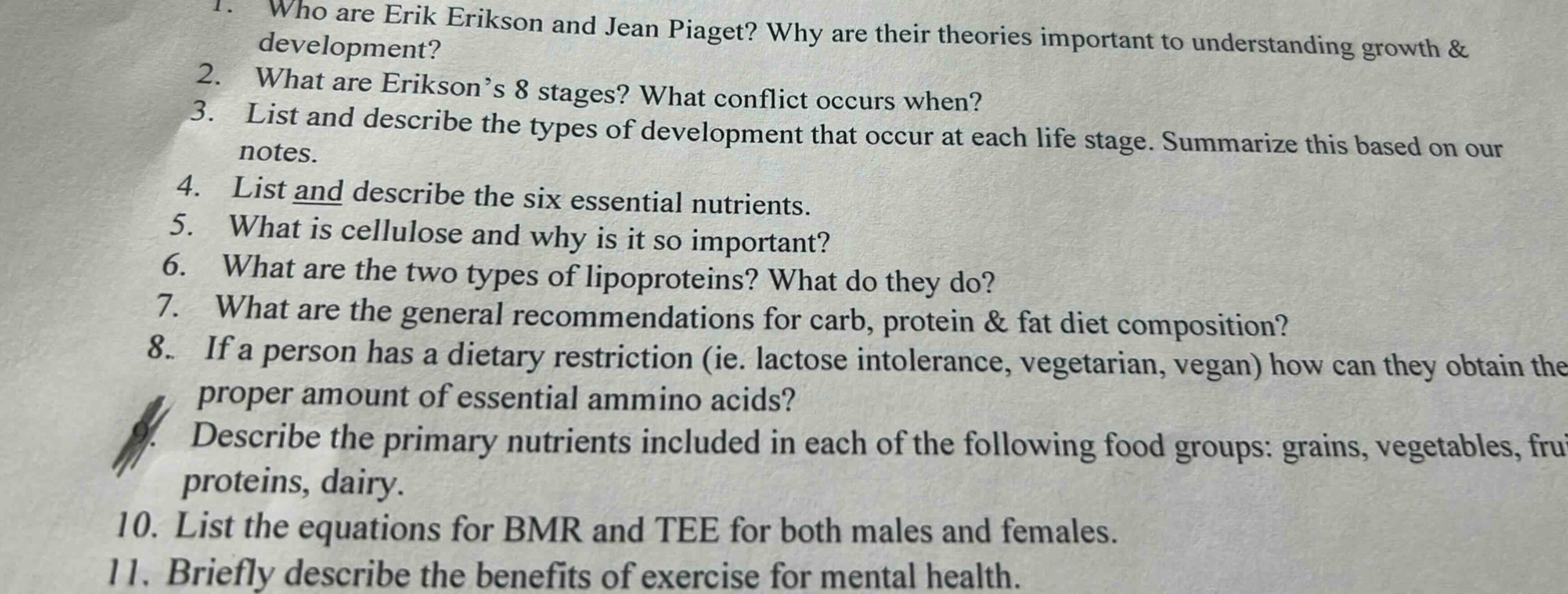
1. who are erik erikson and jean piaget? why are their theories important to understanding growth & development? 2. what are erikson’s 8 stages? what conflict occurs when? 3. list and describe the types of development that occur at each life stage. summarize this based on our notes. 4. list and describe the six essential nutrients. 5. what is cellulose and why is it so important? 6. what are the two types of lipoproteins? what do they do? 7. what are the general recommendations for carb, protein & fat diet composition? 8. if a person has a dietary restriction (ie. lactose intolerance, vegetarian, vegan) how can they obtain the proper amount of essential ammino acids? 9. describe the primary nutrients included in each of the following food groups: grains, vegetables, fruits, proteins, dairy. 10. list the equations for bmr and tee for both males and females. 11. briefly describe the benefits of exercise for mental health.
Answer
Brief Explanations:
- Erik Erikson and Jean Piaget are well - known psychologists. Erikson's psychosocial development theory and Piaget's cognitive development theory help understand human growth and development from different aspects.
- Erikson's 8 stages are: Trust vs. Mistrust (infancy), Autonomy vs. Shame and Doubt (toddlerhood), Initiative vs. Guilt (preschool), Industry vs. Inferiority (school - age), Identity vs. Role Confusion (adolescence), Intimacy vs. Isolation (young adulthood), Generativity vs. Stagnation (middle adulthood), Ego Integrity vs. Despair (late adulthood). Each stage has a specific conflict.
- At each life stage, different types of development occur, such as social, emotional, and cognitive development.
- The six essential nutrients are carbohydrates, proteins, fats, vitamins, minerals, and water. Each has specific functions in the body.
- Cellulose is a polysaccharide. It is important for plant structure and also has benefits for human digestion.
- The two types of lipoproteins are low - density lipoprotein (LDL) and high - density lipoprotein (HDL). LDL transports cholesterol to cells, while HDL removes cholesterol from the bloodstream.
- General recommendations for diet composition: Carbohydrates should make up 45 - 65% of total calories, proteins 10 - 35%, and fats 20 - 35%.
- For those with dietary restrictions, they can obtain essential amino acids through alternative protein sources. For example, lactose - intolerant people can choose lactose - free dairy or plant - based milks; vegetarians and vegans can combine different plant proteins.
- Grains are rich in carbohydrates; vegetables contain vitamins, minerals, and fiber; fruits have vitamins, minerals, and natural sugars; proteins provide amino acids; dairy is a source of calcium, protein, and vitamins.
- BMR (Basal Metabolic Rate) equations for males: Harris - Benedict formula: BMR = 88.362+(13.397×weight in kg)+(4.799×height in cm)-(5.677×age in years). For females: BMR = 447.593+(9.247×weight in kg)+(3.098×height in cm)-(4.330×age in years). TEE (Total Energy Expenditure) = BMR×activity factor.
- Exercise can reduce stress, improve mood, enhance self - esteem, and help with sleep, all of which are beneficial for mental health.
Answer:
- Erik Erikson is a psychologist known for his psychosocial development theory. Jean Piaget is a psychologist known for his cognitive development theory. Their theories are important as they offer frameworks to understand human psychological growth.
- Trust vs. Mistrust (infancy), Autonomy vs. Shame and Doubt (toddlerhood), Initiative vs. Guilt (preschool), Industry vs. Inferiority (school - age), Identity vs. Role Confusion (adolescence), Intimacy vs. Isolation (young adulthood), Generativity vs. Stagnation (middle adulthood), Ego Integrity vs. Despair (late adulthood).
- Infancy: Social - emotional development through attachment. Toddlerhood: Development of self - control. Preschool: Development of initiative. School - age: Development of competence. Adolescence: Development of self - identity. Young adulthood: Development of close relationships. Middle adulthood: Development of productivity. Late adulthood: Development of a sense of life satisfaction.
- Carbohydrates: Provide energy. Proteins: Build and repair tissues. Fats: Store energy and insulate the body. Vitamins: Regulate body processes. Minerals: Maintain body functions. Water: Essential for all body processes.
- Cellulose is a complex carbohydrate in plant cell walls. It is important for plant structure and aids human digestion as dietary fiber.
- Low - density lipoprotein (LDL): Transports cholesterol to cells. High - density lipoprotein (HDL): Removes cholesterol from the bloodstream.
- Carbohydrates: 45 - 65% of total calories. Proteins: 10 - 35% of total calories. Fats: 20 - 35% of total calories.
- Lactose - intolerant: Lactose - free dairy or plant - based milks. Vegetarians/vegans: Combine different plant proteins like beans and rice.
- Grains: Carbohydrates. Vegetables: Vitamins, minerals, fiber. Fruits: Vitamins, minerals, natural sugars. Proteins: Amino acids. Dairy: Calcium, protein, vitamins.
- Males BMR: Harris - Benedict formula: BMR = 88.362+(13.397×weight in kg)+(4.799×height in cm)-(5.677×age in years). Females BMR: BMR = 447.593+(9.247×weight in kg)+(3.098×height in cm)-(4.330×age in years). TEE = BMR×activity factor.
- Reduces stress, improves mood, enhances self - esteem, helps with sleep.