nursery 2\nhours spent napping\nwhich describes an inference that mrs. hardison might make after comparing…
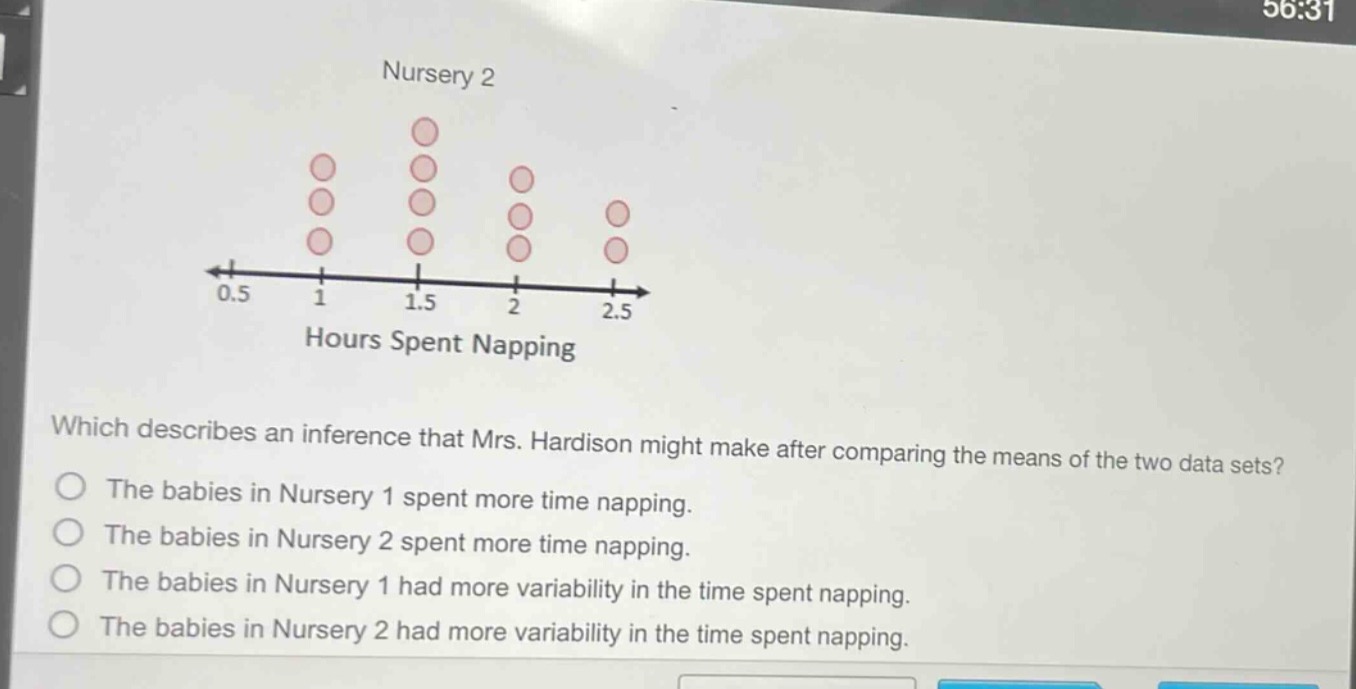
nursery 2\nhours spent napping\nwhich describes an inference that mrs. hardison might make after comparing the means of the two data sets?\nthe babies in nursery 1 spent more time napping.\nthe babies in nursery 2 spent more time napping.\nthe babies in nursery 1 had more variability in the time spent napping.\nthe babies in nursery 2 had more variability in the time spent napping.
Answer
Explanation:
Step1: Recall mean concept
The mean represents the average value of a data - set. To make an inference about which nursery's babies spent more time napping, we need to compare the means. But we also need to understand the concept of variability (spread of data).
Step2: Analyze the dot - plot
From the dot - plot of Nursery 2, we can see that the data points are clustered around 1, 1.5, 2 and 2.5 hours. However, without the data for Nursery 1, we cannot compare the means. But we can analyze variability. Variability is related to how spread out the data is. In Nursery 2, the data points are relatively clustered, so it is likely that Nursery 1 has more variability if its data is more spread out. But if we assume we are only comparing means based on the given information about Nursery 2 and no information about Nursery 1's spread, we focus on the values in Nursery 2. The sum of the values in Nursery 2: (4×1)+(4×1.5)+(3×2)+(2×2.5)=4 + 6+6 + 5=21. There are 4 + 4+3 + 2=13 data points. The mean of Nursery 2 is $\frac{21}{13}\approx1.62$ hours. Without Nursery 1 data, we can't fully compare means, but if we assume we are just making an inference based on this data, we can say that if Nursery 1 has a lower mean, the babies in Nursery 2 spent more time napping.
Answer:
The babies in Nursery 2 spent more time napping.