stery test\nphysicians as the best code of conduct. in the u.s. a formal code of ethics was created in 1847…
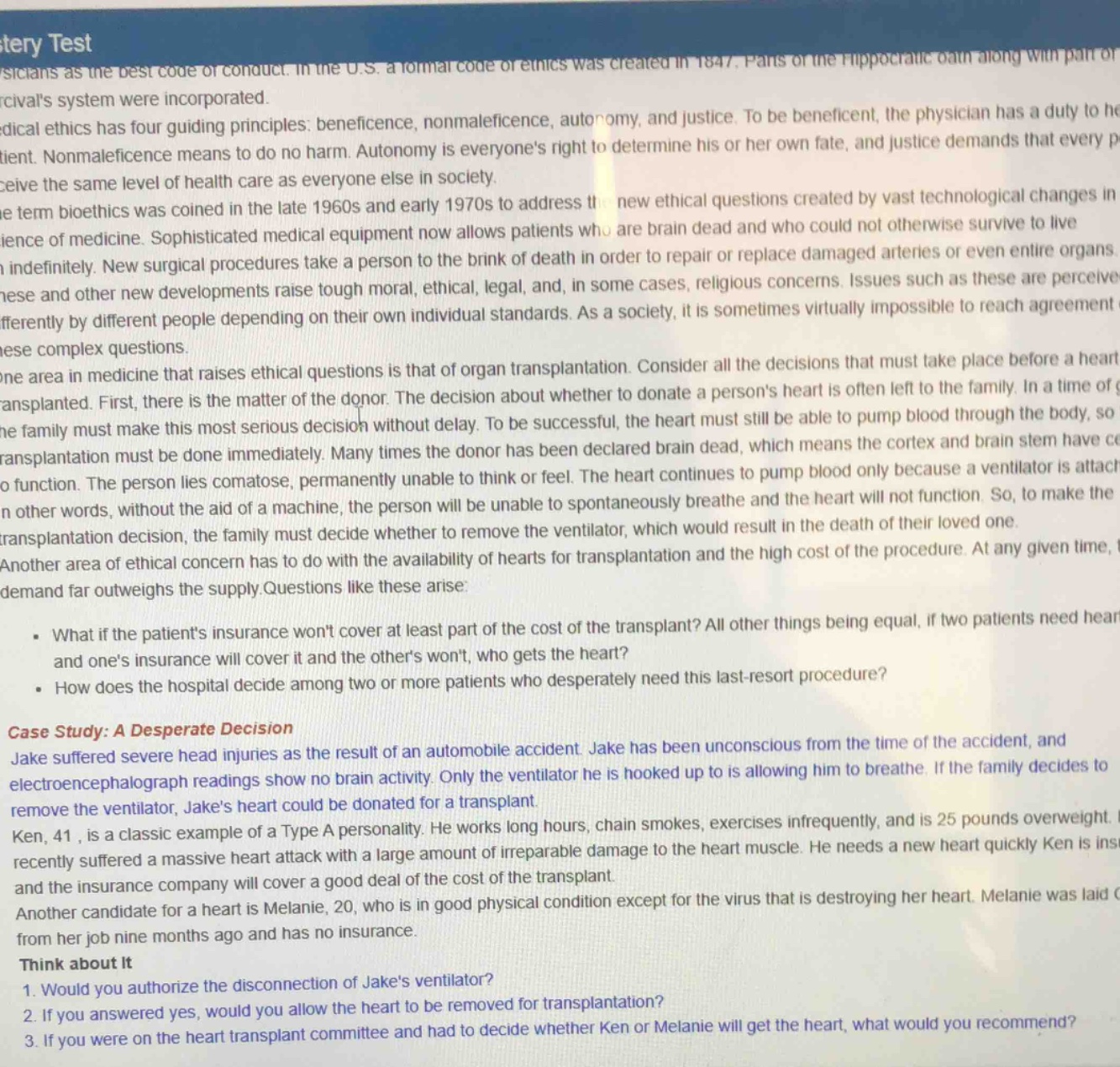
stery test\nphysicians as the best code of conduct. in the u.s. a formal code of ethics was created in 1847. parts of the hippocratic oath along with part of percivals system were incorporated.\nmedical ethics has four guiding principles: beneficence, nonmaleficence, autonomy, and justice. to be beneficent, the physician has a duty to help the patient. nonmaleficence means to do no harm. autonomy is everyones right to determine his or her own fate, and justice demands that every person receive the same level of health care as everyone else in society.\nthe term bioethics was coined in the late 1960s and early 1970s to address the new ethical questions created by vast technological changes in the science of medicine. sophisticated medical equipment now allows patients who are brain - dead and who could not otherwise survive to live indefinitely. new surgical procedures take a person to the brink of death in order to repair or replace damaged arteries or even entire organs.\nthese and other new developments raise tough moral, ethical, legal, and, in some cases, religious concerns. issues such as these are perceived differently by different people depending on their own individual standards. as a society, it is sometimes virtually impossible to reach agreement on these complex questions.\none area in medicine that raises ethical questions is that of organ transplantation. consider all the decisions that must take place before a heart is transplanted. first, there is the matter of the donor. the decision about whether to donate a persons heart is often left to the family. in a time of grief, the family must make this most serious decision without delay. to be successful, the heart must still be able to pump blood through the body, so the transplantation must be done immediately. many times the donor has been declared brain - dead, which means the cortex and brain stem have ceased to function. the person lies comatose, permanently unable to think or feel. the heart continues to pump blood only because a ventilator is attached. in other words, without the aid of a machine, the person will be unable to spontaneously breathe and the heart will not function. so, to make the transplantation decision, the family must decide whether to remove the ventilator, which would result in the death of their loved one.\nanother area of ethical concern has to do with the availability of hearts for transplantation and the high cost of the procedure. at any given time, demand far outweighs the supply. questions like these arise:\n- what if the patients insurance wont cover at least part of the cost of the transplant? all other things being equal, if two patients need hearts and ones insurance will cover it and the others wont, who gets the heart?\n- how does the hospital decide among two or more patients who desperately need this last - resort procedure?\ncase study: a desperate decision\njake suffered severe head injuries as the result of an automobile accident. jake has been unconscious from the time of the accident, and electroencephalograph readings show no brain activity. only the ventilator he is hooked up to is allowing him to breathe. if the family decides to remove the ventilator, jakes heart could be donated for a transplant.\nken, 41, is a classic example of a type a personality. he works long hours, chain smokes, exercises infrequently, and is 25 pounds overweight. he recently suffered a massive heart attack with a large amount of irreparable damage to the heart muscle. he needs a new heart quickly. ken is insured and the insurance company will cover a good deal of the cost of the transplant.\nanother candidate for a heart is melanie, 20, who is in good physical condition except for the virus that is destroying her heart. melanie was laid off from her job nine months ago and has no insurance.\nthink about it\n1. would you authorize the disconnection of jakes ventilator?\n2. if you answered yes, would you allow the heart to be removed for transplantation?\n3. if you were on the heart transplant committee and had to decide whether ken or melanie will get the heart, what would you recommend?
Answer
Brief Explanations:
- Deciding to disconnect Jake's ventilator involves weighing ethical principles like non - maleficence and autonomy. Jake has no brain activity and is only breathing due to the ventilator. Some may consider it in line with his best interests and respect for his autonomy (if he had expressed such wishes previously), while others may be hesitant due to the sanctity of life.
- Allowing the heart to be removed for transplantation also has ethical implications. It must be ensured that the decision - making process is ethical, and the family's consent is obtained in a proper manner.
- Choosing between Ken and Melanie for the heart is a difficult decision. Ken has insurance but has an unhealthy lifestyle, while Melanie is in good physical condition otherwise but has no insurance. One could consider factors like medical need, long - term prognosis, and fairness in access to healthcare.
Answer:
- Answers may vary depending on personal ethical views. Some may say yes, considering Jake's lack of brain activity and the potential to help others. Others may say no, due to moral or religious objections.
- If the answer to 1 is yes, again, it depends on ethical considerations and family consent.
- Answers may vary. Some may recommend Melanie as she is in good physical condition and may have a better long - term prognosis despite no insurance. Others may recommend Ken as his insurance can cover the cost, which may be beneficial for the hospital and the healthcare system in terms of financial burden.