13. the difference between two numbers is 25. the smaller number is 1/6th of the larger number. what is the…
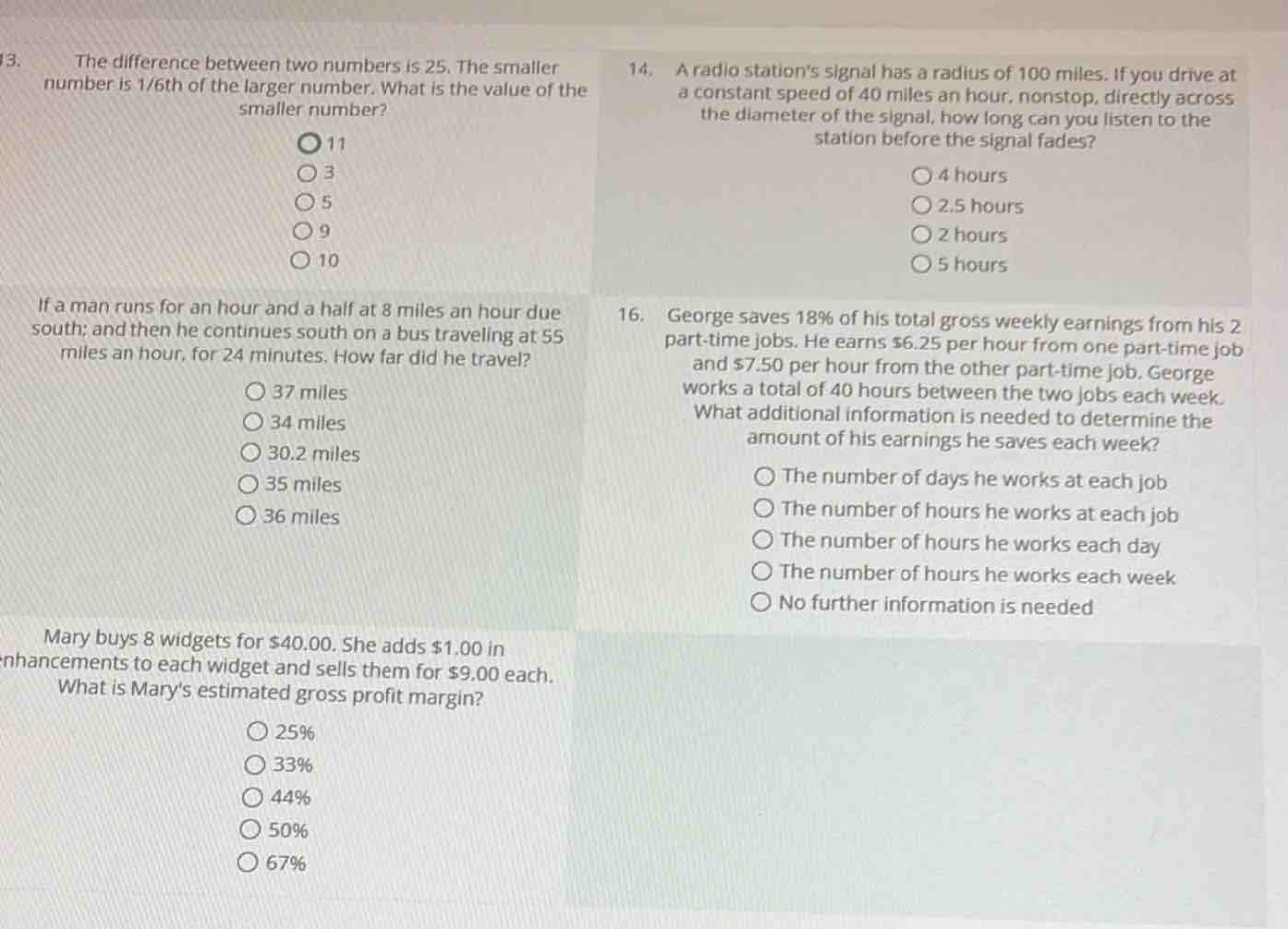
13. the difference between two numbers is 25. the smaller number is 1/6th of the larger number. what is the value of the smaller number?\no 11\no 3\no 5\no 9\no 10\n\nif a man runs for an hour and a half at 8 miles an hour due south; and then he continues south on a bus traveling at 55 miles an hour, for 24 minutes. how far did he travel?\no 37 miles\no 34 miles\no 30.2 miles\no 35 miles\no 36 miles\n\nmary buys 8 widgets for $40.00. she adds $1.00 in enhancements to each widget and sells them for $9.00 each. what is marys estimated gross profit margin?\no 25%\no 33%\no 44%\no 50%\no 67%\n\n14. a radio stations signal has a radius of 100 miles. if you drive at a constant speed of 40 miles an hour, nonstop, directly across the diameter of the signal, how long can you listen to the station before the signal fades?\no 4 hours\no 2.5 hours\no 2 hours\no 5 hours\n\n16. george saves 18% of his total gross weekly earnings from his 2 part - time jobs. he earns $6.25 per hour from one part - time job and $7.50 per hour from the other part - time job. george works a total of 40 hours between the two jobs each week. what additional information is needed to determine the amount of his earnings he saves each week?\no the number of days he works at each job\no the number of hours he works at each job\no the number of hours he works each day\no the number of hours he works each week\no no further information is needed
Answer
Question 13
Explanation:
Step1: Let the larger number be $x$ and the smaller be $y$.
Set up equations: $x - y=25$ and $y=\frac{1}{6}x$.
Step2: Substitute $y=\frac{1}{6}x$ into $x - y=25$.
$x-\frac{1}{6}x = 25$.
Step3: Simplify the left - hand side.
$\frac{6x - x}{6}=25$, so $\frac{5x}{6}=25$.
Step4: Solve for $x$.
$x = 25\times\frac{6}{5}=30$.
Step5: Find $y$.
Since $y=\frac{1}{6}x$, then $y=\frac{1}{6}\times30 = 5$.
Answer:
5
Question 14
Explanation:
Step1: Find the diameter of the radio - station's signal.
The radius $r = 100$ miles, so the diameter $d=2r = 200$ miles.
Step2: Use the formula $t=\frac{d}{v}$ (where $t$ is time, $d$ is distance, and $v$ is speed).
Given $v = 40$ miles per hour and $d = 200$ miles, then $t=\frac{200}{40}=5$ hours.
Answer:
5 hours
Question 15
Explanation:
Step1: Calculate the distance run.
The man runs for $t_1 = 1.5$ hours at a speed $v_1=8$ miles per hour. Using $d_1=v_1t_1$, we get $d_1=8\times1.5 = 12$ miles.
Step2: Calculate the distance traveled by bus.
The bus travels for $t_2=24$ minutes. Since $1$ hour = 60 minutes, $t_2=\frac{24}{60}=0.4$ hours at a speed $v_2 = 55$ miles per hour. Using $d_2=v_2t_2$, we get $d_2=55\times0.4 = 22$ miles.
Step3: Calculate the total distance.
$d=d_1 + d_2=12+22=34$ miles.
Answer:
34 miles
Question 16
Explanation:
Step1: Recall the formula for total earnings.
Let the number of hours worked at the first job be $h_1$ and at the second job be $h_2$, with $h_1 + h_2=40$. Total earnings $E=6.25h_1 + 7.50h_2$.
Step2: Analyze the information needed to find savings.
We know the savings rate is 18% of total earnings. To find total earnings, we need to know $h_1$ and $h_2$ (since we know the hourly rates).
Answer:
The number of hours he works at each job
Question 17
Explanation:
Step1: Calculate the cost per widget.
The cost of buying 8 widgets is $40$, so the cost per widget is $\frac{40}{8}=5$ dollars. After adding $1$ dollar in enhancements, the cost per widget is $C = 5 + 1=6$ dollars.
Step2: Calculate the selling price per widget.
The selling price per widget is $S = 9$ dollars.
Step3: Calculate the profit per widget.
Profit per widget $P=S - C=9 - 6 = 3$ dollars.
Step4: Calculate the gross profit margin.
Gross profit margin $=\frac{P}{S}\times100%=\frac{3}{9}\times100%\approx33%$.
Answer:
33%