accounting problems\nmarch 7, 20x1 purchased new equipment for $9,800 and paid for it immediately by…
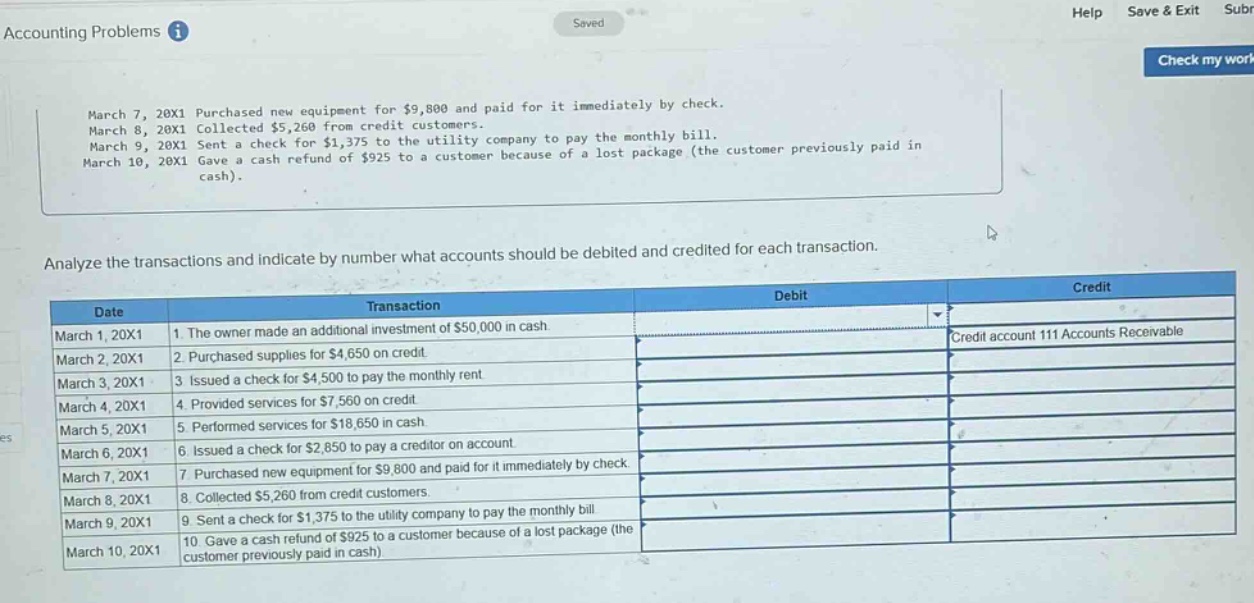
accounting problems\nmarch 7, 20x1 purchased new equipment for $9,800 and paid for it immediately by check.\nmarch 8, 20x1 collected $5,260 from credit customers.\nmarch 9, 20x1 sent a check for $1,375 to the utility company to pay the monthly bill.\nmarch 10, 20x1 gave a cash refund of $925 to a customer because of a lost package (the customer previously paid in cash).\nanalyze the transactions and indicate by number what accounts should be debited and credited for each transaction.\ndate transaction debit credit\nmarch 1, 20x1 1. the owner made an additional investment of $50,000 in cash. credit account 111 accounts receivable\nmarch 2, 20x1 2. purchased supplies for $4,650 on credit.\nmarch 3, 20x1 3. issued a check for $4,500 to pay the monthly rent.\nmarch 4, 20x1 4. provided services for $7,560 on credit.\nmarch 5, 20x1 5. performed services for $18,650 in cash.\nmarch 6, 20x1 6. issued a check for $2,850 to pay a creditor on account.\nmarch 7, 20x1 7. purchased new equipment for $9,800 and paid for it immediately by check.\nmarch 8, 20x1 8. collected $5,260 from credit customers.\nmarch 9, 20x1 9. sent a check for $1,375 to the utility company to pay the monthly bill.\nmarch 10, 20x1 10. gave a cash refund of $925 to a customer because of a lost package (the customer previously paid in cash)
Answer
Explanation:
Step1: Analyze March 1 transaction
Debit cash (increase in asset), credit owner's equity (increase in equity). So debit account for cash, credit account related to owner - investment.
Step2: Analyze March 2 transaction
Debit supplies (increase in asset), credit accounts payable (increase in liability). So debit supplies account, credit accounts payable account.
Step3: Analyze March 3 transaction
Debit rent expense (increase in expense), credit cash (decrease in asset). So debit rent expense account, credit cash account.
Step4: Analyze March 4 transaction
Debit accounts receivable (increase in asset), credit service revenue (increase in revenue). So debit accounts receivable account, credit service revenue account.
Step5: Analyze March 5 transaction
Debit cash (increase in asset), credit service revenue (increase in revenue). So debit cash account, credit service revenue account.
Step6: Analyze March 6 transaction
Debit accounts payable (decrease in liability), credit cash (decrease in asset). So debit accounts payable account, credit cash account.
Step7: Analyze March 7 transaction
Debit equipment (increase in asset), credit cash (decrease in asset). So debit equipment account, credit cash account.
Step8: Analyze March 8 transaction
Debit cash (increase in asset), credit accounts receivable (decrease in asset). So debit cash account, credit accounts receivable account.
Step9: Analyze March 9 transaction
Debit utility expense (increase in expense), credit cash (decrease in asset). So debit utility expense account, credit cash account.
Step10: Analyze March 10 transaction
Debit sales returns and allowances (decrease in revenue), credit cash (decrease in asset). So debit sales returns and allowances account, credit cash account.
| Date | Transaction | Debit | Credit |
|---|---|---|---|
| March 1, 20X1 | 1. The owner made an additional investment of $50,000 in cash. | Cash | Owner's Equity |
| March 2, 20X1 | 2. Purchased supplies for $4,650 on credit. | Supplies | Accounts Payable |
| March 3, 20X1 | 3. Issued a check for $4,500 to pay the monthly rent. | Rent Expense | Cash |
| March 4, 20X1 | 4. Provided services for $7,560 on credit. | Accounts Receivable | Service Revenue |
| March 5, 20X1 | 5. Performed services for $18,650 in cash. | Cash | Service Revenue |
| March 6, 20X1 | 6. Issued a check for $2,850 to pay a creditor on account. | Accounts Payable | Cash |
| March 7, 20X1 | 7. Purchased new equipment for $9,800 and paid for it immediately by check. | Equipment | Cash |
| March 8, 20X1 | 8. Collected $5,260 from credit customers. | Cash | Accounts Receivable |
| March 9, 20X1 | 9. Sent a check for $1,375 to the utility company to pay the monthly bill. | Utility Expense | Cash |
| March 10, 20X1 | 10. Gave a cash refund of $925 to a customer because of a lost package (the customer previously paid in cash). | Sales Returns and Allowances | Cash |