1.) an airport manager faced a forecasting problem. he needs a model to forecast one month ahead in order to…
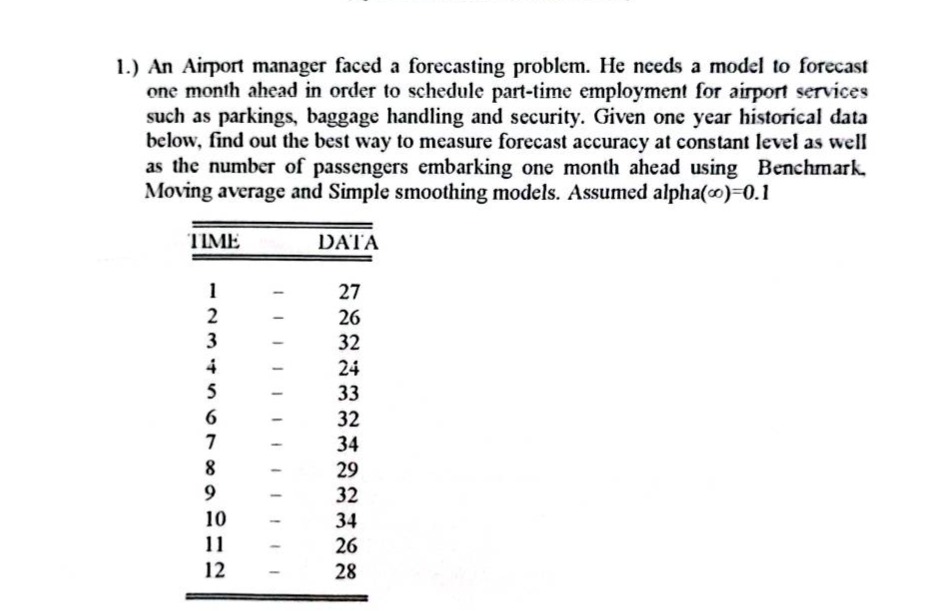
1.) an airport manager faced a forecasting problem. he needs a model to forecast one month ahead in order to schedule part - time employment for airport services such as parkings, baggage handling and security. given one year historical data below, find out the best way to measure forecast accuracy at constant level as well as the number of passengers embarking one month ahead using benchmark. moving average and simple smoothing models. assumed alpha(α)=0.1\n\n|time|data|\n|----|----|\n|1|27|\n|2|26|\n|3|32|\n|4|24|\n|5|33|\n|6|32|\n|7|34|\n|8|29|\n|9|32|\n|10|34|\n|11|26|\n|12|28|
Answer
Explanation:
Step1: Define Benchmark, Moving - average and Simple - smoothing formulas
Benchmark forecast is often the naive forecast (last period value). Moving - average formula for $n$ periods: $F_{t+1}=\frac{\sum_{i = t - n+1}^{t}A_{i}}{n}$. Simple - smoothing formula: $F_{t+1}=\alpha A_{t}+(1 - \alpha)F_{t}$, where $A_{t}$ is the actual value at time $t$ and $F_{t}$ is the forecast value at time $t$. Assume initial forecast $F_1 = A_1=27$.
Step2: Calculate Benchmark forecasts
For $t = 2$, $F_2=A_1 = 27$; for $t = 3$, $F_3=A_2 = 26$; and so on.
Step3: Calculate Moving - average forecasts
Let's assume a 3 - period moving average. For $t=4$, $F_4=\frac{A_1 + A_2+A_3}{3}=\frac{27 + 26+32}{3}=\frac{85}{3}\approx28.33$. For $t = 5$, $F_5=\frac{A_2 + A_3+A_4}{3}=\frac{26 + 32+24}{3}=\frac{82}{3}\approx27.33$, and so on.
Step4: Calculate Simple - smoothing forecasts
For $t = 2$, $F_2=\alpha A_1+(1 - \alpha)F_1=0.1\times27+(1 - 0.1)\times27=27$. For $t = 3$, $F_3=\alpha A_2+(1 - \alpha)F_2=0.1\times26+(1 - 0.1)\times27=26.9$, and so on.
Step5: Calculate forecast accuracy
Common measures of forecast accuracy include Mean Absolute Error (MAE), Mean Squared Error (MSE) and Mean Absolute Percentage Error (MAPE). MAE: $MAE=\frac{\sum_{t = 1}^{n}|A_{t}-F_{t}|}{n}$ MSE: $MSE=\frac{\sum_{t = 1}^{n}(A_{t}-F_{t})^2}{n}$ MAPE: $MAPE=\frac{1}{n}\sum_{t = 1}^{n}\left|\frac{A_{t}-F_{t}}{A_{t}}\right|\times100%$ (when $A_{t}\neq0$) Calculate MAE, MSE and MAPE for each of the three models (Benchmark, Moving - average and Simple - smoothing) to determine the best model in terms of accuracy.
Answer:
The best way to measure accuracy is by calculating MAE, MSE and MAPE. Forecasts for one - month ahead for each model need to be calculated as shown above and then compared based on the accuracy measures. The actual one - month ahead forecast values will depend on the calculations for each model using the given data and formulas.