a bakery has a fixed cost of $119.75 per day plus $2.25 for each pastry. the bakery would like to keep its…
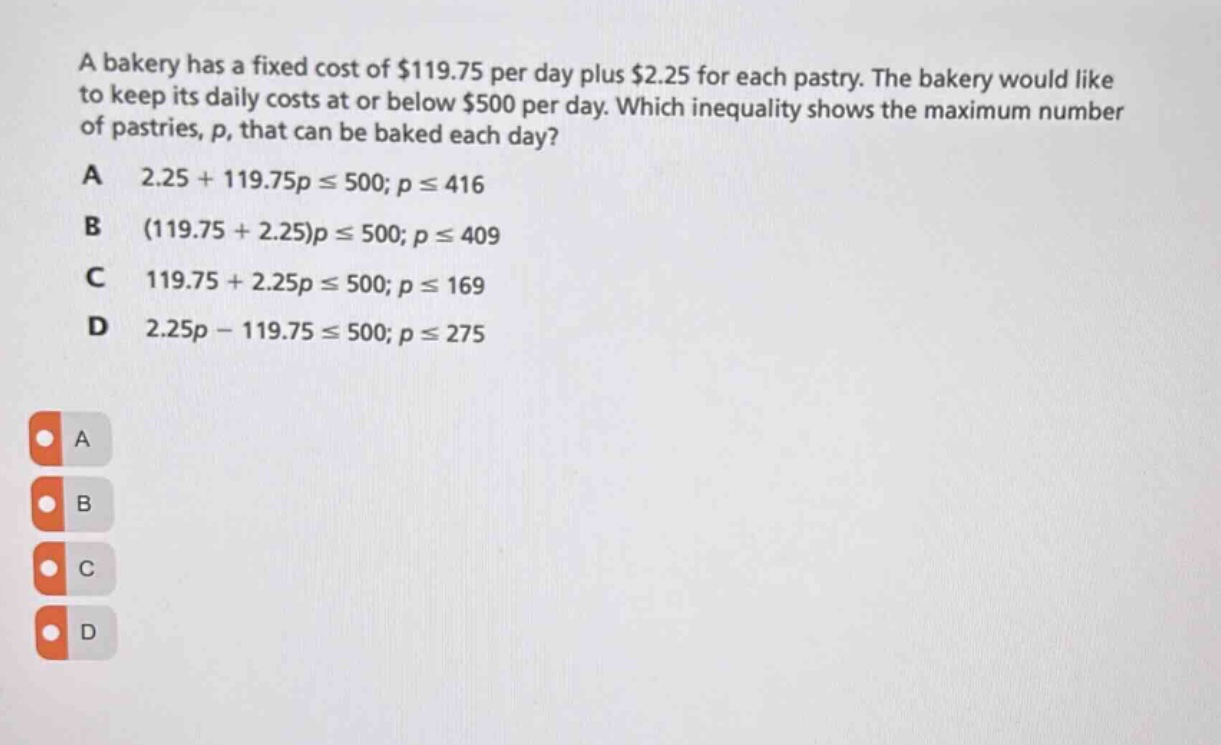
a bakery has a fixed cost of $119.75 per day plus $2.25 for each pastry. the bakery would like to keep its daily costs at or below $500 per day. which inequality shows the maximum number of pastries, p, that can be baked each day?\na 2.25 + 119.75p ≤ 500; p ≤ 416\nb (119.75 + 2.25)p ≤ 500; p ≤ 409\nc 119.75 + 2.25p ≤ 500; p ≤ 169\nd 2.25p - 119.75 ≤ 500; p ≤ 275
Answer
Explanation:
Step1: Set up the cost - inequality
The fixed cost is $119.75$ and the variable cost is $2.25$ per pastry. Let $p$ be the number of pastries. The total cost $C$ is the sum of the fixed cost and the variable cost, so $C = 119.75+2.25p$. The bakery wants the cost to be at or below $500$, so the inequality is $119.75 + 2.25p\leq500$.
Step2: Solve the inequality for $p$
First, subtract $119.75$ from both sides of the inequality: $2.25p\leq500 - 119.75$ $2.25p\leq380.25$ Then, divide both sides by $2.25$: $p\leq\frac{380.25}{2.25}=169$
Answer:
C. $119.75 + 2.25p\leq500; p\leq169$