case 3: merchandise inventory, beg. p 220,000 cost of sales 270,000 purchases? total goods available for…
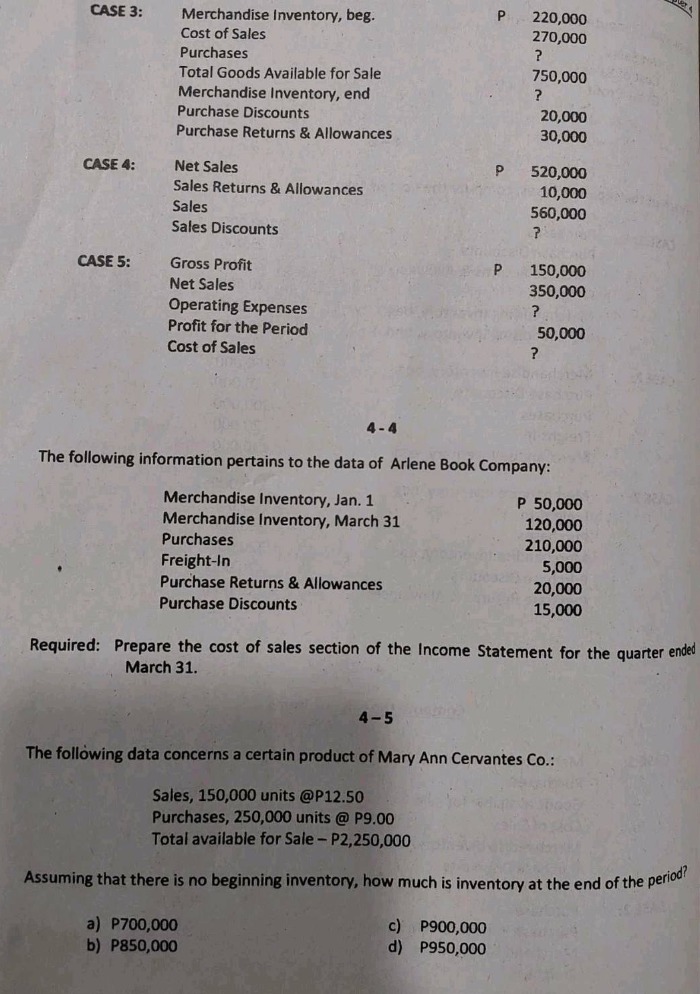
case 3: merchandise inventory, beg. p 220,000 cost of sales 270,000 purchases? total goods available for sale 750,000 merchandise inventory, end? purchase discounts 20,000 purchase returns & allowances 30,000 case 4: net sales p 520,000 sales returns & allowances 10,000 sales 560,000 sales discounts case 5: gross profit p 150,000 net sales 350,000 operating expenses? profit for the period 50,000 cost of sales? 4 - 4 the following information pertains to the data of arlene book company: merchandise inventory, jan. 1 p 50,000 merchandise inventory, march 31 120,000 purchases 210,000 freight - in 5,000 purchase returns & allowances 20,000 purchase discounts 15,000 required: prepare the cost of sales section of the income statement for the quarter ended march 31. 4 - 5 the following data concerns a certain product of mary ann cervantes co.: sales, 150,000 units @p12.50 purchases, 250,000 units @ p9.00 total available for sale - p2,250,000 assuming that there is no beginning inventory, how much is inventory at the end of the period? a) p700,000 c) p900,000 b) p850,000 d) p950,000
Answer
Explanation:
Step1: Calculate cost of goods available for sale
Cost of goods available for sale is the sum of beginning inventory and net purchases. Net purchases = Purchases - Purchase Discounts - Purchase Returns & Allowances + Freight - In. But since we are dealing with the last part - no beginning inventory case: Cost of goods available for sale = Total available for sale = P2,250,000
Step2: Calculate cost of sales
Cost of sales = Number of units sold×Unit - selling price. Number of units sold = 150,000, Unit - selling price = P12.50, so Cost of sales = 150,000×12.50=P1,875,000
Step3: Calculate ending inventory
Ending inventory = Cost of goods available for sale - Cost of sales. Ending inventory = 2250000 - 1875000 = P375000 (There seems to be an error in the problem - setup as this value is not in the options. Let's calculate in another way using cost - based values). Cost of purchases = 250,000×9 = P2,250,000 Cost of sales = 150,000×9 = P1,350,000 Ending inventory = 2250000-1350000 = P900,000
Answer:
c) P900,000