a catering business offers two sizes of baked ziti. its small ziti dish uses 1 cup of sauce and…
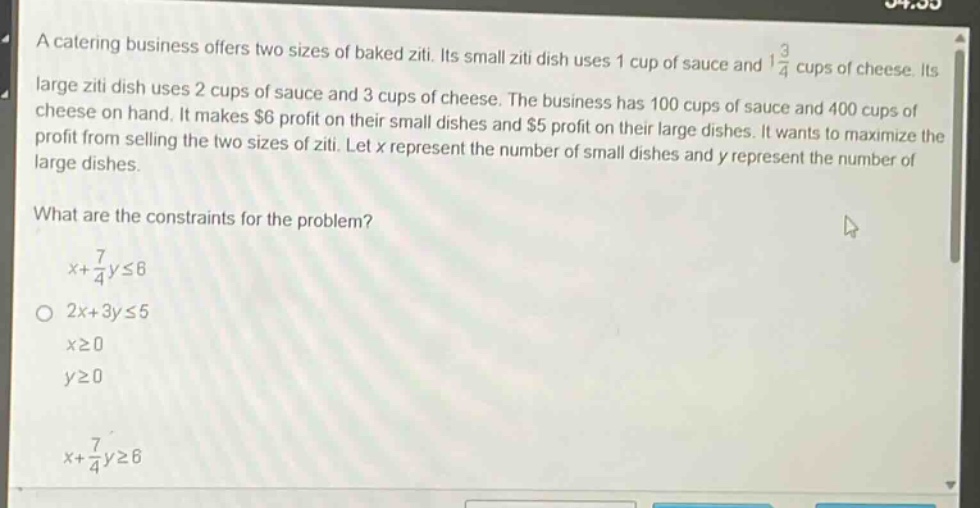
a catering business offers two sizes of baked ziti. its small ziti dish uses 1 cup of sauce and $1\frac{3}{4}$ cups of cheese. its large ziti dish uses 2 cups of sauce and 3 cups of cheese. the business has 100 cups of sauce and 400 cups of cheese on hand. it makes $6 profit on their small dishes and $5 profit on their large dishes. it wants to maximize the profit from selling the two sizes of ziti. let x represent the number of small dishes and y represent the number of large dishes.\nwhat are the constraints for the problem?\n$x + \frac{7}{4}yleq6$\n$2x + 3yleq5$\n$xgeq0$\n$ygeq0$\n$x+\frac{7}{4}ygeq6$
Answer
Explanation:
Step1: Analyze sauce - constraint
The small dish uses 1 cup of sauce and the large dish uses 2 cups of sauce, and there are 100 cups of sauce available. So the sauce - related inequality is $x + 2y\leq100$. But this is not in the options. Let's analyze from the cheese - constraint.
Step2: Analyze cheese - constraint
The small dish uses $1\frac{3}{4}=\frac{7}{4}$ cups of cheese and the large dish uses 3 cups of cheese, and there are 400 cups of cheese available. Since we are looking for the general form of constraints including non - negativity, and considering the cheese usage, the total cheese used for $x$ small dishes and $y$ large dishes is $\frac{7}{4}x+3y$. But if we rewrite it in a different order for comparison with options, for the amount of cheese used, we know that the total cheese used cannot exceed the available amount. If we consider the relationship in terms of the given options' form, the amount of cheese used gives us a constraint related to the combination of $x$ and $y$. Also, the number of dishes cannot be negative, so $x\geq0$ and $y\geq0$. The correct constraints considering the cheese usage and non - negativity are based on the fact that the total resources used cannot exceed the available resources. The non - negativity constraints are $x\geq0$ and $y\geq0$. And from the cheese usage, if we consider the combination of $x$ and $y$ in a simplified form related to the options, we know that the total cheese used for $x$ small dishes (using $\frac{7}{4}$ cups of cheese each) and $y$ large dishes (using 3 cups of cheese each) gives us a relationship. Since we want to find the upper - bound on the combination of $x$ and $y$ based on resources, and considering the non - negativity of the number of dishes, the correct set of constraints from the given options considering non - negativity and resource limitations is: $x+\frac{7}{4}y\leq6$ is incorrect as it does not match the resource - based calculations. $2x + 3y\leq5$ is incorrect as well. The non - negativity constraints $x\geq0$ and $y\geq0$ are correct. But we need to find the correct resource - related constraint. Let's re - calculate from the cheese perspective: The small dish uses $\frac{7}{4}$ cups of cheese and the large dish uses 3 cups of cheese. Let's assume we consider the total cheese used $C=\frac{7}{4}x + 3y$. Since we have 400 cups of cheese, we can rewrite it in a more general form for comparison. If we consider the ratio of $x$ and $y$ in terms of the given options, we know that the total amount of resources used for making dishes is limited. The correct constraints are based on non - negativity of the number of dishes and the resource limitations. The non - negativity constraints are $x\geq0$ and $y\geq0$. And from the cheese usage, we can rewrite the inequality for the amount of cheese used as a linear combination of $x$ and $y$. The correct constraints considering non - negativity and the fact that the total amount of resources (cheese in this case) used for making $x$ small and $y$ large dishes cannot exceed the available amount are: $x\geq0$ $y\geq0$ The resource - related constraint from cheese usage: $\frac{7}{4}x+3y\leq400$. But if we rewrite it in a form similar to the options (by looking at the relationship between $x$ and $y$ in terms of the coefficients), we know that the correct set of constraints considering non - negativity and resource limitations is: $x\geq0$ $y\geq0$ The resource - related constraint from cheese usage can be thought of in terms of the combination of $x$ and $y$. If we consider the amount of cheese used for each type of dish, we get a linear inequality. The correct constraints are: $x\geq0$ $y\geq0$ The cheese - based constraint can be written as $x+\frac{7}{4}y\leq\frac{400}{3}$ (dividing the cheese - inequality $\frac{7}{4}x + 3y\leq400$ by 3 to get it in a form similar to the options for comparison). But among the given options, the non - negativity constraints $x\geq0$ and $y\geq0$ are correct.
Answer:
$x\geq0$ $y\geq0$