a company with a break - even point at $900,000 in sales revenue had fixed costs of $225,000. when actual…
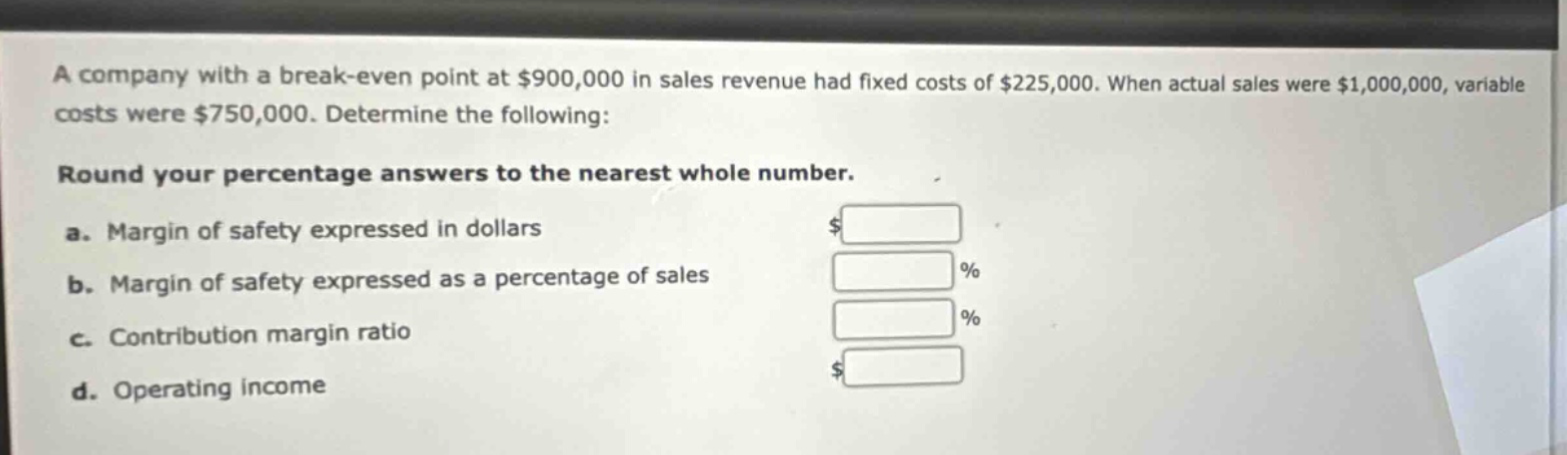
a company with a break - even point at $900,000 in sales revenue had fixed costs of $225,000. when actual sales were $1,000,000, variable costs were $750,000. determine the following:\n\nround your percentage answers to the nearest whole number.\n\na. margin of safety expressed in dollars\n\nb. margin of safety expressed as a percentage of sales\n\nc. contribution margin ratio\n\nd. operating income
Answer
Explanation:
Step1: Calculate margin of safety in dollars
Margin of safety (in dollars) = Actual sales - Break - even sales. Given actual sales = $1,000,000 and break - even sales = $900,000. $1000000 - 900000=100000$
Step2: Calculate margin of safety as a percentage of sales
Margin of safety percentage = $\frac{\text{Margin of safety (in dollars)}}{\text{Actual sales}}\times100%$. Substitute margin of safety (in dollars) = 100000 and actual sales = 1000000. $\frac{100000}{1000000}\times 100% = 10%$
Step3: Calculate contribution margin ratio
Contribution margin = Actual sales - Variable costs. Given actual sales = $1,000,000 and variable costs = $750,000, so contribution margin = $1000000 - 750000=250000$. Contribution margin ratio = $\frac{\text{Contribution margin}}{\text{Actual sales}}\times 100%=\frac{250000}{1000000}\times 100% = 25%$
Step4: Calculate operating income
Operating income = Contribution margin - Fixed costs. Given contribution margin = $250,000 and fixed costs = $225,000. $250000 - 225000 = 25000$
Answer:
a. $100000 b. 10% c. 25% d. $25000