a company gives each new salesperson a commission of $300 for the sale of a new car. the salesperson will…
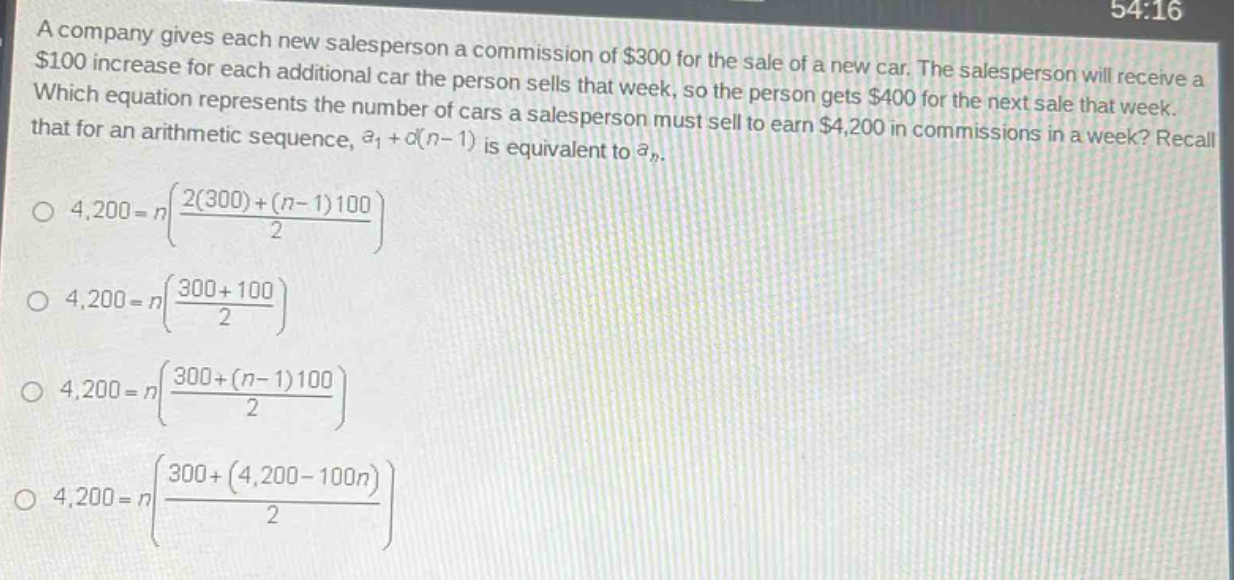
a company gives each new salesperson a commission of $300 for the sale of a new car. the salesperson will receive a $100 increase for each additional car the person sells that week, so the person gets $400 for the next sale that week. which equation represents the number of cars a salesperson must sell to earn $4,200 in commissions in a week? recall that for an arithmetic sequence, $a_1 + d(n - 1)$ is equivalent to $a_n$.\n$4,200 = nleft(\frac{2(300)+(n - 1)100}{2}\right)$\n$4,200 = nleft(\frac{300 + 100}{2}\right)$\n$4,200 = nleft(\frac{300+(n - 1)100}{2}\right)$\n$4,200 = nleft(\frac{300+(4,200 - 100n)}{2}\right)$
Answer
Explanation:
Step1: Identify the arithmetic - sequence formula for the sum of an arithmetic sequence
The sum formula of an arithmetic sequence is $S_n=n\left(\frac{a_1 + a_n}{2}\right)$, where $S_n$ is the sum of the first $n$ terms, $a_1$ is the first - term, and $a_n$ is the $n$th term. Here, $a_1 = 300$ (the commission for the first car), the common difference $d = 100$, and the $n$th term $a_n=a_1+(n - 1)d=300+(n - 1)100$. The sum of the commissions $S_n = 4200$.
Step2: Substitute the values into the sum formula
Substitute $a_1 = 300$, $a_n=300+(n - 1)100$, and $S_n = 4200$ into the sum formula $S_n=n\left(\frac{a_1 + a_n}{2}\right)$. We get $4200=n\left(\frac{300+(300+(n - 1)100)}{2}\right)=n\left(\frac{2\times300+(n - 1)100}{2}\right)$.
Answer:
$4,200 = n\left(\frac{2(300)+(n - 1)100}{2}\right)$