a company sells sets of kitchen knives. a basic set consists of 2 utility knives and 1 chefs knife. a…
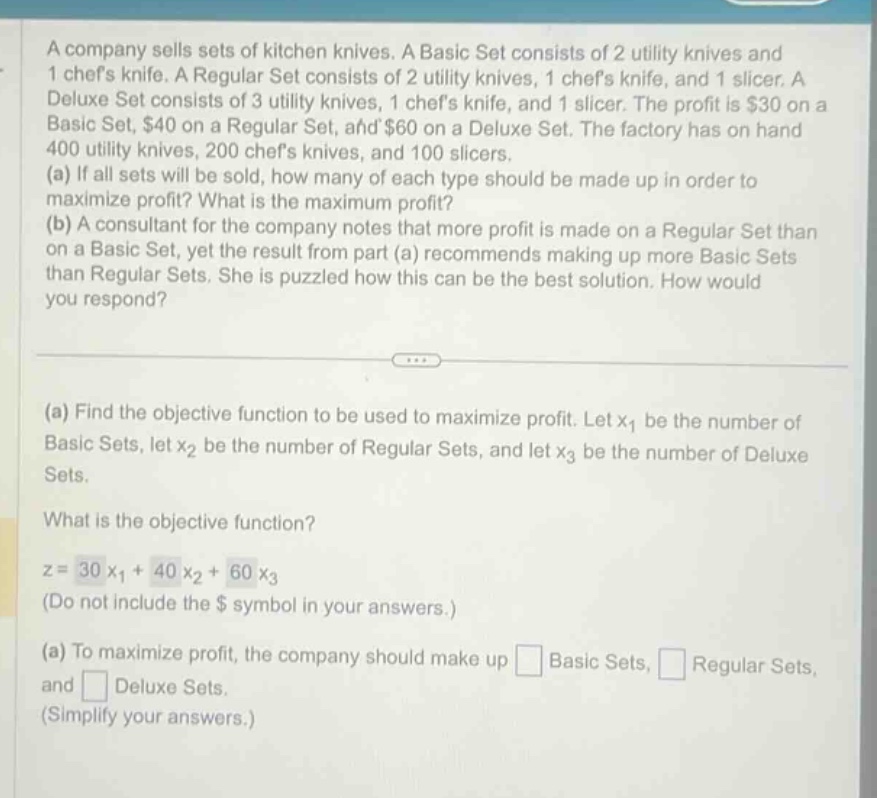
a company sells sets of kitchen knives. a basic set consists of 2 utility knives and 1 chefs knife. a regular set consists of 2 utility knives, 1 chefs knife, and 1 slicer. a deluxe set consists of 3 utility knives, 1 chefs knife, and 1 slicer. the profit is $30 on a basic set, $40 on a regular set, and $60 on a deluxe set. the factory has on hand 400 utility knives, 200 chefs knives, and 100 slicers. (a) if all sets will be sold, how many of each type should be made up in order to maximize profit? what is the maximum profit? (b) a consultant for the company notes that more profit is made on a regular set than on a basic set, yet the result from part (a) recommends making up more basic sets than regular sets. she is puzzled how this can be the best solution. how would you respond? (a) find the objective function to be used to maximize profit. let x1 be the number of basic sets, let x2 be the number of regular sets, and let x3 be the number of deluxe sets. what is the objective function? z = 30 x1 + 40 x2 + 60 x3 (do not include the $ symbol in your answers.) (a) to maximize profit, the company should make up basic sets, regular sets, and deluxe sets. (simplify your answers.)
Answer
Explanation:
Step1: Set up constraints
Based on the number of knives available:
- For utility knives: $2x_1 + 2x_2+3x_3\leq400$.
- For chef's knives: $x_1 + x_2+x_3\leq200$.
- For slicers: $x_2 + x_3\leq100$. Also, $x_1\geq0,x_2\geq0,x_3\geq0$ and they are integers.
Step2: Solve the linear - programming problem
We can use the simplex - method or graphical method for linear programming. But we can also analyze the constraints by hand. Let's consider the profit function $z = 30x_1+40x_2 + 60x_3$. From the slicer constraint $x_2 + x_3\leq100$. Let's express $x_3=100 - x_2$ (to start exploring the boundary). Substitute into the chef's knife constraint: $x_1 + x_2+(100 - x_2)=x_1 + 100\leq200$, so $x_1\leq100$. Substitute into the utility - knife constraint: $2x_1+2x_2 + 3(100 - x_2)=2x_1+2x_2+300 - 3x_2=2x_1 - x_2+300\leq400$, or $2x_1 - x_2\leq100$. If we set $x_3 = 0$ (first, to simplify the problem and see if it gives a good solution). The constraints become:
- Utility knives: $2x_1+2x_2\leq400$ or $x_1 + x_2\leq200$.
- Chef's knives: $x_1 + x_2\leq200$. The profit function is $z = 30x_1+40x_2$. From $x_1 + x_2\leq200$, we can express $x_2=200 - x_1$. Then $z = 30x_1+40(200 - x_1)=30x_1+8000 - 40x_1=8000 - 10x_1$. To maximize $z$, we want to make $x_1$ as small as possible while still satisfying the constraints. Now, if we consider the slicer constraint $x_2 + x_3\leq100$. Let's try to find the corner - points of the feasible region. If $x_3 = 0$, from the utility knife constraint $2x_1+2x_2=400$ and chef's knife constraint $x_1 + x_2 = 200$. We can also use the fact that we want to use up all the resources as much as possible. Let's solve the system of equations considering the constraints. From the slicer constraint $x_2+x_3 = 100$. Substitute into the utility knife constraint: $2x_1+2x_2+3(100 - x_2)=400$, $2x_1+2x_2 + 300-3x_2=400$, $2x_1 - x_2=100$. From the chef's knife constraint $x_1 + x_2+(100 - x_2)=200$, $x_1 = 100$. If $x_1 = 100$, then from $2x_1 - x_2=100$, $2\times100 - x_2=100$, $x_2 = 100$, and $x_3=0$. The profit $z=30\times100 + 40\times100+60\times0=3000 + 4000=7000$. Let's check other combinations. If we set $x_2 = 0$, from the utility knife constraint $2x_1+3x_3=400$, from the chef's knife constraint $x_1 + x_3=200$, solving the system $\begin{cases}2x_1+3x_3=400\x_1 + x_3=200\end{cases}$, multiply the second equation by 2: $2x_1+2x_3 = 400$. Subtract from the first equation: $(2x_1+3x_3)-(2x_1 + 2x_3)=400 - 400$, $x_3 = 0$, $x_1=200$. The profit $z=30\times200+40\times0 + 60\times0=6000$. If we set $x_1 = 0$, from the utility knife constraint $2x_2+3x_3=400$, from the chef's knife constraint $x_2 + x_3=200$, multiply the second equation by 2: $2x_2+2x_3=400$. Subtract from the first equation: $(2x_2+3x_3)-(2x_2 + 2x_3)=400 - 400$, $x_3 = 0$, $x_2=200$. The profit $z=30\times0+40\times200+60\times0 = 8000$. But considering the slicer constraint $x_2+x_3\leq100$, this is not valid. The optimal solution is $x_1 = 100,x_2 = 100,x_3 = 0$.
Answer:
100 Basic Sets, 100 Regular Sets, 0 Deluxe Sets