a deli is offering two specials. the roast beef special gives a profit of $2.30 per sandwich, and the turkey…
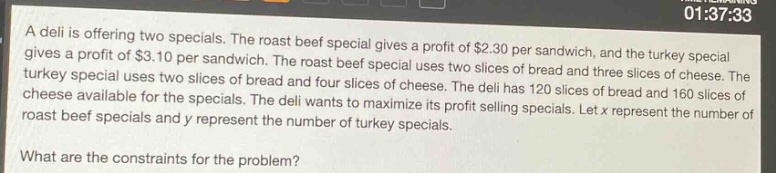
a deli is offering two specials. the roast beef special gives a profit of $2.30 per sandwich, and the turkey special gives a profit of $3.10 per sandwich. the roast beef special uses two slices of bread and three slices of cheese. the turkey special uses two slices of bread and four slices of cheese. the deli has 120 slices of bread and 160 slices of cheese available for the specials. the deli wants to maximize its profit selling specials. let x represent the number of roast beef specials and y represent the number of turkey specials. what are the constraints for the problem?
Answer
Explanation:
Step1: Consider bread - slice constraint
The roast beef special uses 2 slices of bread and the turkey special uses 2 slices of bread. The total number of bread - slices available is 120. So the bread - slice constraint is $2x + 2y\leq120$. Simplifying by dividing through by 2 gives $x + y\leq60$.
Step2: Consider cheese - slice constraint
The roast beef special uses 3 slices of cheese and the turkey special uses 4 slices of cheese. The total number of cheese - slices available is 160. So the cheese - slice constraint is $3x+4y\leq160$.
Step3: Non - negativity constraints
The number of sandwiches cannot be negative. So $x\geq0$ and $y\geq0$.
Answer:
$x + y\leq60$, $3x + 4y\leq160$, $x\geq0$, $y\geq0$