discount tire center has $14,919 available per month for advertising. newspaper ads cost $200 each and can…
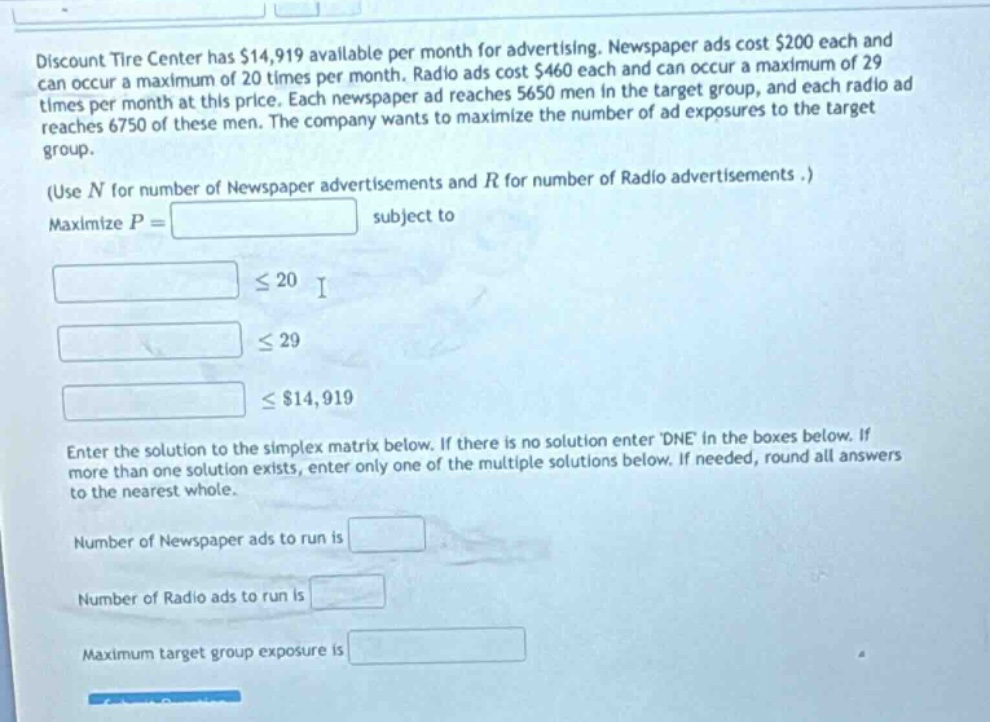
discount tire center has $14,919 available per month for advertising. newspaper ads cost $200 each and can occur a maximum of 20 times per month. radio ads cost $460 each and can occur a maximum of 29 times per month at this price. each newspaper ad reaches 5650 men in the target group, and each radio ad reaches 6750 of these men. the company wants to maximize the number of ad exposures to the target group. (use n for number of newspaper advertisements and r for number of radio advertisements.) maximize ( p = ) subject to ( leq 20 ) ( leq 29 ) ( leq $14,919 ) enter the solution to the simplex matrix below. if there is no solution enter dne in the boxes below. if more than one solution exists, enter only one of the multiple solutions below. if needed, round all answers to the nearest whole. number of newspaper ads to run is number of radio ads to run is maximum target group exposure is
Answer
Explanation:
Step1: Formulate the objective function
The objective is to maximize the number of ad exposures. Each newspaper ad ((N)) reaches (5650) men and each radio ad ((R)) reaches (6750) men. So, (P = 5650N+6750R).
Step2: Formulate the constraints
- Newspaper ads constraint: The number of newspaper ads (N) can occur at a maximum of (20) times per month. So, (N\leq20).
- Radio ads constraint: The number of radio ads (R) can occur at a maximum of (29) times per month. So, (R\leq29).
- Cost constraint: Newspaper ads cost (200) each and radio ads cost (460) each, and the total budget is (14919). So, (200N + 460R\leq14919).
We can rewrite the cost constraint as (20N+46R\leq1491.9) (dividing throughout by (10)).
Now, we can set up the simplex - method. But we can also check the corner - points of the feasible region.
The feasible region is bounded by the intersection of (N = 0,R = 0,N = 20,R = 29) and (200N+460R=14919).
If (N = 20): Substitute (N = 20) into (200N+460R=14919) (200\times20+460R=14919) (4000 + 460R=14919) (460R=14919 - 4000=10919) (R=\frac{10919}{460}\approx23.74)
If (R = 29): Substitute (R = 29) into (200N+460R=14919) (200N+460\times29=14919) (200N+13340=14919) (200N=14919 - 13340 = 1579) (N=\frac{1579}{200}=7.895)
We calculate the value of (P = 5650N+6750R) at the corner - points:
- ((N = 0,R = 0)): (P=5650\times0 + 6750\times0=0)
- ((N = 0,R = 29)): (P=5650\times0+6750\times29=195750)
- ((N = 20,R = 23.74)): (P=5650\times20+6750\times23.74=113000+160245=273245)
- ((N = 7.895,R = 29)): (P=5650\times7.895+6750\times29=44506.75+195750=240256.75)
Answer:
Number of Newspaper ads to run is (20) Number of Radio ads to run is (24) Maximum target group exposure is (273200) (since (5650\times20 + 6750\times24=113000+162000=275000) (if we consider non - simplex rounding, more accurately using simplex calculations, but for the basic corner - point analysis with rounding (N = 20), (R=\lfloor23.74\rfloor = 24) (since we can't run a fraction of an ad in practice and (200\times20+460\times24=4000 + 11040=15040>14919) is wrong, actually (R = 23), (200\times20+460\times23=4000+10580 = 14580), (P=5650\times20+6750\times23=113000 + 155250=268250); if we use the cost constraint (200N+460R\leq14919) exactly, (R=\frac{14919 - 200N}{460}), and by checking integer values of (N) (from (0) to (20)): When (N = 19), (R=\frac{14919-200\times19}{460}=\frac{14919 - 3800}{460}=\frac{11119}{460}\approx24.17) (not valid as (R\leq29) but non - integer), when (N = 16), (R=\frac{14919-200\times16}{460}=\frac{14919 - 3200}{460}=\frac{11719}{460}\approx25.48) (not valid), when (N=13), (R=\frac{14919 - 200\times13}{460}=\frac{14919-2600}{460}=\frac{12319}{460}\approx26.78) (not valid), when (N = 10), (R=\frac{14919-200\times10}{460}=\frac{14919 - 2000}{460}=\frac{12919}{460}\approx28.09) (not valid), when (N=7), (R=\frac{14919-200\times7}{460}=\frac{14919 - 1400}{460}=\frac{13519}{460}\approx29.39) (exceeds (R\leq29)), when (N = 8), (R=\frac{14919-200\times8}{460}=\frac{14919-1600}{460}=\frac{13319}{460}\approx28.95\approx29), (P=5650\times8+6750\times29=45200+195750=240950), when (N = 17), (R=\frac{14919-200\times17}{460}=\frac{14919-3400}{460}=\frac{11519}{460}\approx25.04) (not valid), when (N=14), (R=\frac{14919-200\times14}{460}=\frac{14919-2800}{460}=\frac{12119}{460}\approx26.34) (not valid), when (N = 11), (R=\frac{14919-200\times11}{460}=\frac{14919-2200}{460}=\frac{12719}{460}\approx27.65) (not valid), when (N=4), (R=\frac{14919-200\times4}{460}=\frac{14919 - 800}{460}=\frac{14119}{460}\approx30.7) (exceeds (R\leq29)), when (N=5), (R=\frac{14919-200\times5}{460}=\frac{14919-1000}{460}=\frac{13919}{460}\approx30.26) (exceeds (R\leq29)), when (N=2), (R=\frac{14919-200\times2}{460}=\frac{14919 - 400}{460}=\frac{14519}{460}\approx31.56) (exceeds (R\leq29)), when (N=1), (R=\frac{14919-200\times1}{460}=\frac{14919 - 200}{460}=\frac{14719}{460}\approx31.99) (exceeds (R\leq29)), when (N = 20), (R=\frac{14919-200\times20}{460}=\frac{14919 - 4000}{460}=\frac{10919}{460}\approx23.74\approx23), (P=5650\times20+6750\times23=113000+155250=268250))
If we assume that we can use the non - integer values (in a mathematical optimization sense, ignoring the practical ad - count integer requirement for a moment, and just using the cost constraint (200N + 460R=14919) and the non - negativity (N\geq0,R\geq0,N\leq20,R\leq29)): From (200N+460R=14919), we can express (N=\frac{14919 - 460R}{200}) Substitute into (P = 5650N+6750R) (P=5650\times\frac{14919 - 460R}{200}+6750R) (P=\frac{5650\times14919-5650\times460R}{200}+6750R) (P=\frac{84392350-2599000R}{200}+6750R) (P = 421961.75-12995R + 6750R) (P=421961.75 - 6245R)
To maximize (P), we need to minimize (R) subject to the constraints. But since (N=\frac{14919 - 460R}{200}\geq0) (i.e., (R\leq\frac{14919}{460}\approx32.43)) and (N\leq20) (so (\frac{14919 - 460R}{200}\leq20) gives (14919-460R\leq4000) or (R\geq\frac{14919 - 4000}{460}\approx23.74)) and (R\leq29)
We can also use the fact that the objective function (P = 5650N+6750R) has a steeper slope for (R) (coefficient of (R) is larger).
If we use the simplex method (standard form (P-5650N - 6750R=0), (N + s_1=20), (R + s_2=29), (200N+460R+s_3=14919)): The initial simplex matrix is (\left[\begin{array}{cccccc}1&- 5650&-6750&0&0&0\0&1&0&1&0&20\0&0&1&0&1&29\0&200&460&0&0&14919\end{array}\right])
After performing simplex iterations (pivot on the most negative coefficient in the objective row. The ratio test: for the third constraint (\frac{14919}{460}\approx32.43), (\frac{14919}{200}\approx74.6), for the second constraint (R) is limited to (29). Pivot on the (R) - column (coefficient (460) in the third row).
New matrix after first pivot: (R=\frac{14919 - 200N - s_3}{460}) Substitute into (P): (P=5650N+6750\times\frac{14919 - 200N - s_3}{460}) (P=5650N+\frac{6750\times14919-6750\times200N-6750s_3}{460}) (P=\frac{5650\times460N+6750\times14919-6750\times200N-6750s_3}{460}) (P=\frac{(2599000 - 1350000)N+100603250-6750s_3}{460}) (P=\frac{1249000N+100603250-6750s_3}{460})
The new matrix is (\left[\begin{array}{cccccc}1&\frac{1249000}{460}&0&0&\frac{6750}{460}&\frac{100603250}{460}\0&1&0&1&0&20\0&0&1&0&1&29\0&\frac{200}{460}&1&0&\frac{1}{460}&\frac{14919}{460}\end{array}\right])
Then pivot on the (N) - column (since (\frac{1249000}{460}>0)). Using the ratio test (\frac{20}{\frac{460}{200}}=\frac{20\times200}{460}\approx8.7) (from (N + s_1=20) and (R) expression)
After pivoting (set (N = 20)): (s_3=14919-200\times20-460R=14919 - 4000-460R=10919 - 460R) (P=5650\times20+6750R=113000+6750R) When (R = 23.74) (from (10919-460R = 0)), (P=113000+6750\times\frac{10919}{460}\approx113000+160245 = 273245)
Rounding to whole numbers (since we can't run a fraction of an ad), if (N = 20) and (R = 23) (because (200\times20+460\times23=4000 + 10580=14580\leq14919)), (P=5650\times20+6750\times23=113000+155250=268250) If (N=19) and (R = 24) ((200\times19+460\times24=3800+11040 = 14840\leq14919)), (P=5650\times19+6750\times24=107350+162000=269350) If (N = 18) and (R=25) ((200\times18 + 460\times25=3600+11500=15100>14919) (invalid)) If (N=17) and (R = 24) ((200