employees who have retired from a company are placed in different benefit categories. the bar graph shows…
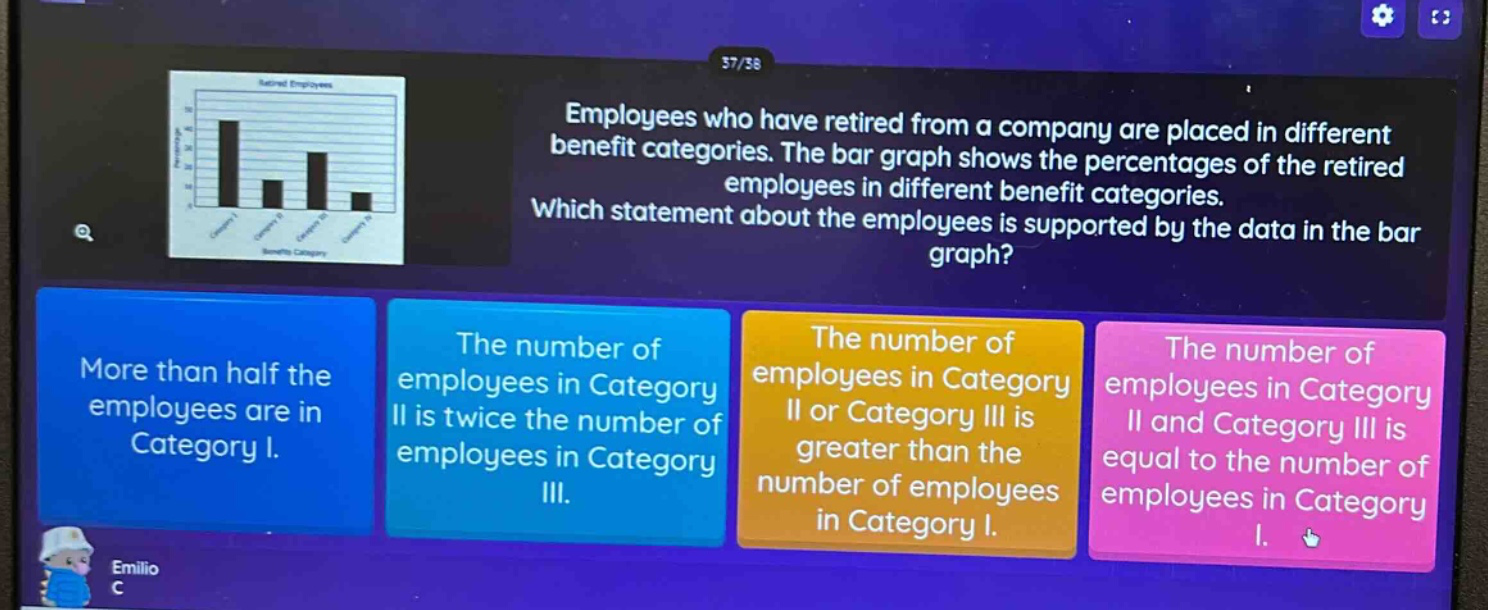
employees who have retired from a company are placed in different benefit categories. the bar graph shows the percentages of the retired employees in different benefit categories. which statement about the employees is supported by the data in the bar graph? more than half the employees are in category i. the number of employees in category ii is twice the number of employees in category iii. the number of employees in category ii or category iii is greater than the number of employees in category i. the number of employees in category ii and category iii is equal to the number of employees in category i.
Answer
Explanation:
Step1: Analyze option A
Since we don't know if the percentage of Category I is over 50%, we can't say more than half are in Category I.
Step2: Analyze option B
There is no information to show that the number in Category II is twice that in Category III.
Step3: Analyze option C
If we assume the percentages of Category I, II and III are (a), (b) and (c) respectively. From the bar - graph, (b + c>a), so the number of employees in Category II or Category III is greater than the number of employees in Category I.
Step4: Analyze option D
There is no evidence to suggest that (b + c=a).
Answer:
The number of employees in Category II or Category III is greater than the number of employees in Category I.