1. ending inventory as calculated at the closing of an accounting period is also used as the \no b…
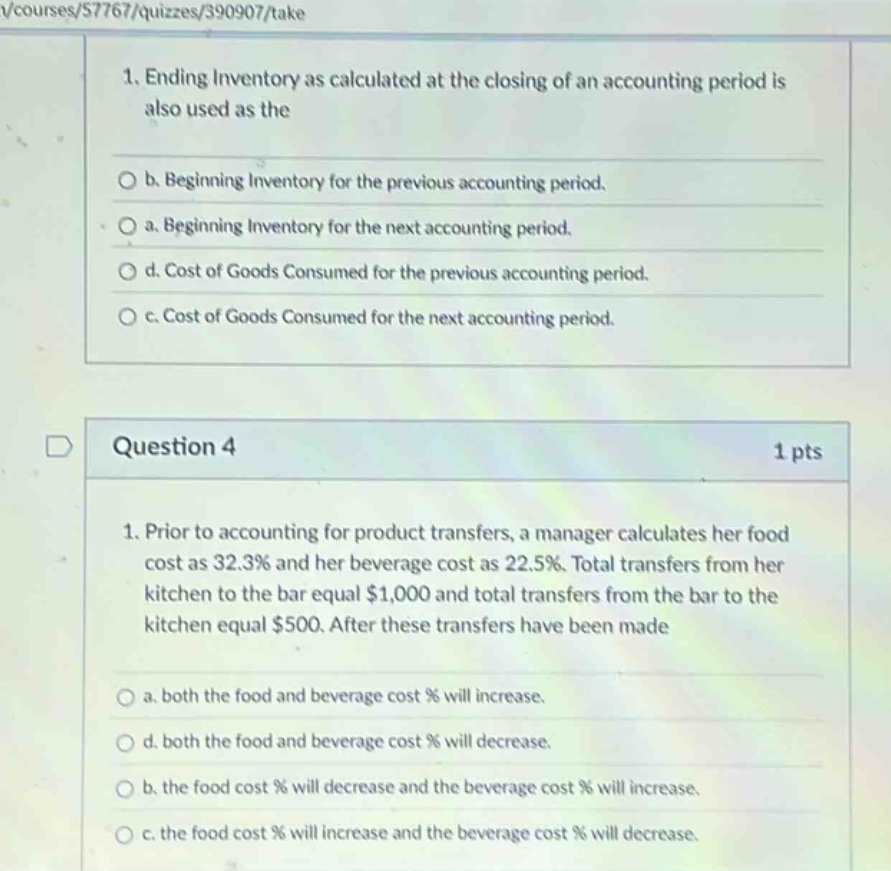
1. ending inventory as calculated at the closing of an accounting period is also used as the \no b. beginning inventory for the previous accounting period.\no a. beginning inventory for the next accounting period.\no d. cost of goods consumed for the previous accounting period.\no c. cost of goods consumed for the next accounting period.\nquestion 4\n1 pts\n1. prior to accounting for product transfers, a manager calculates her food cost as 32.3% and her beverage cost as 22.5%. total transfers from her kitchen to the bar equal $1,000 and total transfers from the bar to the kitchen equal $500. after these transfers have been made\no a. both the food and beverage cost % will increase.\no d. both the food and beverage cost % will decrease.\no b. the food cost % will decrease and the beverage cost % will increase.\no c. the food cost % will increase and the beverage cost % will decrease.
Answer
Brief Explanations:
- In accounting, the ending inventory of one accounting - period is used as the beginning inventory for the next accounting period. This is a fundamental concept in inventory accounting.
- For the product - transfer problem, more products are transferred from the kitchen to the bar ($1000$) than from the bar to the kitchen ($500$). So, the food cost percentage will increase as more food - related items are being transferred out of the kitchen, and the beverage cost percentage will decrease as more items are coming into the bar.
Answer:
- a. Beginning Inventory for the next accounting period.
- c. the food cost % will increase and the beverage cost % will decrease.