a factory employee spends two hours putting together a car part. a machine can do the same job in thirty…
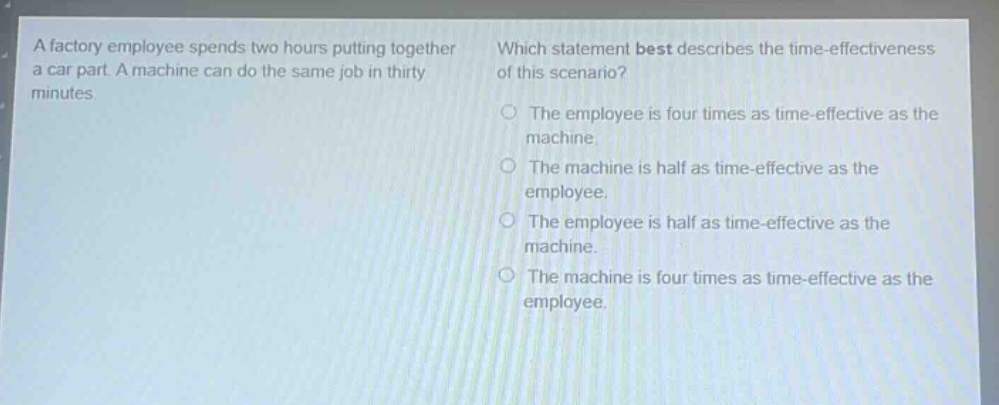
a factory employee spends two hours putting together a car part. a machine can do the same job in thirty minutes. which statement best describes the time - effectiveness of this scenario? the employee is four times as time - effective as the machine. the machine is half as time - effective as the employee. the employee is half as time - effective as the machine. the machine is four times as time - effective as the employee.
Answer
Explanation:
Step1: Convert time to same unit
The employee takes 2 hours = 2×60 = 120 minutes, and the machine takes 30 minutes.
Step2: Calculate time - effectiveness ratio
Time - effectiveness is inversely proportional to time taken. Let (E_e) be the employee's time - effectiveness and (E_m) be the machine's time - effectiveness. If the work (W) is the same, and (W = E\times t) (where (t) is time), then (\frac{E_e}{E_m}=\frac{t_m}{t_e}). Substituting (t_e = 120) minutes and (t_m=30) minutes, we get (\frac{E_e}{E_m}=\frac{30}{120}=\frac{1}{4}), which means (E_m = 4E_e).
Answer:
The machine is four times as time - effective as the employee.