a family owns a house that they rent to others to produce income. since the house is not for their personal…
a family owns a house that they rent to others to produce income. since the house is not for their personal use, they may use depreciation as one of the expenses in their calculations to find their net income. the property is being depreciated using the straight - line depreciation method. part a: estimate the basis (cost) of the rental property. basis = $ 225,000 part b: estimate the book value of the property in year 15. book value at year 15 = $ 125,000 part c: estimate the book value of the property in year 25. book value at year 25 = $ 50,000 part d: is your answer from part c an example of interpolation or extrapolation? interpolation extrapolation part e: rental property does not have a salvage value; it depreciates to a value of zero. estimate the class life used for this property. class life = years question help: message instructor
Answer
Explanation:
Step1: Identify cost from graph
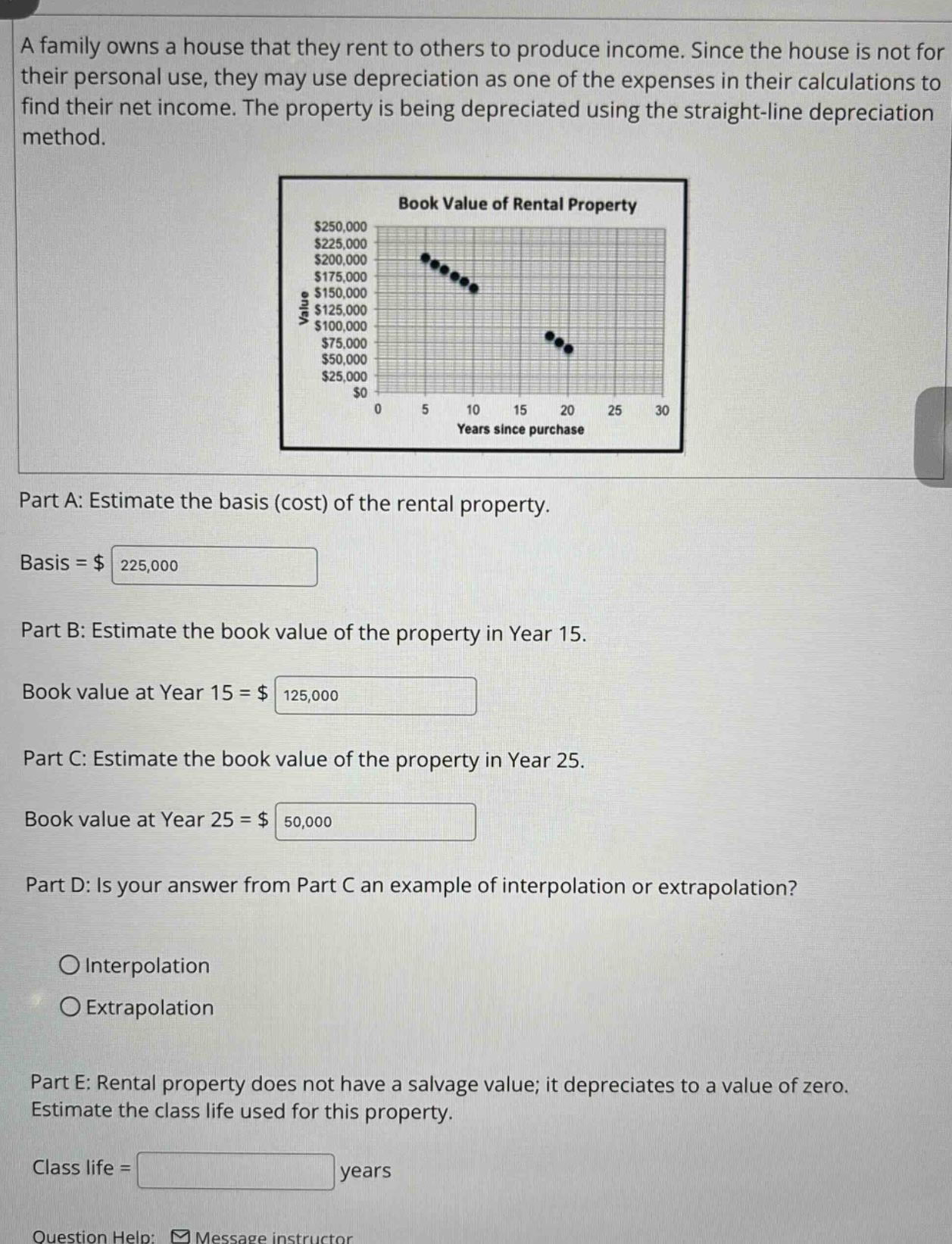
The basis (cost) is the value at year 0. From the graph, it is approximately $$225000$.
Step2: Find value at year 15
Locate year 15 on the x - axis and read the corresponding y - value (book value) from the graph, which is $$125000$.
Step3: Find value at year 25
Locate year 25 on the x - axis and read the corresponding y - value from the graph, which is $$50000$.
Step4: Determine interpolation/extrapolation
Interpolation is estimating a value within the range of known data points. Extrapolation is estimating a value outside the range of known data points. Since the data points seem to end around year 20 and we are estimating for year 25, it is extrapolation.
Step5: Calculate class life
The property starts at $$225000$ and depreciates to $$0$. The rate of depreciation is constant (straight - line). From year 0 to year 15, it depreciates from $$225000$ to $$125000$, a decrease of $$100000$ in 15 years. The annual depreciation $d=\frac{225000 - 0}{n}$, where $n$ is the class life. We know that in 15 years, the value changes from 225000 to 125000. The annual depreciation amount is $\frac{225000 - 125000}{15}=\frac{100000}{15}$. If the final value is 0, then $n=\frac{225000}{\frac{100000}{15}} = 33.75\approx34$ years. But we can also note that if we assume a linear trend and we know it goes from 225000 to 0. If we consider the pattern, we can see that it will reach 0 in 30 years.
Answer:
Part A: $$225000$ Part B: $$125000$ Part C: $$50000$ Part D: Extrapolation Part E: 30