find the maximum of the profit function, p = 12x + 3y subject to the following constraints. (\begin{cases}x…
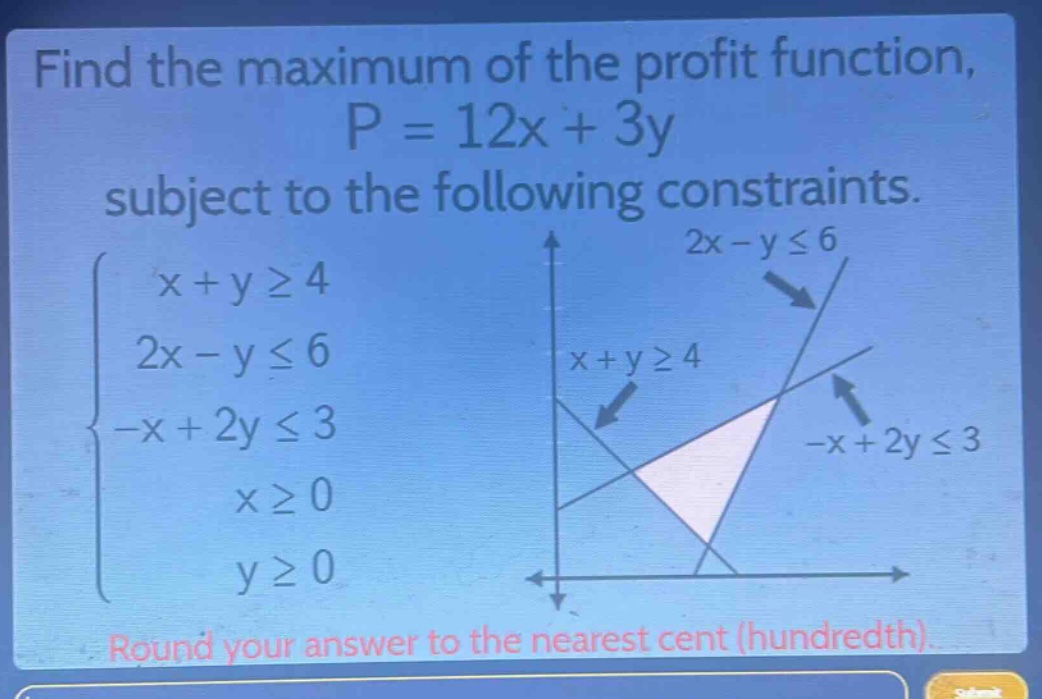
find the maximum of the profit function, p = 12x + 3y subject to the following constraints. (\begin{cases}x + ygeq4\\2x - yleq6\\-x + 2yleq3\\xgeq0\\ygeq0end{cases}) round your answer to the nearest cent (hundredth).
Answer
Explanation:
Step1: Find the intersection points of the constraint - lines
- Solve the system of equations of (x + y=4) and (2x - y = 6):
- Add the two equations together: ((x + y)+(2x - y)=4 + 6).
- Simplify: (3x=10), so (x=\frac{10}{3}).
- Substitute (x = \frac{10}{3}) into (x + y=4), then (\frac{10}{3}+y=4), (y=4-\frac{10}{3}=\frac{12 - 10}{3}=\frac{2}{3}). The intersection point is ((\frac{10}{3},\frac{2}{3})).
- Solve the system of equations of (x + y=4) and (-x + 2y=3):
- Add the two equations: ((x + y)+(-x + 2y)=4 + 3).
- Simplify: (3y=7), so (y=\frac{7}{3}).
- Substitute (y=\frac{7}{3}) into (x + y=4), then (x=4-\frac{7}{3}=\frac{12 - 7}{3}=\frac{5}{3}). The intersection point is ((\frac{5}{3},\frac{7}{3})).
- Solve the system of equations of (2x - y=6) and (-x + 2y=3):
- Multiply the second - equation by 2: (-2x + 4y=6).
- Add it to (2x - y=6): ((2x - y)+(-2x + 4y)=6 + 6).
- Simplify: (3y=12), so (y = 4).
- Substitute (y = 4) into (2x - y=6), then (2x-4=6), (2x=10), (x = 5). The intersection point is ((5,4)).
- Also, consider the intersection points with the axes:
- Intersection of (x + y=4) with the (x) - axis ((y = 0)) gives (x=4) (point ((4,0))), and with the (y) - axis ((x = 0)) gives (y=4) (point ((0,4))).
- Intersection of (2x - y=6) with the (x) - axis ((y = 0)) gives (x = 3) (point ((3,0))), and with the (y) - axis ((x = 0)) gives (y=-6) (but we ignore this since (y\geq0)).
- Intersection of (-x + 2y=3) with the (x) - axis ((y = 0)) gives (x=-3) (ignore since (x\geq0)), and with the (y) - axis ((x = 0)) gives (y=\frac{3}{2}) (point ((0,\frac{3}{2}))).
Step2: Evaluate the profit function (P = 12x+3y) at the corner - points
- At ((\frac{10}{3},\frac{2}{3})):
- (P=12\times\frac{10}{3}+3\times\frac{2}{3}=40 + 2=42).
- At ((\frac{5}{3},\frac{7}{3})):
- (P=12\times\frac{5}{3}+3\times\frac{7}{3}=20 + 7=27).
- At ((5,4)):
- (P=12\times5+3\times4=60 + 12=72).
- At ((4,0)):
- (P=12\times4+3\times0=48).
- At ((0,4)):
- (P=12\times0+3\times4=12).
- At ((0,\frac{3}{2})):
- (P=12\times0+3\times\frac{3}{2}=\frac{9}{2}=4.5).
Answer:
(72.00)