find the maximum for the profit function, p = 3.25x + 1.5y subject to the following constraints…
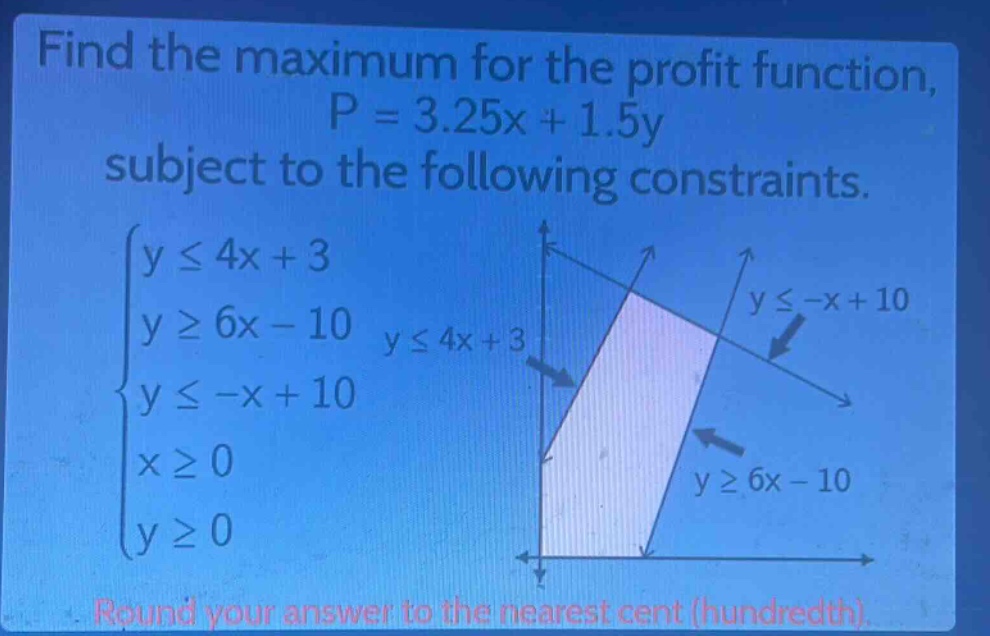
find the maximum for the profit function, p = 3.25x + 1.5y subject to the following constraints. (\begin{cases}yleq4x + 3\\ygeq6x - 10\\yleq -x + 10\\xgeq0\\ygeq0end{cases}) round your answer to the nearest cent (hundredth).
Answer
Answer:
The maximum value of the profit function needs to be found by evaluating the profit function at the corner - points of the feasible region.
- First, find the intersection points of the boundary lines:
- Intersection of (y = 4x+3) and (y = 6x - 10):
- Set (4x+3=6x - 10).
- Subtract (4x) from both sides: (3 = 2x-10).
- Add 10 to both sides: (13 = 2x), so (x=\frac{13}{2}=6.5).
- Substitute (x = 6.5) into (y = 4x+3), then (y=4\times6.5 + 3=26 + 3=29). The intersection point is ((6.5,29)). But this point may not be in the feasible region. We need to check the inequalities. Since (y = 29), (6x-10=6\times6.5 - 10=39 - 10 = 29) and (4x + 3=4\times6.5+3=26 + 3=29), and for (y=-x + 10), when (x = 6.5), (y=-6.5 + 10 = 3.5), and (29>3.5), so this point is not in the feasible region.
- Intersection of (y = 4x+3) and (y=-x + 10):
- Set (4x+3=-x + 10).
- Add (x) to both sides: (5x+3 = 10).
- Subtract 3 from both sides: (5x=7), so (x=\frac{7}{5}=1.4).
- Substitute (x = 1.4) into (y=-x + 10), then (y=-1.4 + 10 = 8.6). The intersection point is ((1.4,8.6)).
- Intersection of (y = 6x-10) and (y=-x + 10):
- Set (6x-10=-x + 10).
- Add (x) to both sides: (7x-10 = 10).
- Add 10 to both sides: (7x=20), so (x=\frac{20}{7}\approx2.86).
- Substitute (x=\frac{20}{7}) into (y=-x + 10), then (y=-\frac{20}{7}+10=\frac{-20 + 70}{7}=\frac{50}{7}\approx7.14). The intersection point is ((\frac{20}{7},\frac{50}{7})).
- Intersection of (y = 6x-10) and (x = 0):
- Substitute (x = 0) into (y = 6x-10), then (y=-10) (not in the feasible region since (y\geq0)).
- Intersection of (y = 4x+3) and (x = 0):
- Substitute (x = 0) into (y = 4x+3), then (y = 3). The intersection point is ((0,3)).
- Intersection of (y=-x + 10) and (x = 0):
- Substitute (x = 0) into (y=-x + 10), then (y = 10). The intersection point is ((0,10)).
- Intersection of (y=-x + 10) and (y = 0):
- Set (0=-x + 10), then (x = 10). The intersection point is ((10,0)).
- Intersection of (y = 6x-10) and (y = 0):
- Set (0=6x-10), then (6x=10), (x=\frac{5}{3}\approx1.67). The intersection point is ((\frac{5}{3},0)).
- Intersection of (y = 4x+3) and (y = 6x - 10):
- Then, evaluate the profit function (P = 3.25x+1.5y) at the corner - points of the feasible region:
- At ((0,3)): (P=3.25\times0+1.5\times3=4.50).
- At ((0,10)): (P=3.25\times0+1.5\times10 = 15.00).
- At ((10,0)): (P=3.25\times10+1.5\times0=32.50).
- At ((\frac{5}{3},0)): (P=3.25\times\frac{5}{3}+1.5\times0=\frac{16.25}{3}\approx5.42).
- At ((1.4,8.6)): (P=3.25\times1.4+1.5\times8.6=4.55+12.9 = 17.45).
- At ((\frac{20}{7},\frac{50}{7})): (P=3.25\times\frac{20}{7}+1.5\times\frac{50}{7}=\frac{65}{7}+\frac{75}{7}=\frac{65 + 75}{7}=\frac{140}{7}=20.00).
The maximum value of (P) is (32.50).
Explanation:
Step1: Find intersection points
Find intersection of boundary - lines of constraints.
Step2: Check feasibility
Verify if intersection points satisfy all constraints.
Step3: Evaluate profit function
Evaluate (P = 3.25x+1.5y) at corner - points of feasible region.
Step4: Determine maximum
Compare values of (P) at corner - points to find maximum.