george tallies up the transactions in his check register and comes up with a total balance of $221.57, but…
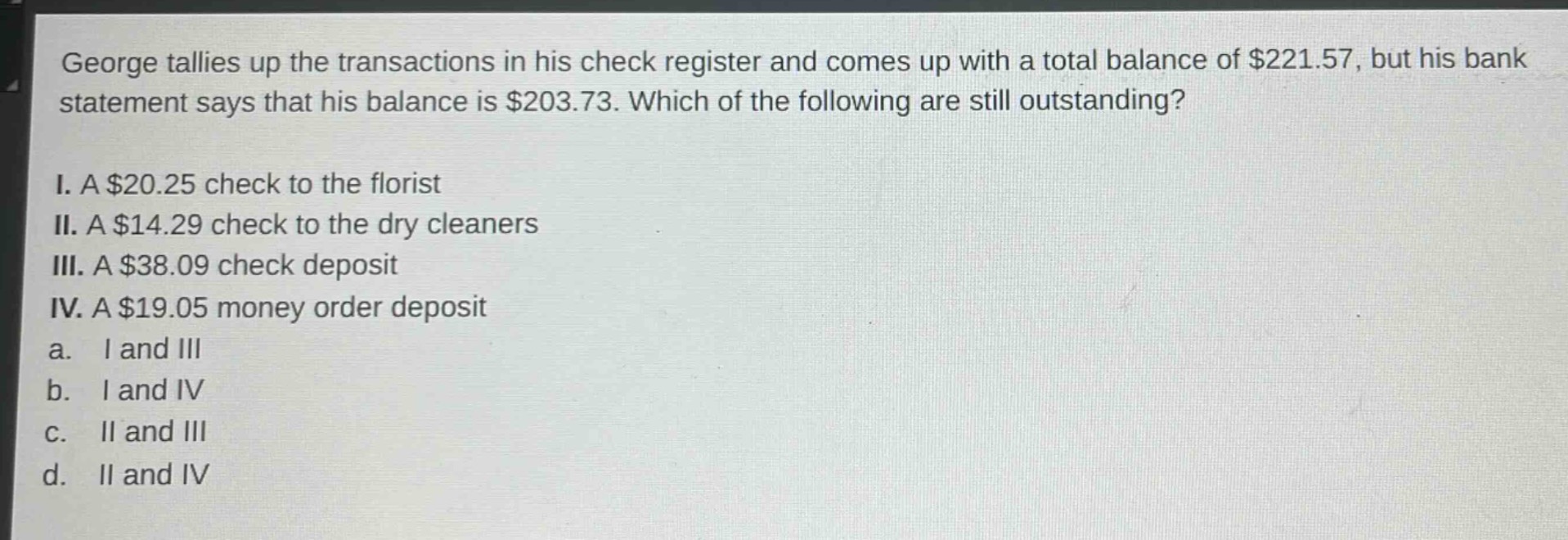
george tallies up the transactions in his check register and comes up with a total balance of $221.57, but his bank statement says that his balance is $203.73. which of the following are still outstanding?\ni. a $20.25 check to the florist\nii. a $14.29 check to the dry cleaners\niii. a $38.09 check deposit\niv. a $19.05 money order deposit\na. i and iii\nb. i and iv\nc. ii and iii\nd. ii and iv
Answer
Answer:
b. I and IV
Explanation:
Step1: Calculate the difference in balances
$221.57 - 203.73=17.84$
Step2: Analyze each transaction
- For I: A $20.25$ check is a deduction.
- For II: A $14.29$ check is a deduction.
- For III: A $38.09$ check - deposit is an addition.
- For IV: A $19.05$ money - order deposit is an addition.
Step3: Find combinations that match the difference
If we consider a check (deduction) and a deposit (addition), the combination of the $20.25$ check (I) and the $19.05$ money - order deposit (IV) gives $20.25-19.05 = 1.2$. But if we consider the overall effect on the balance difference, when we account for the way outstanding transactions affect the balance, the outstanding transactions that can explain the difference are the $20.25$ check to the florist (I) and the $19.05$ money - order deposit (IV).