george tallies up the transactions in his check register and comes up with a total balance of $221.57, but…
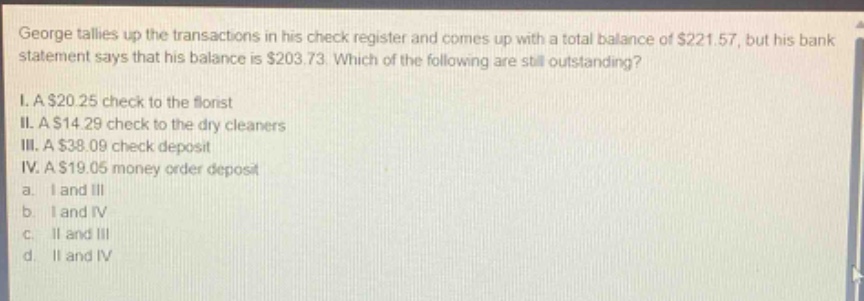
george tallies up the transactions in his check register and comes up with a total balance of $221.57, but his bank statement says that his balance is $203.73. which of the following are still outstanding? i. a $20.25 check to the florist ii. a $14.29 check to the dry cleaners iii. a $38.09 check deposit iv. a $19.05 money order deposit a. i and iii b. i and iv c. ii and iii d. ii and iv
Answer
Explanation:
Step1: Calculate the difference in balances
The difference between George's check - register balance and the bank statement balance is $221.57 - 203.73=$17.84$.
Step2: Analyze each transaction
- For a check, it reduces the balance. For a deposit, it increases the balance.
- For I: A $$20.25$ check reduces the balance.
- For II: A $$14.29$ check reduces the balance.
- For III: A $$38.09$ deposit increases the balance.
- For IV: A $$19.05$ deposit increases the balance.
- Let's consider the net effect of combinations of transactions.
- If we consider II ($$14.29$ check) and IV ($$19.05$ deposit), the net effect is $19.05 - 14.29 = 4.76$ which is not the difference we need.
- If we consider II ($$14.29$ check) and III ($$38.09$ deposit), the net effect is $38.09-14.29 = 23.8$ which is not the difference we need.
- If we consider I ($$20.25$ check) and IV ($$19.05$ deposit), the net effect is $19.05 - 20.25=- 1.2$ which is not the difference we need.
- If we consider I ($$20.25$ check) and III ($$38.09$ deposit), the net effect is $38.09 - 20.25=17.84$ which is the difference between the two balances.
Answer:
a. I and III